

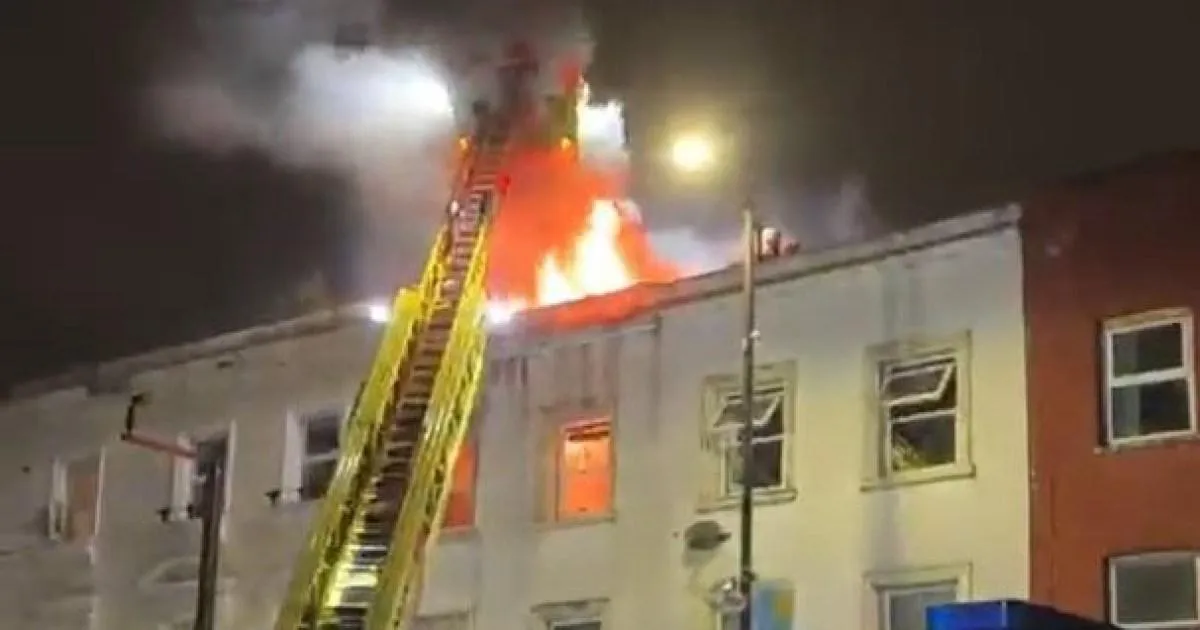
It was supposed to be a night of crackling fireworks, smoky skies, and the warm glow of bonfires—a distinctly British evening where communities gather to mark an old tradition with sparklers and treacle toffee. But for residents of Seven Sisters Road in Finsbury Park, Bonfire Night took on a far more alarming meaning when a fierce blaze tore through a flat and turned an ordinary street into a scene of chaos, fear, and desperate escape. As darkness fell and fireworks still popped in the distance, thick black smoke began to rise from the building, and within minutes, the unmistakable orange glow of flames was visible from the top floor and roof. What had begun as an evening of festive amusement quickly became an emergency, as ten fire engines and seventy firefighters were dispatched to the scene in response to the escalating situation. The fire ripped through the property with startling speed, forcing one man to make the agonizing decision to jump from a second-story window just to save himself. He landed with injuries that were thankfully described as minor, but the image of a grown man hurling himself into the air from a burning building will no doubt linger in the minds of everyone who witnessed it. Eight other people had to be evacuated from the surrounding flats, stumbling out into the cold November air while the blaze continued to devour the structure behind them.
The scale of the fire was breathtaking in the worst possible way. Neighbors emerged from their homes, wrapped in coats and clutching phones, drawn by the roar of flames and the wail of sirens. As the fire crews worked frantically to contain the inferno, their efforts seemed almost futile at first. One witness, Elle Hodgson, described the scene as unlike anything she had ever experienced. She spoke of the heat billowing off the blaze, a raw, pulsing warmth that could be felt from a safe distance and made the winter night feel like a furnace. She watched as four different fire hoses poured water onto the house from multiple angles, the powerful jets arcing through the air and cascading over the building in a desperate attempt to subdue the flames. Yet despite all that water, the fire appeared to grow, defying the firefighters’ best efforts and climbing higher into the structure. Flames licked out from the top-floor windows and began eating into the roof, sending a massive plume of smoke spiraling into the night sky, visible for miles around. Around a hundred people gathered to watch, their faces illuminated by the orange glow, a mixture of horror, disbelief, and helplessness in their eyes. The atmosphere was electric with tension, as strangers stood shoulder to shoulder in the street, united by a shared sense of dread. People three doors down leaned out of their windows, anxiously watching the disaster unfold, perhaps wondering whether their own homes might be next. For the man who jumped, the decision to leap from the second floor was a split-second calculation between certain danger and possible survival—a moment of terror that must have felt like falling into the unknown.
Finsbury Park is a bustling, densely populated corner of north London, known for its lively streets, independent shops, and the constant hum of city life. Seven Sisters Road, in particular, is a thoroughfare that never truly sleeps, filled with restaurants, cafes, and the ever-present flow of pedestrians and traffic. On this particular evening, the area outside the Shish Shack, a popular local spot, became an unintended grandstand for the disaster unfolding before everyone’s eyes. The irony of a fire on Bonfire Night was not lost on those who stood watching, as the smell of burning wood and smoke mixed with the usual traces of fireworks and bonfires that fill the November air. The cause of the fire was not immediately known, and as the night wore on, investigators were left with the painstaking task of sifting through the charred remains to determine how such a destructive blaze had started. While the flames were eventually brought under control enough to prevent further spread, the fire had not yet been fully extinguished at the time of reporting, leaving residents in a state of limbo. In the midst of the emergency, Station Commander Adam Lawson issued a stark warning to the local community, advising residents to keep their windows and doors firmly closed to prevent smoke from entering their homes. He also urged people to stay away from the area entirely, noting that the Seven Sisters Road had been closed between Holloway Road and Finsbury Park station. The road closure caused heavy traffic to build up in the surrounding streets, with motorists stuck in long queues while the emergency services worked to secure the scene. Pedestrians were advised to find alternative routes, and the ripple effect of the fire was felt across the neighborhood, disrupting travel and daily life well into the evening.
Beyond the logistics of the emergency response, there was a deeply human element to the evening that cannot be captured by statistics alone. For the eight people who were evacuated, the most basic of comforts were upended in an instant. They had to leave behind their belongings, their pets, their photographs, and the simple security of home, not knowing if they would ever see it again. The man who jumped from the second floor took a gamble that no one should ever have to take, and while his injuries were minor, the psychological scars of such a traumatic experience may prove far harder to heal. The crowd that gathered on the pavement was not merely curious; they were fellow human beings who felt the visceral pull of a tragedy unfolding in their midst. Some called out encouragement to the firefighters, others recorded the scene on their phones, still others stood in stunned silence, clutching loved ones tightly as if to shield them from the horror. In times like these, the fabric of community is stretched and tested, but it also reveals itself in surprising ways. Neighbors checked on neighbors, strangers offered drinks and blankets to the evacuated, and local businesses opened their doors to provide shelter from the cold. The fire may have been destructive and frightening, but the response of ordinary people gathering together, sharing what they could, and offering comfort in a moment of crisis was a reminder that resilience often emerges from the ashes of disaster. It was a night that no one who witnessed it will easily forget, not because of the flames or the sirens, but because of the shared vulnerability that suddenly connected everyone on that street.
As the fire continued to burn and the investigation began, the broader implications of the incident started to settle in. Bonfire Night is a time when fire safety is already at the forefront of many people’s minds, with warnings about sparklers, fireworks, and outdoor bonfires filling television screens and social media feeds. But this blaze served as a stark reminder that fire does not discriminate; it can strike anywhere, at any time, often when we feel safest. The fact that the fire broke out inside a home—a place where people are supposed to feel secure—added an extra layer of unease. For the residents of Finsbury Park, the image of flames roaring through a flat will linger for a long time, prompting questions about their own safety and preparedness. Firefighters worked tirelessly, not just to extinguish the flames but to ensure that the fire did not spread to adjacent properties, which would have made an already bad situation far worse. Their professionalism and bravery on the night were evident, as they positioned themselves around the burning building, taking calculated risks to protect life and property. The investigation into the cause would likely take days, even weeks, as experts examined the scene, interviewed witnesses, and pieced together the timeline of events. Whether the fire was caused by an electrical fault, an unattended candle, or some other accident, the outcome for those affected remains the same: a night of terror, displacement, and uncertainty. Yet in the aftermath, there is also a sense of gratitude that no lives were lost, that the man who jumped survived, and that the injuries sustained were not more severe. Every fire that ends without a fatality is, in some sense, a tragedy narrowly avoided, and that thought offered a sliver of comfort to those who watched the flames consume part of their neighborhood.
Looking back, the fire on Seven Sisters Road will be remembered as a defining night for the community, a moment when the old certainties of home and safety were tested by an unexpected and terrifying event. The festive atmosphere of Bonfire Night was transformed into something else entirely—a lesson in fragility, a study in fear, and ultimately, a testament to human endurance. The man who jumped from the second-floor window will carry his story with him for the rest of his life, a story of survival and instinct. The eight people who were evacuated will return to their homes, or perhaps find new ones, forever changed by the knowledge that everything can be lost in a matter of minutes. The hundred or so onlookers who stood on the pavement will remember the heat on their faces and the sound of crackling timber, and they will think about it every time they hear a fire alarm or see a flame. And the firefighters who battled the blaze will move on to the next call, carrying a quiet pride in their work but also the weight of every incident they witness. As the smoke cleared and the last embers were finally extinguished, the street began to return to normal, though the stains on the building and the memory in the air remained. In the days that followed, residents would exchange hushed conversations over garden fences and in local shops, sharing snippets of the story, offering support to those affected, and trying to make sense of what had happened. The fire may have been caused by an unknown accident, but its impact on the community was undeniable. It stripped away the illusion of invulnerability and replaced it with a shared awareness that we are all at the mercy of forces we cannot always control. Yet from that awareness came a renewed sense of solidarity, a reminder that even in the darkest moments, people find ways to reach out to one another. And as the neighborhood slowly healed, the spirit of Finsbury Park remained unbroken, proving that while fire can destroy buildings, it cannot destroy the bonds that hold a community together.