


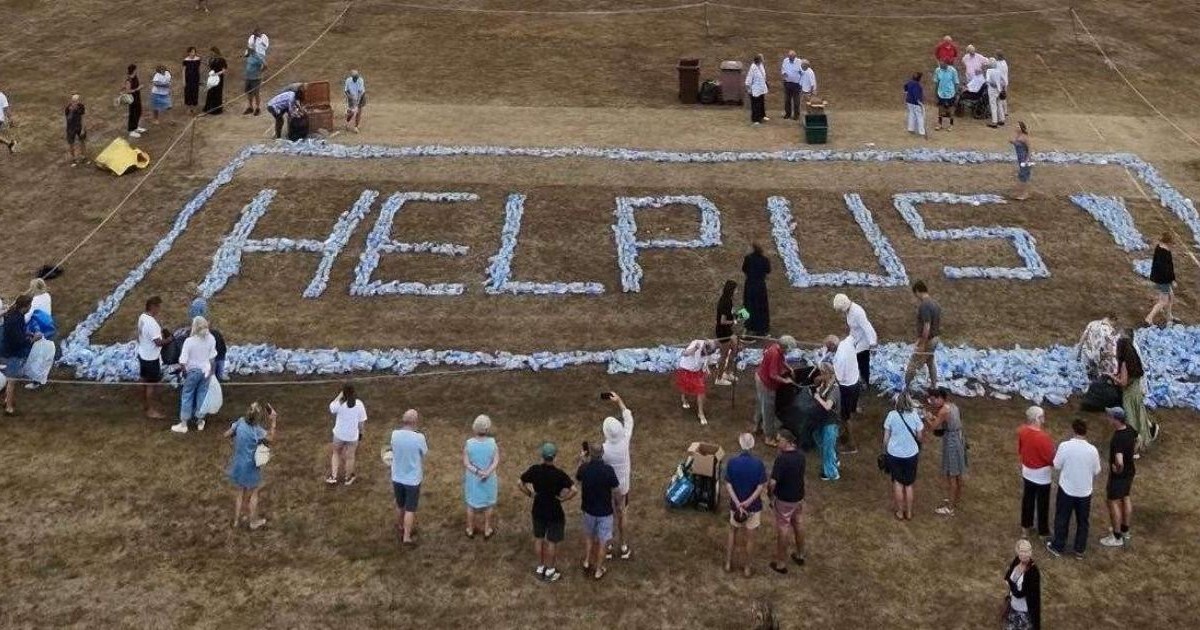
On a balmy evening in the quiet Kent village of Benenden, a strange and striking sight appeared on the cricket square. Instead of the usual white-clad players and gentle hum of summer sport, there were dozens of residents, clutching bin liners and carrier bags, their arms full of empty plastic bottles. Some were quiet, some were angry, and many were simply exhausted. Carefully, deliberately, they laid the bottles out in giant letters. When they stood back, the message was unmistakable: HELP US. It was a literal cry for help, spelled out in the very plastic waste the water crisis had forced them to create. For more than a week, hundreds of homes in and around Tunbridge Wells had been without running water or had suffered severely low pressure. At the height of the problem, around 1,800 properties were affected. Even after seven full days, roughly 400 homes were still dry. The residents of this rural corner of Kent had endured heatwave after heatwave, and twice during those heatwaves the taps had stopped working. They were hot, tired and worried. They were also angry. The pile of plastic bottles was not just a protest; it was evidence. It showed, vividly and undeniably, what happens when a community is left without mains water for days on end. People cannot wash, cook or stay hydrated without buying bottled water, and that plastic mounts up quickly. In less than a week, the village had collected about six thousand bottles. The green looked less like a playing field and more like an environmental disaster zone. But at the centre of that disaster, there was also something hopeful: a community coming together to make itself heard.
The demonstration was the brainchild of Lucy Barron-Reid, the 56-year-old landlady of The Bull, the village pub. Lucy has run The Bull for 22 years, and she knows her neighbours and their struggles better than most. On Monday at 5pm, she rallied 70 to 80 people to bring their empty two-litre bottles to the cricket square. Each person arrived with around three bin liners full of plastic, with roughly 25 bottles in each. The total was somewhere in the region of 6,000 bottles. It was, she said, ‘incredible’ waste. But the point was not merely to shock; it was to make a connection. ‘We wanted to show the environmental impact of not having mains water, the amount of plastic that was collected in less than one week, and add some community spirit,’ she explained. Her frustration with South East Water was palpable. ‘Everyone is exhausted,’ she said. ‘Let’s not forget, we’ve just had three or four heatwaves in a row, and two of those heatwaves we’ve not had any water.’ The message to the water company was blunt: ‘This has got to stop, but you’ve also got to start listening to us. You can’t just keep sending different reasons daily as to why the water is off.’ She accused the company of applying sticking plasters rather than fixing the underlying problem. She also wanted answers to crucial questions: where was all the plastic coming from? Who was profiting from the crisis? Did South East Water ever discuss recycling with Tunbridge Wells council? For Lucy, the plastic bottles were a symptom of a much larger failure—an infrastructure that was crumbling, a company that appeared not to care, and a community left to carry the burden.
Lucy’s own experience captures the dual hardship of the crisis. As a resident, she faced the relentlessly practical problems that come from living without water. Every toilet flush required thought. Every shower had to be planned around whatever supplies were available. Laundry piled up. Dishes were impossible. Even a simple glass of water had to be poured from a plastic bottle, contributing to the mountain of waste now covering the village green. ‘As an individual it’s difficult, like it is for any other resident,’ she said. ‘Just having to think, right, we need to flush the loos, we need to shower, put the washing machine on, drink water, to just live normally.’ As a business owner, however, the challenge was magnified. ‘As a business owner, it’s all of those things tenfold because we’ve got to still cater for customers,’ she added. The Bull remained open, because closing would have a financial impact, but keeping a pub running without running water is almost impossible. Every pint pulled, every meal served, every glass cleaned required extra effort, extra money and extra bottles. Lucy has owned the pub for more than two decades and remembers a time when the water supply was reliable. Up until four years ago, she said, it was ‘what you would expect in the 21st century.’ Since then, there have been sporadic outages, and this year has been particularly bad. The latest outage lasted eight days, matching the longest one people could remember. Over Christmas, the village had already endured five days without water. The recurrence is what makes it so draining. It is not a one-off emergency; it is a pattern of neglect and uncertainty that wears people down and makes them feel forgotten.
Peter Massey, a resident of nearby Iden Green, knows that feeling all too well. He went without water for three days last week and says the normalisation of outages has become a ‘big issue.’ What angers him most is the way water companies and the government seem to be preparing people for a future with less water, rather than delivering the service they are supposed to provide. ‘The thing that upsets me is the drip feed from the government and the water companies is all about normalising this,’ he said. ‘They’re talking about, should we do surge charging when there’s a lack of water? This is just about normalising the idea that there will be a lack of water.’ Surge charging would mean customers paying more for water at times of shortages—a policy that would punish those least able to store water and most reliant on the supply. Peter rejected the entire premise. ‘We shouldn’t be expecting to have less than 100% of taps with running water in this country in this day and age,’ he said. ‘We’re not going to accept that we don’t get water out of our taps.’ His voice is echoed by many in the village. This is not a developing country with a failing infrastructure; this is Kent, in the south-east of England, one of the wealthiest regions in the UK. The constant stream of excuses and apologies, without any meaningful action, has created a deep well of scepticism. People no longer believe the promises they hear. They want to know why the pipes keep breaking, why the investment has not been made, and why they are expected to simply cope. They are tired of being told to be patient. They have been patient. Now they want answers.
South East Water, meanwhile, has offered apologies but few answers. The company acknowledged that up to 1,800 properties in the Benenden and Rolvenden areas may have been experiencing low pressure or no water as of Wednesday morning. By Thursday, the number had fallen to about 400. Incident Manager Jenny Rhodes said overnight water had been returning to customers in the Benenden area. Tankers had been used to support the network, and storage levels at the company’s tanks had ‘improved significantly.’ ‘We know how difficult it has been for our customers to be without water for so long,’ she said. ‘This is not the standard of service we want to provide and we apologise sincerely for the frustration and inconvenience it has caused.’ She went on to say that the company was ‘already looking at the actions we need to take to prevent this happening again.’ But for villagers, the apology sounded familiar. They had heard it all before. The promise to ‘look at actions’ was vague, and there was still no explanation for why the outage had happened, why it had lasted so long, or what would be done differently in the future. The use of tankers was a temporary fix, not a solution. The storage levels improving was small comfort to the 400 households still waiting for water on Thursday. The residents of Benenden have heard enough corporate language. They want guarantees, not apologies; action, not promises. The fact that a water company serving a modern community would allow a village to go without water for eight days, during a heatwave, suggests a systemic failure that cannot be solved by a few tankers and a press release. The apology, though polite, did little to restore their trust.
In the end, the image of a village green covered in plastic bottles is both a warning and a testament. It is a warning about what happens when essential infrastructure is neglected, when private companies put profit before people, and when the climate makes extremes more common. It is also a testament to the strength of a community that refuses to be ignored. The people of Benenden did not simply complain; they acted. They turned their frustration into something visible and powerful. They used the very plastic that the crisis had forced upon them to spell out a message that could not be missed. In doing so, they highlighted the absurdity of the situation: in a country like the United Kingdom, a village should never have to rely on bottled water. They also reminded everyone that water is not a luxury, but a human right. Lucy Barron-Reid, Peter Massey and their neighbours are not asking for special treatment. They are asking for the same basic service that most people take for granted—turning on the tap and having water flow. They want accountability from South East Water, and from the regulators and politicians who allow such failures to repeat. They want investment in the network, proper maintenance, and a long-term plan that addresses the reality of climate change and population growth. And they want to be heard. The protest on the cricket square was a desperate act, but it was also a dignified one. It showed that ordinary people, when pushed to their limits, can find extraordinary ways to speak truth to power. The water may eventually come back, but the memory of that ‘help us’ message will remain. It is a symbol of a community’s resilience, and a challenge to those responsible to do better. They should not have to spell it out.