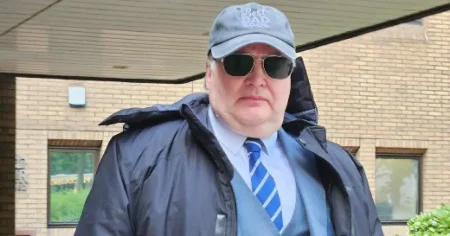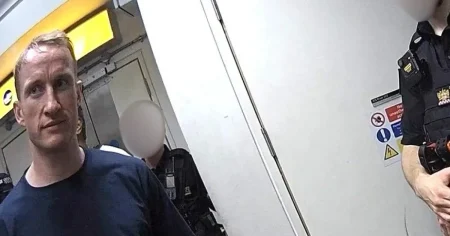
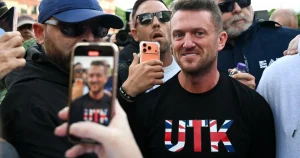


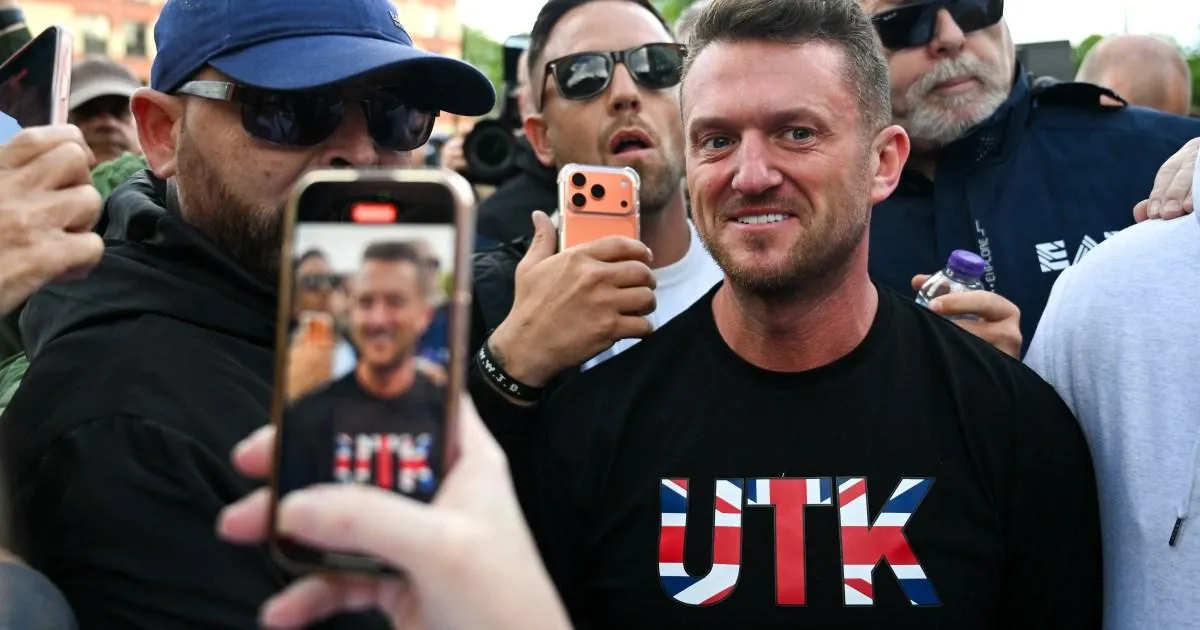
There is a moment at every airport when the world seems to hang in a perfect, weightless pause. Passengers sip overpriced coffee, stare at departure boards, drag their lives behind them in wheeled suitcases, and think about the people waiting at the other end of their journey. Then, without warning, that fragile routine can shatter. According to a post on his X account, Stephen Yaxley-Lennon, the man known across the globe as Tommy Robinson, has been detained at an airport by Counter Terrorism Police. The exact airport has not been identified, and the official reason remains clouded in silence. The post, issued by his team, carried the familiar tone of alarm and defiance: “Tommy has been detained again, at an airport by Counter Terrorism Police. They will never stop trying to destroy this man. Why are they so scared?” In a matter of minutes, those words were shared, quoted, and turned into headlines across the internet. But behind the social media noise, a real scene was unfolding out of sight: an activist stopped in the middle of a journey, an exchange of questions and answers between officers and a man who has spent years positioning himself against the state, a doorway leading not to the departure gate but to an interview room. No one travelling beside him could have known what was happening. No official statement has yet explained whether this was an arrest, a detention, or a police inquiry. The only certainty is that Tommy Robinson, a name that seems to divide the country more sharply than almost any other, was not allowed to carry on with his day. And in that unnamed airport, as the fluorescent lights hummed and the tannoy called out distant flights, everything about his life shifted, perhaps for a moment, perhaps for much longer.
Robinson’s own contribution to the story had already been made before he reached the airport. In an earlier post, he said he was willing to fight the “establishment f*ing w**s” rather than Russia. The language was extreme, crude, and deliberate. It was also a perfect illustration of the way modern political outrage works. Rather than directing his animosity toward a foreign adversary, Robinson aimed it at the people he believes are pulling the strings at home: judges, officials, ministers, police officers, journalists, the whole apparatus he habitually describes as the establishment. To his followers, that rant was not a sign of instability but a badge of honesty. They have come to expect from him the raw fury and unpolished speech that they feel are absent from mainstream politicians, who seem to speak in carefully managed terms. By invoking Russia, he was pre-empting accusations that he is somehow aligned with the Kremlin. Instead, he insists, the true enemies are the ones who govern Britain without hearing the people who live there. That framing turns law enforcement into a political weapon. It also makes his supporters ask, as they did in the immediate announcement, “Why are they so scared?” It is a question that cannot be answered simply, because it is based on a perception of the world rather than a legal charge. For those who dislike Robinson, the question sounds absurd: a man who has pushed against the limits of acceptable speech is finally meeting a consequence. For those who believe him, it is the only logical conclusion: a state that fears his influence would naturally try to stop him at the border, where the ordinary rules of travel become extraordinary tools of control. The anger in his language is not just a performance. It is a worldview, and the airport detention has now become its latest evidence.
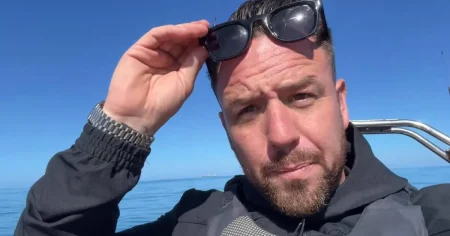
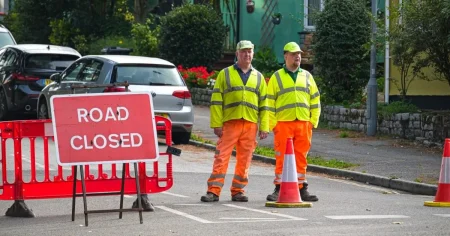
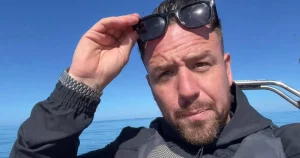
The immediate context for the detention appears to be Robinson’s support for Daniel Thomas, the man known as Danny Tommo. In a video that has caused revulsion and alarm in equal measure, Thomas livestreamed himself slashing a rubber dinghy in the middle of the English Channel. A rescue worker was already onboard the vessel at the time. The video, shared with the title “Tommy Robinson’s ‘right-hand man’ ‘slashes dinghy’ with rescue worker onboard,” shows a scene that is difficult to reconcile with any idea of safety. The Channel is not just a body of water; it is a corridor of hope and desperation, a place where even experienced crews are tested by shifting tides and hidden currents. To slash a rubber dinghy in such a place is not a clever symbol. It is a direct threat to life. The people who cross in those boats are not statistics. They are persons who have already travelled thousands of miles, fleeing bombs, prisons, poverty and despair, and placing their lives in the hands of smugglers who sell cheap inflatable crafts designed for ponds, not for the open sea. A single tear in the rubber, in wind and cold and moving water, can be enough to sink a boat. The rescue worker onboard faced a situation of fear and urgency while another human being moved around them, cutting the very thing that kept them afloat. Robinson nevertheless posted a message of support for Thomas, and in doing so, he added another layer of meaning to the event. He also wrote: “Police chaperone the invaders in. Then look prosecute those trying to stop the invasion.” His choice of the word “invaders” is not accidental. It paints every man, woman and child arriving by boat as part of a hostile force. It also turns Thomas’s reckless act into a form of patriotic resistance. The result is a collision of action and meaning that any government might find alarming. It is not hard to see why the authorities, already under pressure to respond to public anxiety about migration, would regard open support for an act that endangered a rescue worker as something requiring a response. Whatever the law says about Thomas, the human impact of his actions reaches far beyond gesture.
This is not a distant story about a celebrity agitator. It is a story about the shape of political life in Britain today. Stephen Yaxley-Lennon has never held high office, and yet his name has become a sort of mirror, reflecting how deep and dangerous the gap is between the governed and the governing. The report describes him as a far-right activist, and that label carries connotations of nativist anger, street conflict, and the politics of confrontation. To his supporters, such labels are badges of honour: proof that he is not part of the polite, careful careerism that has come to define political life. To his critics, the same identity is a warning sign: a man who has dedicated himself to division, whose agitation has a toll on communities, and whose language has been blamed for driving fear into the hearts of minorities. Accounts of the airport incident will be interpreted through that split. The announcement from his team, “They will never stop trying to destroy this man,” is meant to create a permanent narrative of martyrdom. In that story, every court appearance or counter-terrorism stop is a chapter in the persecution of a patriot. But the police are not supposed to be the enemy of a functioning democracy; they are ordinary men and women, working under their own rules, doing the work of keeping people safe. That they have not yet spoken publicly leaves the interpretation open to both sides. “Why are they so scared?” ask the supporters. But a resident of Kent hearing about a rescue worker onboard a punctured dinghy might ask why the police would not act. In the gap between those two questions lies a deeper conflict in society, a conflict where trust is scarce, suspicion is normal, and every fact is treated like a weapon. It may be that Robinson is detained, questioned, and released. It may be that he is charged. It may be that the whole episode disappears into legal procedure. Whatever happens, the very fact that a man known for his public anger can inspire such reactions shows how far we have drifted into a politics of emotion rather than understanding. Some see a heroic resistance fighter; others see a reckless provocateur; almost nobody sees the whole person, with all his history, his beliefs, his flaws, and his contradictions.
At the time of this writing, the Counter Terror Police have been approached for comment, and there has been no official answer. The news was still moving in fragments, breaking without a full picture. Which airport? Which officers? What exactly happened at the moment that life was interrupted? No one could say. The phrase “This is a breaking news story… More to follow…” invites us to remember that journalism, too, is human and imperfect. It works in real time, updating as events unfold, and sometimes the first account is the least complete. In the meantime, the internet has moved on to speculation. Every possible explanation has been offered, and every explanation has been met with a screenshot and a battle. Some have pointed to the Danny Tommo video as the trigger. Others have looked for hidden motives in the political establishment. Many have simply watched the clicks roll in, using the incident to draw attention to their own platforms. This is not how a mature democracy ought to discuss such matters. But it is how we often do it now. It is also important to remember that behind the drama, human beings are waiting in uncertainty. Robinson’s family, if they have heard the news, must be feeling the weight of public attention. His legal team will be bracing for a lengthy process. The police officers involved will have to justify their decision, minute by minute, in an environment where every action will be scrutinised. Even the other passengers, the ones who happened to be in the same terminal, will carry with them the strangeness of a police presence in a place reserved for travel. They may never know what happened. They may never find out. But the uncertainty itself is a form of weight; it leaves everyone with questions and no answers, with fear and no resolution. Until the police issue a full statement, all we can do is wait, report, and wonder. And in that waiting, we see what we want to see: a state too powerful, or a society too careless; a man silenced, or a man finally met by his actions.
At its heart, this story is not simply about one man in an airport. It is about the fragile line between freedom and safety, between protest and harm, between the words we say and the actions they inspire. Robinson has built his name on crossing lines. Some of those crossings have been protected speech; others have tested the limits of the law, and the law has caught up with him before. But the question we must ask ourselves is not only whether he should have been arrested, but why a society has grown so divided that the answer to that question is immediately framed as a war. The migrants crossing the Channel do not have social media accounts that resonate with millions. The rescue workers called to their aid do not have time to argue about ideology. They are simply trying to do the next thing: save a life, or begin a life, or keep a life afloat for another hour. When a man like Daniel Thomas slashes a dinghy, and when a prominent figure like Tommy Robinson rushes to support him, we are witnessing the human cost of a discourse that has ceased to see other humans at all. It is tempting to watch the next update with morbid curiosity, to refresh our screens, to wait for the next outrageous quote. But what would it mean to watch as a human being? It would mean keeping in mind that the labels “invaders” and “patriots” hide the complexity of every person. It would mean insisting that the police give a clear account, not because we have chosen a side, but because we believe in a society where power is answerable. It would mean remaining open to the possibility that the law and its critics both contain something true, and both carry responsibility. Whether this arrest becomes a conviction, a release, or a footnote in a longer history, the deeper story remains: we are all in the same channel, crossing the same thin, fragile water, and the only way to avoid sinking is to remember that every passenger is a person. More to follow, yes. But let us not forget, in the waiting, the humanity we are supposed to be following.