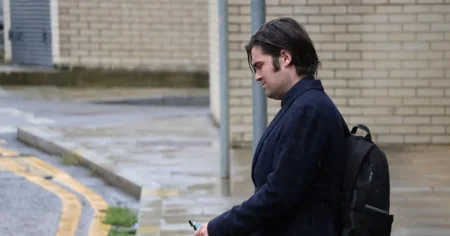




On a cool September morning, the town of Swindon woke to familiar rhythms: rush-hour traffic, shopfront shutters lifting, the quiet hum of an ordinary day. It was the kind of place where news like this would normally belong to a scripted drama, not real life. But for Joshua Cammidge, a 31-year-old resident of the town, this particular week marked the beginning of an extraordinary legal ordeal. On September 5, Cammidge was arrested by counter-terrorism police, supported by officers from Wiltshire Police, in a coordinated operation that underscored how seriously the authorities treated the emerging allegations. By Thursday, he stood in the dock at Westminster Magistrates’ Court wearing a prison-issue grey tracksuit, looking less like a spy than a man caught in the machinery of the justice system. Appearances, however, can be deceiving. The Crown Prosecution Service had charged him with two offences under the National Security Act 2023: assisting a foreign intelligence service and engaging in preparatory conduct. The allegations behind those charges were startling. He was accused of planning to assist Russian security forces with the sabotage of a drone factory, and of carrying out reconnaissance on potential targets in and around his hometown. The courtroom atmosphere was subdued. Cammidge did not enter a plea, and District Judge Daniel Sternberg made it clear that this was only the first step. The case was sent to the Central Criminal Court, with a hearing at the Old Bailey scheduled for September 25. Cammidge was remanded in custody, meaning the weeks ahead would be spent not in familiar surroundings but in a prison cell awaiting the next stage of proceedings. For those watching, the strangest part was the juxtaposition: a young man from an ordinary British town, accused in a London courtroom of plotting sabotage on behalf of a foreign power, all without any of the drama one might expect from such a case. His family, friends, and anyone who knew him were left to reconcile the person they thought they knew with the person now described in court, while Cammidge himself sat in silence, his liberty already a thing of the past.
The details of the alleged plot emerged during a prosecution outline that painted a picture of quiet, methodical preparation. Warren Stanier, the prosecutor, told the court that Cammidge had researched four drone manufacturing sites as well as a WiFi jamming device, and that he had carried out reconnaissance on those locations. The drone factory near the defendant’s house was said to be among the targets, giving the reconnaissance an unsettlingly local dimension. No long drives, no overnight stays, no suspicious absence that might have alarmed family or neighbours. Instead, the prosecution alleged, Cammidge needed only to observe the daily patterns of a nearby industrial facility, perhaps logging arrival times, security patrols, or moments when the site seemed most vulnerable. A WiFi jamming device is a piece of equipment no ordinary civilian has a pressing need for; in the context of sabotage, it could be used to knock out communications during an attack, delaying emergency response and creating confusion. According to the prosecution, these actions were not idle research. Cammidge was allegedly in contact with a man who instructed him to do a “recce” of potential targets, and he was allegedly willing to assist. The man was said to be connected to the GRU Volunteer Corps, a shadowy group whose name invokes Russia’s military intelligence directorate and represents a growing concern for security services across Europe: the outsourcing of hostile operations to civilians and volunteer networks. Most of the evidence, Stanier said, came from a mobile telephone seized after the arrest. In an age when a phone can contain a person’s entire inner life—messages, searches, maps, photos, encrypted chats—that single device apparently revealed a hidden existence that Cammidge had managed to keep separate from his everyday identity as a resident of Swindon. It is an uncomfortable thought that such an operation could take shape so close to home, in the same ordinary post-war town where people go to work, raise families, and think little about the shadowy world of international espionage.
The legal framework for this case is as significant as the allegations themselves. The National Security Act 2023 was introduced to modernise the UK’s response to hostile state activity, replacing espionage laws that had not kept pace with the realities of hybrid warfare. The first charge, assisting a foreign intelligence service, is set out under section 3 of the Act. The second, preparatory conduct, makes it an offence to do anything that is preparatory to a serious act of sabotage or other state-threat activity. Together, these charges allowed prosecutors to intervene early, before any plot was carried out and before any factory was damaged. The Crown Prosecution Service alleged that Cammidge was planning to commit or prepare for an act of sabotage—a legal term that means much more than criminal damage. It suggests deliberate, targeted disruption or destruction designed to harm the country’s economic or national security interests. At the hearing, prosecutor Warren Stanier laid out the case in spare, measured language. He told the court that Cammidge had a mobile telephone in his possession and that “most of the evidence came from the mobile telephone.” That phrase, so casually delivered, was a reminder of how modern security cases are won and lost. The alleged contact with a man linked to the GRU Volunteer Corps, the instructions to conduct reconnaissance, the searches for drone manufacturers and a WiFi jamming device, and the apparent willingness to help—all of it was said to be captured in digital form. None of this has been tested in court. Cammidge did not enter a plea, and the judge, in a brisk and businesslike manner, said: “I will simply send this case to the Central Criminal Court.” The next stop is the Old Bailey on September 25. Behind those understated words lay the possibility of a long trial, with sensitive evidence, questions about foreign intelligence operations, and a jury asked to determine whether a man from an ordinary Wiltshire town had crossed an extraordinary line.
For all the weight of the accusations, it is worth pausing on the human reality of the courtroom. There is a temptation to imagine people charged with terrorism or espionage as master criminals, characters from a thriller with secret identities and villainous confidence. But the figure who appeared before District Judge Daniel Sternberg was described simply as a 31-year-old from Swindon, dressed in the same grey prison-issue tracksuit worn by countless defendants across the country. He did not enter a plea, and no gestures, statements, or emotional outbursts were reported. The hearing was functional, almost routine: charges read, facts summarised, case sent upward. Yet nothing about the situation was routine for the man at the centre of it. Remand in custody means immediate separation from whatever life he had before—home, family, job, the small freedoms of daily existence. Even if he is ultimately acquitted, that life is gone. Friends and neighbours in Swindon, many of whom may have known him only from passing moments, are left to reconcile the person they thought they knew with the allegations now attached to his name. It is a strange and uncomfortable process, and it is too easy to forget that the legal system is not just about abstract principles. It is about people: the accused, the alleged conspirators, the workers at drone factories who may have been under silent surveillance, and the investigators who pieced together the evidence. The mobile phone seized after the arrest was, in a sense, a betrayal. It was a portal to a private world, and it now belongs to the prosecution. Whatever the truth, Cammidge’s life has already been profoundly altered by a chain of events that began, perhaps, with a decision to engage with the wrong people online or to let curiosity turn into something more dangerous. The unremarkable man in the dock was also a human being, with a past, relationships, and a future that has now been placed on hold indefinitely.
The case also needs to be understood against a broader backdrop. Across Europe, security agencies have warned that Russian intelligence services are increasingly willing to use unconventional means to disrupt support for Ukraine. Armed with drones deployed on battlefields and in reconnaissance, modern warfare has given drone manufacturing a strategic importance that would have been hard to imagine a generation ago. A factory that produces drones or components for drones is not just an industrial building; it is a node in a supply chain that directly affects the course of a conflict. Sabotage against such a facility could delay deliveries, damage morale, or force resources to be diverted to security and repair. The alleged involvement of the GRU Volunteer Corps, a network linked in the public mind to Russian military intelligence, fits this pattern of using local proxies to carry out hostile acts while maintaining a degree of deniability. The instruction to conduct a “recce” is a classic tradecraft move: before any operation, someone on the ground must provide current information about targets, security, and escape routes. Western security services have repeatedly warned that this kind of recruitment happens online; ordinary people can be drawn in through social media, encrypted messaging apps, or even fake employment offers, gradually lowering their own barriers until they find themselves agreeing to act as eyes and ears for a foreign power. The police response to Cammidge’s alleged activities was swift and serious. Counter-terrorism police took the lead, but they did so with the support of Wiltshire officers, a reflection of how national security is ultimately rooted in local policing. The investigation, the arrest, and the decision to charge were all collaborative efforts, and the case demonstrates that the threat of hostile state activity is not confined to London, ports, or military bases. It can surface anywhere—even in a town best known for its railway heritage and roundabouts.
What happens next will unfold in the coming months. Cammidge is due to appear at the Old Bailey on September 25, where the case will be committed or further directed, with a trial likely if the charges proceed. At this stage, the law presumes him innocent, and no plea has been entered. It is a legal principle too important to forget, no matter how serious the allegations. The evidence from the mobile phone will be scrutinised, defence lawyers will test the legality and reliability of the methods used to obtain it, and the court will have to decide whether the Crown has proved its case beyond reasonable doubt. For the public, the case is a chilling glimpse into the shadowy world of espionage and sabotage. For the people of Swindon, it is also a reminder that the front lines of modern conflict are not always in distant countries. They can exist in industrial estates, in quiet residential neighbourhoods, in the seemingly innocuous contents of a smartphone. There is no shortage of unanswered questions: How did Cammidge come into contact with someone allegedly connected to the GRU Volunteer Corps? What, if anything, did he believe he was achieving? Did he truly understand the consequences of his alleged actions, or was he manipulated by people thousands of miles away who saw him as nothing more than a disposable asset? Those questions may never be fully answered in public. What is certain is that a man from an ordinary town now faces the most serious charges imaginable, and a legal system designed to protect the country will have to ensure that justice is done—not only for the state, but for the accused, whose life has become a strange and public footnote in a larger struggle. In the meantime, life goes on in Swindon, but for Joshua Cammidge it has paused indefinitely, caught between the ordinary world he once inhabited and the serious accusations that now define him.