


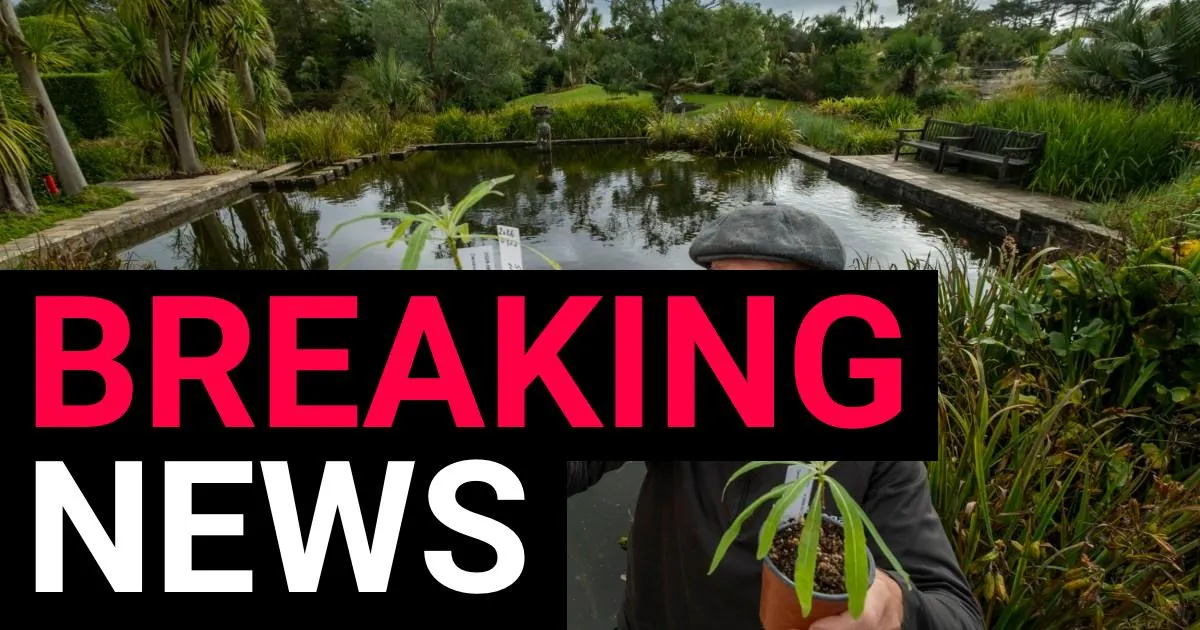
On Sunday, as Storm Boelo tore across Scotland with winds that reached 80 miles per hour, a quiet community in Dumfries and Galloway was struck by a tragedy that no weather warning could have prepared anyone for. Richard Baines, the 60-year-old curator of Logan Botanic Garden, had gone out for a walk near his home, perhaps to clear his head, perhaps simply to stretch his legs between the gusts, as so many of us do without a second thought. That ordinary act became fatal when a tree, loosened by the ferocious storm, fell and struck him. He died there, outside, in the landscape he knew and loved, in a storm that had turned the familiar into something dangerous. For those who knew him, the loss is almost impossible to process. Baines was not just a public figure or a professional horticulturist; he was a man whose entire life revolved around plants, who believed in the quiet power of green spaces to heal, inspire, and connect people across generations. The irony is unbearably cruel: a man who spent decades protecting, nurturing, and celebrating trees and plants was killed by one during a moment of violent weather. As the storm battered Scotland with damaging gusts, leaving behind power outages, travel chaos, and debris-strewn streets, the news of his death rippled far beyond the small stretch of coastline he called home. Colleagues, friends, volunteers, and garden visitors began to share memories of a man who had made Logan Botanic Garden one of the most beloved and respected gardens in the country. In the midst of the storm’s aftermath, his loss became a reminder of the fragility of life, of how quickly a normal Sunday can change, and of how much one person’s passion can shape the world without most of us ever noticing.
Tributes have since poured in, led by those who worked alongside Richard Baines at the Royal Botanic Garden Edinburgh, of which Logan is a regional gem. David Knott, the director of horticulture at the Royal Botanic Garden Edinburgh, spoke with profound sadness and admiration, describing Baines as an “enthusiastic plantsman” who would be “deeply missed.” Those words, though simple, carry the weight of decades of shared purpose. Baines was primarily responsible for a number of significant developments and initiatives at Logan, including the creation of the first “all green” public conservatory powered entirely by green energy in the United Kingdom. That project reflected his forward-thinking vision, his belief that botanic gardens had to evolve, not just preserve the past but model a more sustainable future. Under his tenure, Logan Botanic Garden also earned a remarkable accolade that meant a great deal to the entire team: it was voted the best garden in the UK by Which? in 2021. That was not just a professional achievement; it was a public affirmation of what those who had wandered through Logan’s winding paths already knew. Baines had helped transform the garden into a place of wonder, where rare plants thrived, where visitors felt welcome, and where the sheer beauty of the natural world could stop people in their tracks. But for all the awards and recognition, what colleagues remember most was his passion, the way his eyes lit up when he talked about a newly opened flower or a struggling species that had finally taken root. He did not simply manage the garden; he lived inside it, and he had an extraordinary ability to make others feel the same sense of awe and curiosity that drove him every single day.
His influence extended far beyond the borders of Logan. Baines was a genuine plant explorer, one of those rare individuals who combined scientific rigor with an almost romantic love of discovery. He participated in and led fieldwork in China, the Canary Islands, and Vietnam, journeys that were not glamorous but demanding, often physically challenging, and always motivated by a deep desire to understand and protect plant diversity. Those expeditions produced results that will outlive us all: seven plant species that are currently being published as new to science, discoveries that bear the mark of his careful eye and his willingness to go to remote places in search of botanical treasures. Each of those species is a living legacy, a small piece of him that will continue to grow and be studied for generations. David Knott noted that Richard’s contribution to Logan and to the wider work and culture of the Royal Botanic Garden Edinburgh has been “immeasurable.” That is not a word used lightly. It speaks to the countless ways Baines shaped the institution, through his enthusiasm, his expertise, his generosity, and his belief that a botanic garden is not just a collection of plants but a community of people bound together by a shared sense of wonder. He significantly increased and expanded the plant collection at Logan, bringing new life into the garden and ensuring that visitors would always have something new to discover. He was the kind of curator who never saw a plant as merely ornamental, but as a living story, a thread in the fabric of biodiversity, a gift from another part of the world that deserved care and respect. The grief felt by his colleagues is therefore not just for the loss of a friend and mentor, but for the loss of a singular voice, a person whose enthusiasm was so infectious that it made everyone around him want to be better at their own work.
The tragedy of Richard Baines took place against a backdrop of wider destruction caused by Storm Boelo, which continued to make its presence felt across the United Kingdom even after the worst of the winds had passed. The storm brought gusts of up to 84 miles per hour and dumped the equivalent of a third of a month’s rain in some parts of Scotland, leaving homes without power, roads blocked, and communities struggling to recover. In Aberfeldy, Perth and Kinross, two women were taken to hospital after being struck by another falling tree, a chilling reminder that the danger was not limited to remote coastal paths or isolated countryside lanes. Everywhere, people were dealing with the aftermath: fences blown down, roofs damaged, gardens scattered with branches and leaves. For those already grieving Baines, the continuing storm served as a bitter reminder of the randomness of such tragedies. Why him? Why a man who spent his life nurturing trees? Why a Sunday morning walk that suddenly turned fatal? There are no answers to those questions, only the quiet, relentless work of cleanup and recovery. Emergency services, tree surgeons, power crews, and volunteers all began the slow process of putting things back together, clearing roads, restoring electricity, and checking on vulnerable neighbors. But the recovery was hampered by the weather itself. Fresh warnings had already been issued, with strong winds and heavy rain forecast to move in across western areas of the UK on Monday and Tuesday. The Met Office warned of ongoing disruption, particularly around exposed coasts and higher ground, meaning that even as communities tried to heal, the sky above them remained restless and unsettled. For many, the storm had become more than just a weather event; it was a marker in time, the day a beloved local figure was lost, the day nature turned briefly hostile, the day that reminded everyone how little control they truly have.
Looking ahead, the forecast offered a mixed picture. A yellow Met Office warning for strong winds and potentially damaging gusts was in place from 3am on Tuesday until midnight for the far north of England, Scotland, and the far north-east of Northern Ireland. The winds would not be as intense as those that accompanied Storm Boelo, but they would still be strong enough to cause trouble, especially in those areas already weakened by the previous storm. Monday was expected to remain wet and windy, with rain moving across southern and western areas before spreading north-east, bringing with it the potential for coastal flooding, particularly in northern areas. As that system cleared, drier conditions were expected to develop across England and Wales later in the day. Tuesday would see early rain clearing from eastern and south-eastern England, while heavier rain in the north-west of Scotland gradually turned to showers. The strongest winds were expected to continue to affect Scotland, especially in the far north and north-west, where gusts in excess of 70 miles per hour were possible. The Hebrides, in particular, were most likely to experience the strongest winds, which could potentially last for several hours, testing already weary residents and threatening to undo some of the repair work that had only just begun. Elsewhere, there would be sunny spells and showers, with some heavy in western areas. For those mourning Richard Baines, the weather seemed almost conspiratorially cruel, as if the skies themselves were refusing to offer any comfort. And yet, life went on. People went to work, children went to school, and the persistent work of recovery continued, because that is what people do, even in the aftermath of grief.
But there was hope on the horizon, a promise of calmer days. From Wednesday onward, high pressure was expected to begin increasingly influencing the UK, bringing lighter winds and drier weather across much of the country. Wednesday night and Thursday looked likely to offer a welcome respite, though western areas might remain breezy and experience a few light showers. Mist and fog could be dense and slow to clear, leaving some areas chilly and grey, while brighter spells elsewhere would allow temperatures to rise into the teens. By Friday, high pressure was expected to keep England and Wales mostly dry, with morning fog clearing to sunny spells and temperatures of 13C to 16C. It would not be a perfect return to normal, but it would be a start, a chance for communities to breathe again, to remove the last fallen branches, to visit gardens and parks and remember why they loved the natural world in the first place. For Logan Botanic Garden, the days ahead would be strange and heavy with absence. The garden itself, battered by wind and rain, would need care and attention, work that Richard Baines would have led with characteristic energy. Instead, his colleagues would have to do it without him, and every plant they tended, every path they cleared, every rare species they checked on, would be a small act of remembrance. Gardens are, in their own way, monuments to hope. They grow, they change, they survive storms, and they return, season after season, with new life. Richard Baines understood this better than almost anyone. He gave his life to plants, and in the end, it was a tree that took him. But the gardens he tended, the collections he expanded, the colleagues he inspired, and the new species he discovered will carry his memory forward. The wind will eventually stop, the warnings will lift, and the sun will find its way through the clouds. And when it does, those who walk through Logan Botanic Garden will see his legacy blooming all around them, in every leaf, every flower, every quiet corner where a man with a passionate heart once stopped to look, and knew that he belonged.