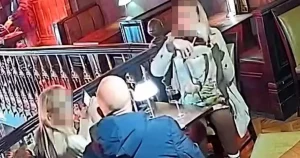



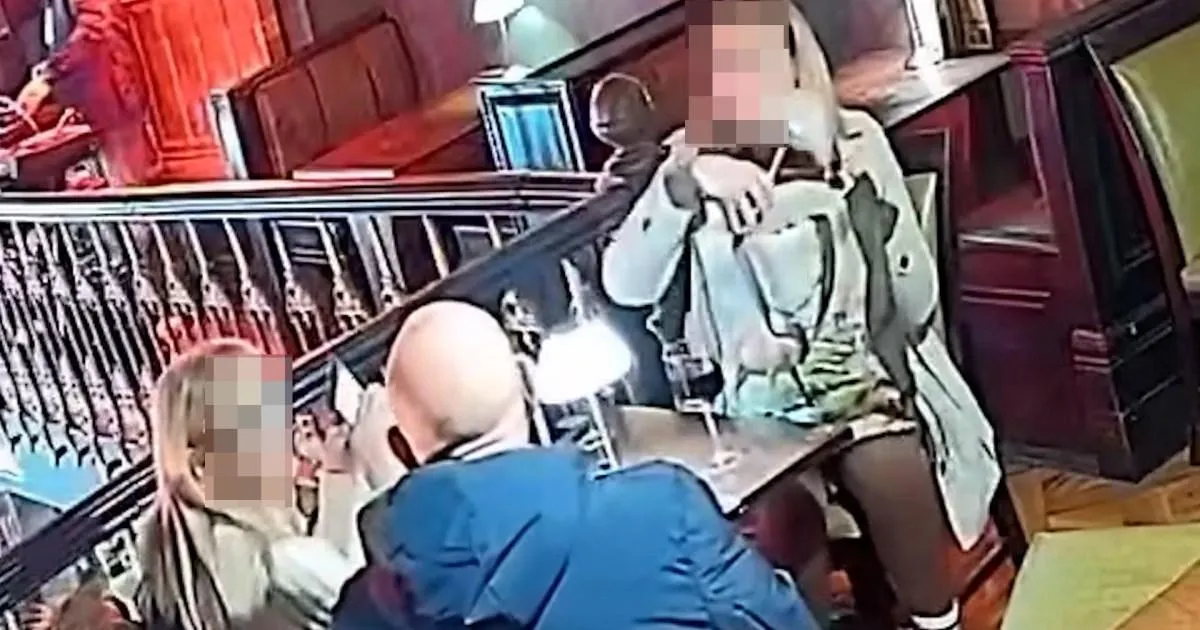
Every so often, a piece of surveillance footage captures not a crime so much as a tiny, baffling human moment. That is exactly what happened at Krak Bar in Matlock, Derbyshire, where a woman was caught on CCTV apparently helping herself to one of the venue’s brand-new table lamps. The clip, which has been watched millions of times since the bar shared it on social media, shows the woman in the middle of a busy evening, calmly picking up the small lamp and slipping it into her bag as though she were tidying away her own belongings. It is a gesture so casual, so matter-of-fact, that it almost doesn’t look like theft at all — more like an absent-minded reflex, the kind of thing someone might do without thinking, only to realise later what they have done. The bar clearly saw the funny side, at least initially. In a post accompanying the footage, the team wrote: “Seems we’ve lost one of our new table lamps. Whilst on the hunt to find it, we came across this footage of a lovely lady misplacing it! Does anybody know how we could get in touch with the lady to get this back, as one of our tables is in complete darkness. Please message our page with her name so we could contact her or, even better, please could you drop us a message to let us know when we can receive our property!” The wording is wonderfully gentle — not an accusation but an invitation, wrapped in wit and a little bit of mischief. The image of a table sitting in complete darkness because someone fancied a free lamp is both ridiculous and strangely poetic. It turns a petty theft into a shared joke, and it invites the woman to do the right thing without being publicly shamed. Whether she has returned it, or ever will, is unknown. But the clip has clearly touched a nerve, perhaps because many of us recognise the strange impulses that can take over in a warm, noisy bar, where the line between what’s yours and what’s just there can sometimes blur.
The bar’s decision to use humour rather than fury is worth pausing over. In an era when every questionable act is filmed, uploaded and met with a digital mob, Krak Bar chose a different path. They did not name the woman, call the police, or demand her public trial. Instead, they described her as a “lovely lady” who had “misplaced” the lamp, and they framed the entire episode as a mild inconvenience: a table in darkness, a search for a missing object, a request for a quiet return. That approach is not only kind; it is also deeply human. It acknowledges that people do odd things, especially after a couple of drinks or in a moment of peculiar temptation. Maybe the woman genuinely thought the lamp was a freebie or a giveaway. Maybe she confused it with something she had brought in. Maybe she simply made a strange, spur-of-the-moment choice that she now regrets. The bar’s post gives her every opportunity to make amends without losing face. It also turns an otherwise ordinary petty theft into a piece of shared storytelling. Nearly everyone who watches the clip probably thinks, “That could be me” — not in the sense of stealing a lamp, but in the sense of doing something inexplicable in a busy room, something that later makes you cringe. By responding with gentleness, the bar has made the story about how a community handles a minor transgression rather than about the transgression itself. It is a reminder that not every mistake requires punishment; sometimes a prompt to return the item, wrapped in a joke, is enough. And if the woman does come back, she will likely be greeted with laughter rather than suspicion, which says a lot about the kind of place Krak Bar wants to be. It also says something about the strange appeal of viral stories: we are drawn not to the seriousness of the crime, but to the sheer oddness of it. A stolen lamp is not a pressing social problem, but it is a perfect little mystery, and the bar’s good-humoured handling of it has made it a story people actually want to talk about.
Of course, not every incident in a pub is so innocent or so easily resolved. In April, two thieves were caught on CCTV rifling through strangers’ bags and stealing the contents in the middle of a pub in London. The footage showed Majazy Latif, 28, and Youcef Aliouat, 32, calmly taking their time going through people’s belongings for almost seven minutes, while blending in with other pub-goers. The pair were seen strolling up to the bar on Cannon Street, where they positioned themselves around a pile of bags. They even pulled a chair in front of the bags, despite the fact that the bar was empty and there were plenty of other places to sit, and placed their own rucksack among the pile to create a cover. People standing near them and walking past were seemingly unaware of what was happening right beside them, according to City of London Police. That detail is perhaps the most unsettling part of the footage. In a crowded, lively pub, everyone assumes someone else is watching. A person with a rucksack and a chair looks like they belong, looks like they are waiting for a friend or checking their phone. The confidence of the two men is almost breathtaking. They were not snatching a handbag and running for the door; they were methodically sorting through wallets, phones, keys and laptops, all while ordinary customers laughed, chatted and ordered drinks a few feet away. It is a chilling contrast to the lamp story. The lamp theft, however odd, seems relatively harmless — an item of small value, taken without confronting anyone. This was a violation of personal space and trust, carried out by people who knew exactly what they were doing and who were prepared to let ordinary people bear the cost. It is one thing to take something that was sitting in plain sight; it is quite another to reach into someone’s bag, to touch their private belongings, to make off with the tools of their working life, all while pretending to be just another customer.
The consequences for the two London thieves were serious. Latif was jailed for 23 months after pleading guilty to nine counts of theft between 6 August 2025 and 25 September 2025. Officers found that he stole around £14,250 worth of personal belongings, including laptops, in licensed premises across the City of London. He was also handed a Criminal Behaviour Order (CBO), banning him from entering the City for five years. Aliouat, meanwhile, was sentenced to 18 months in prison for stealing nine laptops between 14 August 2025 and 6 October 2025 in the City, and was given a similar CBO banning him from entering the Square Mile for five years. There is something sobering about those numbers. Nine laptops, nine people whose work, photographs, passwords, private letters and perhaps entire livelihoods were in those bags. £14,250 is not just a figure; it represents a series of losses, each one felt by a real person who went to a pub for a relaxing evening and left with far less than they brought. The CBOs are also significant. They mean that even after the prison sentences are served, these men will be barred from the very places they once hunted. Bar staff, door supervisors and police will be able to spot them if they try to return. It is a small but important layer of protection for the public. The sentences send a message that this kind of stealthy, brazen theft will not be treated as minor. At the same time, one cannot help but wonder about the human waste involved. Two relatively young men, with enough nerve and social skill to stand calmly in a crowd, chose to use those talents to steal. They might have found decent work, built relationships, become trusted figures in their communities. Instead, they are prisoners, and their names are now attached to a story that will follow them around for years. It is a bleak reminder that the same confidence that can charm a room can also be used to rob it.
Taken together, the two stories offer a strange but useful snapshot of theft in British pubs. On one end of the scale, you have a woman taking a lamp because, for some reason, she wanted it. On the other, you have a pair of professionals methodically clearing out bags. Both took place in public, both were captured on camera, and both expose the vulnerability that comes with relaxing in a social space. We go to pubs to let our guard down. We put our bags on the floor, on the back of chairs, on benches beside us. We assume that the person next to us is there for the same reason we are: to have a drink, talk to friends, watch the football. Most of the time, that assumption is correct. But the London case shows that there are people who study those assumptions and exploit them. The lamp case shows something else: that not every act of taking is driven by greed or need. Sometimes it is simply bizarre. Maybe that is why the lamp clip has resonated so widely. It offers a moment of levity in a world that often feels threatening. It is a story about a table lamp, of all things, and about a bar that chose to respond with wit rather than outrage. It also invites us to think about how we react when we have been wronged. Do we call for punishment, or do we leave the door open for redemption? The bar’s message might be playful, but it is also a clever piece of social engineering. By making the woman’s action a matter of public curiosity rather than criminal accusation, they have made it almost impossible for her to slip away silently without feeling a pang of guilt. If she has any sense of shame, she will find a way to return the lamp, perhaps under cover of darkness, perhaps in a bag with a note of apology. And if she does, the story will become even better: not just a video of a strange theft, but a story of someone who did the right thing in the end.
And so we are left with a pair of images that will probably stick with us. One is a woman sliding a small lamp into her bag, her face perhaps hidden, her intentions unknown, while the lights of the bar glitter around her. The other is two men calmly sorting through other people’s belongings, invisible in plain sight. Both images are unusual, and both have a strange kind of clarity. In the end, the lamp story is not really about the lamp. It is about second chances, about the silly things we do that somehow get caught on camera, and about the kindness of strangers who could have been cruel but chose not to be. It is about a bar that turned a minor loss into a moment of connection with thousands of strangers. The London story is a reminder that the same settings can also attract people whose intentions are far less innocent. We should enjoy the joke, but we should also keep our zips fastened and our bags close. There is no contradiction in doing both. For Krak Bar, the whole affair has become something of a blessing in disguise. A few million views will not hurt business, and the mystery of the missing lamp has given the place a friendly, approachable identity. Perhaps one night soon, a woman will walk in, place a lamp back on the table, and order a quiet drink. If she does, the bar will probably buy her that drink. And if she never returns, the story will still be told, a little more exaggerated with each telling, about the night someone stole a lamp and a whole town decided to laugh about it. Sometimes the best way to deal with a difficult moment is to find the humour in it, to turn an offence into an anecdote, and to remember that a table in darkness can still be the warmest spot in the room.