

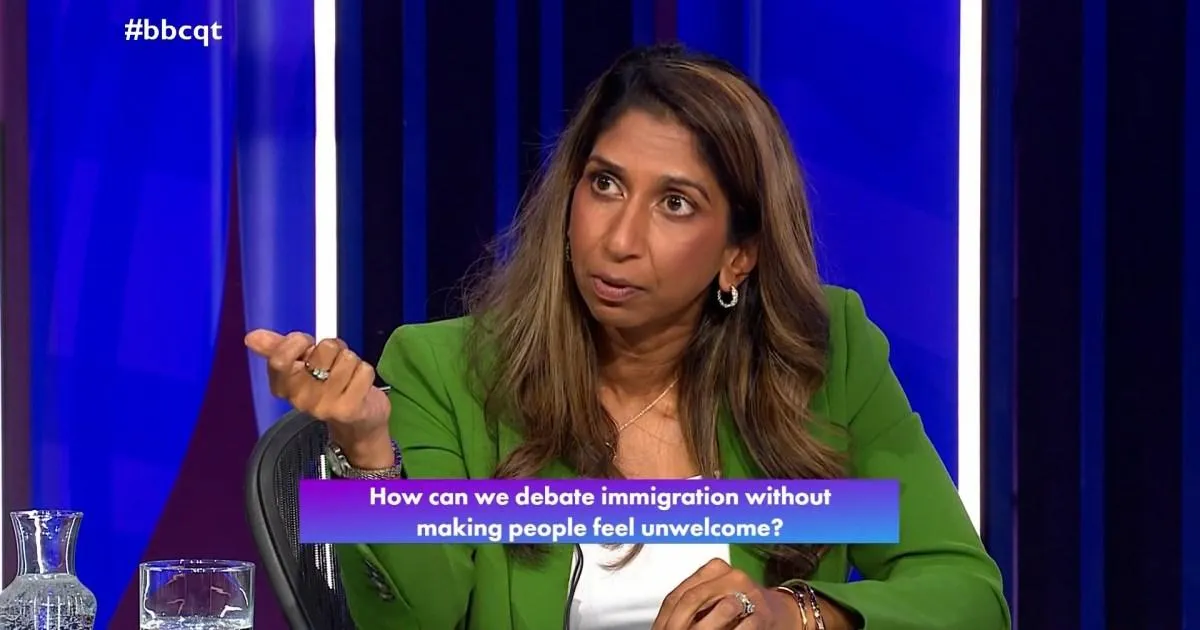
The studio lights seemed harsher than usual, the air thick with anticipation, as Suella Braverman sat down for what would become one of the most uncomfortable television moments of the year. The Reform MP, a woman whose own family story is woven from the fabric of migration, had come to the BBC’s Question Time to debate a question that has haunted British society for generations: who can truly call themselves English? It was a subject that required sensitivity, nuance, and perhaps a willingness to listen. Instead, the conversation quickly became a raw, personal, and deeply revealing confrontation about identity, belonging, and the color of a person’s skin. The presenter, Fiona Bruce, did not let the politician drift into vague rhetoric. She pushed, probed, and pressed for a straight answer, because the audience, and indeed the country, was waiting to hear what Braverman genuinely believed. What followed was a definition that surprised many, offended some, and left even Braverman herself looking strangely like a woman caught between her own biography and her political convictions. From the very first moments, it was clear that this would not be a debate about policy or history. It would be a debate about hearts, families, and the subtle, often painful ways we decide who belongs and who does not.
When Bruce asked Braverman what a person would have to look like or what heritage they would need to claim to be English, the politician offered a response that seemed to distance her from the very country she has served in public office for years. Her parents were not born here, her grandparents were not born in England, she explained, and therefore, in her particular instance, she was not of English origin. The admission was striking, not only because Braverman was born in London and has spent her entire career as a British politician, but because it appeared to endorse the very idea that Englishness is rooted in ancestry and lineage rather than birthplace, culture, or commitment. Bruce, sensing the evasion, asked her to be precise: if that is not what Englishness is, then what is it? The question hung in the air, demanding an answer that could not be dressed up in parliamentary phrases. Eventually, Braverman suggested that Englishness becomes obvious through a lineage, an ancestry, a connection to the heritage of the country that dates back a few generations. She insisted this was not an unreasonable expectation for people who come to this country. But for the millions of people who were born on English soil, who have never lived anywhere else, and who have loved and contributed to this nation all their lives, her words felt like a door quietly closing in their faces. The notion that a few generations must pass before one can truly be considered English was not, for many, a harmless observation. It was a quiet redefinition of belonging, one that placed people like Braverman herself on the outside looking in.
The tension in the room reached its peak when a black man in the audience rose to speak. He had been on this planet for fifty-four years, he said, and in all that time, he had lost count of the moments he had been told he was not English, even though he was born and raised in this country. If he had received a penny for every time, he joked, he would be a very rich man. There was no anger in his voice, only the weariness of someone who had lived through this exact conversation again and again, in different rooms, with different faces, but always with the same underlying message: that his presence, his skin color, his heritage somehow disqualified him from the culture he called his own. He looked at Braverman, not with hatred, but with a kind of sorrow, and accused her of reinforcing the racist argument. Worse, he said, she was perpetuating a form of internalised racism, a painful phrase that lingered in the air like smoke. Braverman reacted with disbelief. The idea that she, a woman of Indian descent, a former Home Secretary, could be accused of racism against her own community and herself seemed almost absurd to her. She replied, with a mixture of sarcasm and incredulity, that she was not going to be racist against herself. But the audience member held his ground, repeating softly: basically, you are. It was a moment of extraordinary emotional intensity, a collision between two very different understandings of what it means to be English, and what it means to fight for acceptance.
The debate did not end in the studio. As clips from the show spread across social media, commentators and ordinary viewers alike began to weigh in. Oli Dugmore, a journalist from the New Statesman, captured the central criticism when he said that Braverman was of course entitled to identify personally in whatever way she chose, but that the political function of her argument was undeniable. When a prominent politician stands on a national stage and insists that Englishness is a matter of ancestry stretching back several generations, the practical consequence is to suggest that certain people, particularly those from ethnic minority backgrounds, can never truly belong. Dugmore called this a racist point of view, not necessarily because of any personal malice in Braverman’s heart, but because of the way such language operates in society. It creates an in-group and an out-group, it divides people into authentic and inauthentic, and it tells children who have grown up in England, who speak with English accents, who study English history, that they are somehow visitors in their own home. For Braverman, however, the accusation was just another example of the left smearing her and her party. She took to social media with a statement that was equal parts defiance and frustration. She claimed that she had been called racist in a contorted way, and that the debate had been lowered by divisive and inflammatory language. She even suggested that it was because of irresponsible language like Dugmore’s that Reform, her party, needed security, a comment that pointed to the increasingly volatile nature of British political discourse.
To understand Braverman’s position, one has to appreciate the strange and contradictory place she occupies in the national conversation. She is, by her own admission, a woman whose parents and grandparents were not born in England, yet she has risen to the highest levels of British political life. She was born in London, grew up in the British schooling system, and became a barrister and a minister, dedicated to governing the very country she now claims not to belong to by ancestry. She defected from the Conservative Party to Reform earlier this year, a move that aligned her with a political movement whose central mission has often been the restriction of immigration and the protection of an imagined traditional British identity. In that context, her comments on Question Time take on a deeper significance. She is not merely sharing a personal reflection; she is articulating a political ideology that has profound consequences for the way people are treated in this country. But there is also something heartbreakingly human about her insistence on her own identity. Perhaps she genuinely believes that her Indian heritage, and the fact that her ancestors did not live in England generations ago, means she is not culturally English. Perhaps she has spent so long navigating a world that questioned her belonging that she has internalised the idea that blood and lineage matter more than birthplace. Or perhaps she simply believes that integration and naturalisation require time, and that her own story is not yet long enough for the label she has nevertheless worked so hard to embody. No single explanation captures the complexity of her feelings, and that may be the tragedy at the heart of the entire debate.
What makes this story so powerful is that it is not really about Suella Braverman or one audience member’s anger. It is about the wider crisis of identity that haunts modern England. In an age of mass migration, globalisation, and shifting cultural boundaries, the old certainties have crumbled. We no longer agree on what it means to be English, or British, or anything else. Some people find comfort in ancestry and tradition, in the idea that identity is a chain stretching back through generations, linking the living to the dead. Others find comfort in citizenship and shared experience, in the belief that if you are born here, contribute here, love here, and choose here, you are as English as anyone else. These two visions are not always in conflict, but when they collide, they do so with enormous force. Braverman’s comments were not the cause of this collision, but they were a stark reminder of how far apart we have drifted. The black man in the audience, with his fifty-four years of experience, had no doubt about his Englishness, and yet he had been denied it countless times by people who, like Braverman, thought they had the right to define him. And Braverman, herself a daughter of migrants, could not see the harm in her words because she genuinely believed she was speaking about her own situation, her own heritage, her own refusal to claim something she felt she had not earned. Somewhere in that misunderstanding lies the entire story of modern Britain: a country of incredible diversity, still struggling to find a language that can hold all its people together without leaving anyone behind. Perhaps there is no easy answer, no single definition that will satisfy everyone, no formula that can measure how many generations make a person truly native. Perhaps the best we can do is recognise that Englishness, like all identities, is not a fixed destination but a living, breathing thing, made and remade every day by the people who love this country, in all their beautiful, complicated, and often contradictory variety.