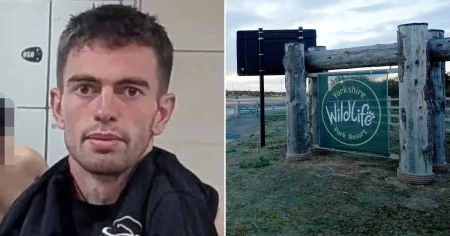


At some point in the past few days, Daniel Graham walked out of a prison gate and back into a world that no longer looks quite the same as the one he left behind. At 41, he is the second of two men convicted in connection with one of the most famous acts of vandalism in modern British memory: the felling of the Sycamore Gap tree. Graham was sentenced alongside Adam Carruthers in July last year, with each man receiving four years and three months for causing criminal damage to the beloved sycamore that stood in a dramatic dip beside Hadrian’s Wall in Northumberland. Carruthers was released on licence in April, and now Graham has been freed too, after serving 16 months in custody plus the time he spent on remand before his conviction. The judge, Mrs Justice Lambert, had made clear at sentencing that the pair would serve 40 percent of their sentence in prison, with the remaining 60 percent spent in the community under licence. That means Graham’s release is not a simple return to freedom. He will be subject to strict conditions, and if he breaks them, he can be sent straight back to prison. The Ministry of Justice was quick to remind the public of that reality in a statement, calling the felling of the tree a “disgraceful crime” and emphasising that offenders released on licence are monitored and can be recalled at any time. But for many people who followed the story, the news of his release will stir complicated feelings: relief that the legal process has run its course, frustration that the punishment was not longer, or simply sadness that no sentence can ever bring the tree back.
The tree that Graham was convicted of helping to destroy was never just a tree. It stood for more than a century in a natural notch in the rolling Northumberland landscape, a place where the ancient Roman wall bends dramatically through the hills, and where the sycamore somehow rooted itself into the earth and became a symbol of endurance. Generations of walkers, hikers, artists and photographers made the pilgrimage to see it. Its image appeared on calendars, postcards, guidebooks and social media feeds. It was featured in the 1991 film Robin Hood: Prince of Thieves, with Kevin Costner and Morgan Freeman, which gave it a kind of cinematic immortality. But for the people who lived nearby, and for those who visited year after year, the tree was more than a film location or a photograph. It was a quiet companion, a meeting point, a place where proposals were made, where ashes were scattered, where children played and where weary minds found a moment of peace. It stood in a fold in the earth, as if the landscape itself had created a cradling space for something precious. When news broke in September 2023 that the tree had been cut down overnight, the shock was felt far beyond Northumberland. Headlines around the world carried the story. People who had never seen the tree in person mourned it as though they had lost a friend. The sheer senselessness of the act seemed to touch something universal: the knowledge that beautiful, irreplaceable things can be destroyed in an instant by human carelessness, arrogance or cruelty.
The crime itself was as baffling as it was destructive. According to evidence heard at Newcastle Crown Court, Graham and Carruthers, who had once been friends, drove for more than 40 minutes from their homes in Cumbria to reach the remote site. They then carried their equipment across pitch-black moorland during a storm, a journey that would have been difficult even for people with innocent intentions. The night was wild, the terrain uneven, and the conditions dangerous. Yet the two men pressed on, apparently determined to bring down the landmark. Once at the tree, they went to work with a saw or saws, and within less than three minutes, the sycamore was on the ground. The damage was not limited to the tree itself. As it fell, it crashed into the ancient stones of Hadrian’s Wall, which is a UNESCO World Heritage Site, causing criminal damage to the wall as well. The prosecution described the operation as a “moronic mission,” and the phrase stuck because it captured something essential about the act: it was not a protest, not a crime of passion, not a desperate act of need. It was vandalism for its own sake, carried out with planning and effort but without any discernible purpose. What made it even stranger was what happened afterward. The two men took a wedge from the tree as a trophy, a bizarre souvenir that has never been recovered. They also, according to the judge, revelled in the media coverage as the story exploded across national and international news. It was as though the destruction itself was not enough; they also wanted the attention, the notoriety, the dark thrill of knowing that they had done something that would make people gasp in disbelief.
The legal case against the two men was never straightforward. Both were charged with criminal damage to the tree and to Hadrian’s Wall, and both were eventually convicted. But Mrs Justice Lambert was careful to distinguish their roles. She was sure that Carruthers was the one who actually cut the tree down, while Graham drove him there and filmed the destruction on his phone. That distinction did not make Graham innocent. Under the law, he was equally responsible because he was part of the joint enterprise, and his decision to film rather than stop the act made him a participant, not a bystander. The court heard how the two men had travelled together, brought the equipment, carried it across the moor, and then stood by as the tree was felled. The video on Graham’s phone, presumably meant as a keepsake, instead became evidence of his involvement. In sentencing, the judge said they would serve 40 percent of the four years and three months in custody, with the rest to be served on licence in the community. That meant Graham, who had already spent time on remand, would be released after about 16 months of prison time. Carruthers had been released in April, and now Graham has followed. For the Ministry of Justice, the release is part of the normal process of rehabilitation, but it is also a reminder that prison sentences do not simply end on the day someone walks out. The men will have to live with strict conditions, report to probation officers, and face the possibility of recall if they step out of line. Whether they have truly learned anything from their time inside is something that cannot be known from a court document or a press release. What is known is that they will now have to rebuild their lives in a world that will not forget what they did.
What is perhaps most human about this story is the way it has left a lasting scar on everyone it touched. The tree is gone, and no sentence can bring it back. The stump remains, a raw wound in the landscape, and although the grass has begun to grow over some of the damage, the missing shape of the sycamore is still deeply felt. For the local community, the loss was not just visual. It was a loss of memory, of place, of something that had seemed permanent. For Graham and Carruthers, the consequences have been equally profound, though in a different way. The two men were described as former friends, meaning their friendship did not survive the crime, the arrest, the trial or the prison sentences. The wedge they took as a trophy has never been found, so even that strange piece of the story remains unresolved. Their families have had to endure the shame of seeing their names in the news, the long months of court proceedings, and the difficult visits to prison. It is impossible to know what goes through a person’s mind when they are released from custody after committing a crime that made headlines around the world. Perhaps there is remorse, perhaps there is resentment, perhaps there is simply exhaustion. The law does not require them to be sorry. It only requires them to serve their sentence and then to obey the conditions of their release. But the human cost of that night in September 2023 will follow them for the rest of their lives. Every time their names appear in a news story, every time someone mentions Sycamore Gap, the memory will resurface. The crime took less than three minutes to commit, but its consequences are measured in years, and in ways that cannot be undone.
Ultimately, the release of Daniel Graham brings the criminal justice process to a close, but it does not bring closure. The story of Sycamore Gap has become something larger than a crime report. It has become a parable about the fragility of beauty, the randomness of destruction, and the strange, inexplicable things people do. The two men are no longer behind bars, but the tree is still gone, and the world is still poorer for it. There is a natural human urge to look for meaning in such events, to ask why someone would destroy something so precious. Sometimes there is no satisfying answer. Sometimes people do terrible things simply because they can, and the rest of us are left to make sense of the wreckage. In the months since the felling, there have been conversations about whether the tree can regrow, whether a new one should be planted, whether the site should be left as it is. Those conversations are themselves a kind of healing, a way of moving forward without pretending the loss never happened. The release of Graham is not a happy ending or a tragic one. It is just another step in a long, slow process of reckoning. For Graham and Carruthers, the chance to rebuild their lives is a privilege, but it is also a burden. They will always be the men who cut down the Sycamore Gap tree. No matter how quietly they live, no matter how many years pass, that is part of their story now. And for the rest of us, the image of that empty notch in the Northumberland landscape remains a quiet, powerful reminder that some things are worth protecting, and that once they are gone, no amount of punishment, regret or explanation can ever truly make it right.