


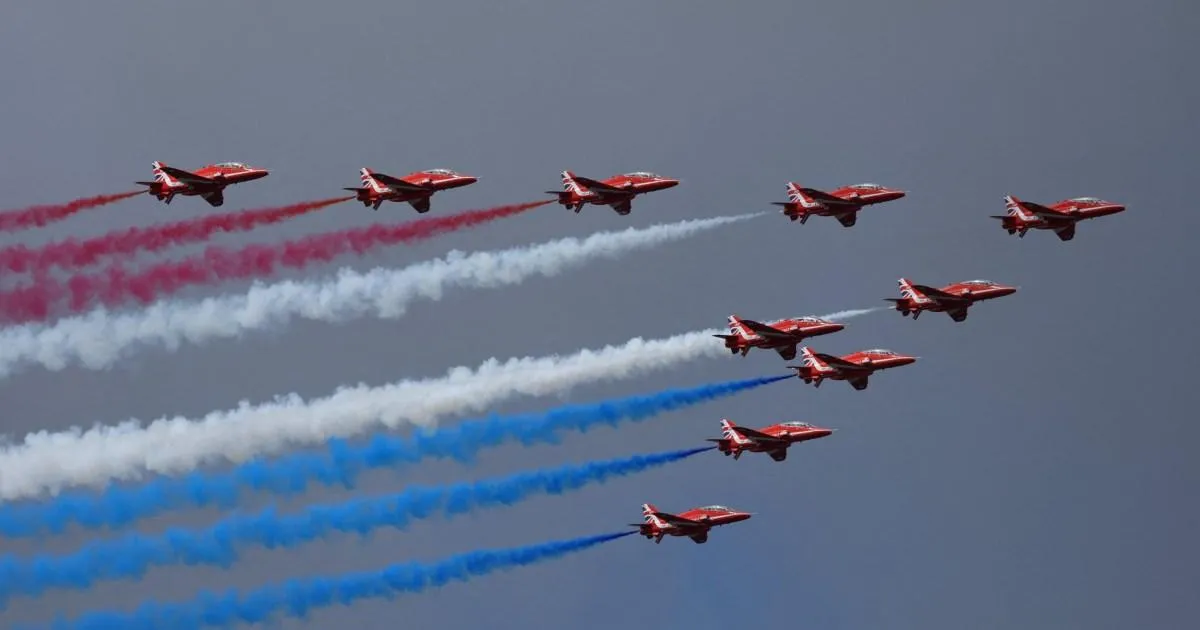
The iconic red silhouettes of the Royal Air Force Aerobatic Team, known globally as the Red Arrows, are a symbol of precision, pride, and British engineering excellence. Usually, their schedule is a tightly choreographed dance across the summer skies, bringing joy to thousands of spectators at airshows and festivals. However, nature has a way of reminding us that even the most sophisticated machinery and the most highly trained pilots are subject to the whims of the elements. Currently, the team finds themselves grounded in eastern Canada, caught in a logistical standoff with relentless weather patterns that have forced them to pause their return journey to the United Kingdom.
The predicament began while the team was nearing the conclusion of “Operation Eagle Hawk,” an ambitious tour of North America designed to commemorate the upcoming 250th anniversary of the Declaration of Independence. Because the Red Arrows utilize single-engine Hawk aircraft—jets that are not equipped for mid-air refueling—their journey back across the Atlantic is a complex, multi-stage mission. The flight path requires them to hop from the United States to eastern Canada, then onward to Greenland and Iceland, before finally touching down on home soil. Unfortunately, a prolonged and unforgiving bout of poor weather hit them early in the journey, creating conditions deemed too hazardous for the team to continue their delicate cross-ocean transit.
As a result of this involuntary stopover, the Red Arrows have been forced to pull out of several cherished events back in the UK, including the Airbourne: Eastbourne International Airshow, the Royal Edinburgh Military Tattoo, and Lyme Regis Lifeboat Week. For the organizers and the thousands of families who look forward to these displays every year, the news comes as a significant disappointment. While the events themselves will continue as planned, the absence of those signature red plumes of smoke will undoubtedly be felt, leaving a noticeable void in the summer sky where the roar of the jets should have been.
Wing Commander Sasha Nash, the officer commanding the Red Arrows, was quick to express the team’s sincere regret regarding the cancellations. In a measured and responsible tone, she emphasized that while the team is eager to return to their busy display schedule, safety remains the singular, non-negotiable factor governing their actions. There is no room for bravado when navigating the harsh realities of transatlantic aviation; when the weather refuses to cooperate, the only professional choice is to wait. The team’s commitment to safety is a testament to the discipline that defines them, ensuring that they do not just perform, but do so with the absolute security of their crews and aircraft in mind.
Rather than letting this downtime go to waste, the team has taken a pragmatic approach to their isolation in Canada. They have proactively rearranged their technical schedule, opting to perform necessary engineering maintenance on the Hawk jets while abroad rather than waiting to reach the UK. By shifting these critical tasks to the Canadian leg of their journey, the team is working to ensure that once they are finally airborne again, they can hit the ground running. This strategic pivot is designed to maximize efficiency and minimize further disruption, allowing the pilots to transition back into their 2026 program as smoothly and quickly as possible once the skies clear.
Looking toward the horizon, there is a tangible sense of optimism regarding the team’s eventual return. The current plan suggests that spectators will be able to reunite with the Red Arrows at the Cromer Carnival and Air Display on August 19, marking a welcome return to the display circuit. From there, the team is set to travel to Sweden to participate in the centennial celebrations of the Swedish Air Force in Linköping. While the weather may have forced a temporary detour, the spirit of the Red Arrows remains undaunted. It serves as a gentle humanizing reminder that despite our technological advancements, we still live at the mercy of the atmosphere, and that patience is often the most important tool in an aviator’s kit.