

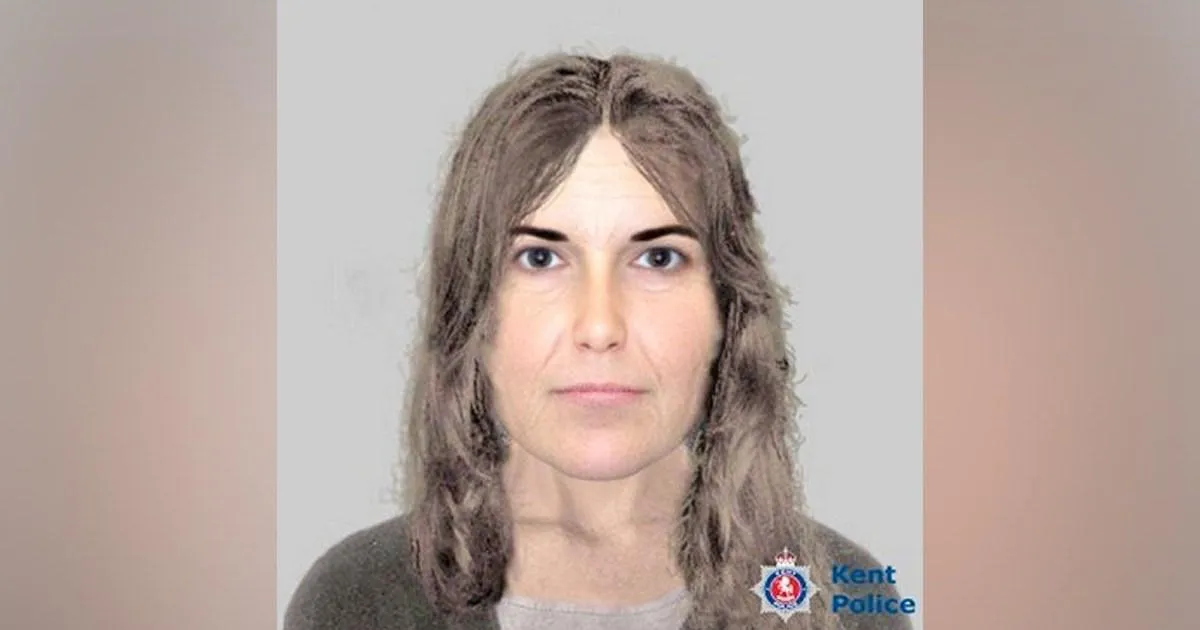
For more than three decades, a small cluster of flowers and a quiet grave in Bybrook Cemetery have marked the final resting place of a child the world never got to know. The headstone does not bear a mother’s surname or a family’s last goodbye; it simply marks the spot where a newborn known only as Baby April was laid to rest after her tiny body was discovered discarded at Singleton Lake in Ashford, Kent, on April 3, 1995. It is the kind of case that stays with people, not just because of the brutality of the circumstances, but because of the emptiness left behind—no name, no parents, no answers, and no one to mourn at the graveside except perhaps the one person who might hold the key to the mystery. Now, in a development that has quietly reignited hope among detectives after nearly thirty years, police have released a computer-generated e-fit of a woman seen standing at Baby April’s grave on the afternoon of June 21 this year. She appeared distressed, according to witnesses, and lingered long enough for her presence to be reported to officers. That single sighting has led to a fresh wave of leads, new lines of inquiry, and a renewed determination to finally give this baby a name and a story.
The circumstances surrounding Baby April’s death are as heartbreaking as they are baffling. On that cold April morning in 1995, her body was discovered in a Kleenex tissue bag near the water at Singleton Lake, a local beauty spot in Ashford. The newborn had clearly not been alive for long, and a post-mortem examination later determined that she had died of asphyxiation. Yet despite the best efforts of Kent Police at the time, the investigation ran into a wall of silence. Her mother was never identified, her father never traced, and no relative ever came forward to claim her. In the initial weeks after her body was found, detectives arrested a suspect, but that person was ultimately released without charge, and the trail went cold. The case file, thick with witness statements and forensic reports, sat in evidence rooms for years, occasionally revisited but never solved. Then in 2011, in a last-ditch effort to crack the case, police exhumed Baby April’s body from Bybrook Cemetery in order to extract a full DNA profile. The hope was that modern forensic science might finally match her genetic code to a potential parent or relative. But even that painstaking procedure led to no breakthrough, and the little girl remained as anonymous in death as she had been in life.
It is against that backdrop of frustration and failure that the June sighting has taken on such significance. On the afternoon of June 21, someone noticed a woman standing at Baby April’s grave, visibly upset and lingering for some time. The woman was described as white, in her 40s, no taller than 5ft 7in, and of medium to slim build with a pale complexion. She was dressed simply, in a grey short cardigan, black leggings, and trainers, and she carried two bags—a small shoulder bag and a fuller-looking fabric holdall with a floral pattern that she wore across her body. At first, this may sound like a mundane description of an ordinary visitor to a cemetery. But in the context of a thirty-year-old cold case involving a baby with no known relatives, her presence at that specific grave is far from ordinary. Police have not gone so far as to say she is the mother, nor have they identified her as a suspect. What they have said is that the woman may have important information, and that her emotional reaction at the graveside suggests a connection that the investigation has been seeking for years. The decision to release the e-fit was a deliberate one, made in the hope that someone in the Ashford community would recognize her and come forward.
The response, according to Detective Chief Inspector Neil Kimber, has exceeded all expectations. Kimber, who joined the investigation last year, spoke candidly about the renewed sense of momentum in a case that has often felt hopeless. He described the e-fit appeal as generating a flood of public cooperation, resulting in what he estimated to be more than 25 lines of inquiry for his team to pursue. Of those, he admitted that three or four looked “reasonably promising,” a cautious assessment from a detective who has learned not to let hope run ahead of evidence. But his tone was unmistakably optimistic. “The answers to this investigation are overdue but I am optimistic about the inquiries that we have got from that last appeal,” he said. “I didn’t expect to get as much as we did. The public are fantastic; they are all so willing to help.” Kimber, who inherited a case file that spans multiple generations of police officers, emphasized that the investigation would not be allowed to fade away again. “We’re not going to let it go,” he said. Behind those words lies a massive body of work: more than 180 statements taken over the years, in excess of 80 DNA samples collected, and countless theories examined and discarded. Yet none of it has produced a name for the baby who died alone in a plastic bag.
What makes this case so uniquely affecting is not just the tragedy of the death itself, but the vacuum left in its wake. There are no grandparents to demand justice, no siblings to hold vigils, no family photographs to circulate. Baby April exists only as a casefile, a grave, and a stain on the conscience of a community that has never forgotten her. The people of Ashford, Kimber noted, remain deeply invested in the mystery. “The public really need the answers to this as well because there is a lot of interest in it in the community in Ashford and in the wider country,” he said. “This is quite an emotional case and people are really coming forward to help us with it which I am so grateful for.” That emotional intensity is understandable. Almost everyone who hears the story wonders about the mother—was she a frightened teenager, an abused partner, a woman with no support system? Did she make the unbearable choice alone, or was someone else involved? Did she ever visit the grave in secret, carrying guilt and grief for decades? The image of a distressed woman standing over that grave in 2025, nearly thirty years after the death, suggests that someone, somewhere has never been able to let go either. The human heart is complicated, and this case has always felt personal to the investigators who have handled it, precisely because it is about the most basic of bonds—mother and child—and the most inexplicable of betrayals.
Now, as the autumn months settle in, the investigation is at a crossroads. DCI Kimber acknowledged that the new leads could be pivotal, or they could send the team back to the drawing board. “We have a number of lines of inquiry and they could be really key or it could be back to the drawing board,” he said. That honesty is refreshing, but so too is the dogged persistence. After all these years, no detective is obliged to keep digging. Yet Kimber and his team have chosen to, driven by the simple belief that Baby April deserves more than a stone that will eventually weather beyond recognition. They are appealing once more for information, not just about the woman at the grave, but about anyone who might have known the circumstances of the newborn’s brief life. They want to hear from anyone who remembers a pregnant woman in 1995 who appeared suddenly without a child, or who seemed haunted by a secret. They want to know who the woman in the grey cardigan was, and why she came to stand over that forgotten grave. Perhaps she was a witness, a grandmother, a Good Samaritan, or perhaps she was the one person who has carried the greatest burden of all. The answers, as they always have been, lie somewhere in the memory of Ashford. The case may be decades old, but it is not closed. Baby April is no longer just a photograph and a file; thanks to one woman’s mournful visit, she is once again a living question, and the search for the truth has never been more alive.