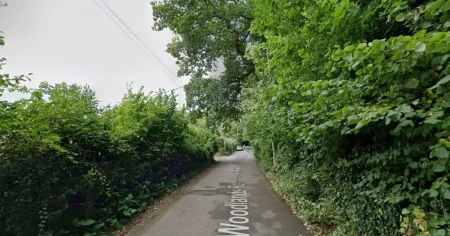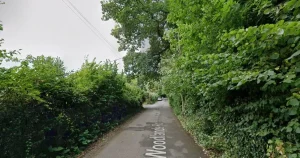
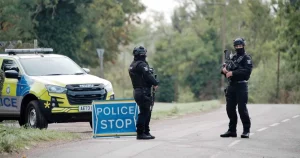

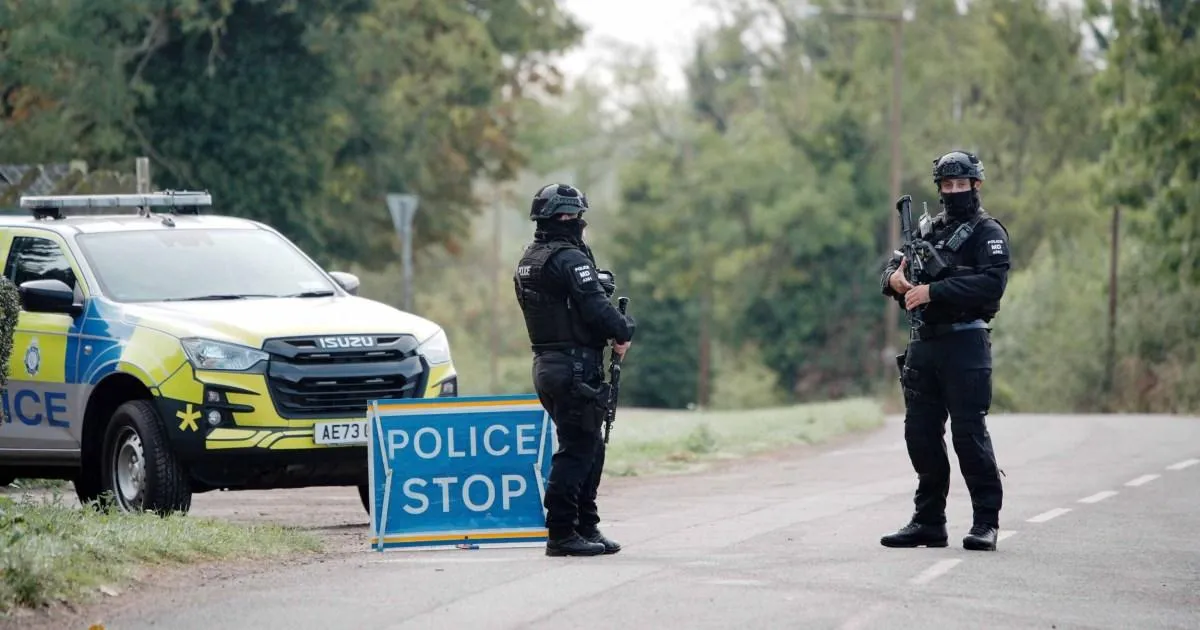
The quiet Cotswolds village of Whelford, Gloucestershire, had always been the kind of place where the loudest disturbance was the low hum of tractors at dawn and the distant bleating of sheep across dewy fields. But on a tense afternoon that jolted the world’s attention toward this bucolic corner of England, that peace was violently shattered. A local farmer, going about her ordinary day, found herself face-to-face with a nightmare. She spotted three white vans parked on a driveway near her land, surrounded by a group of men who were unmistakably out of place in the rural idyll — hooded, masked, all dressed in similar dark clothing, their bodies described as “fit and young.” Something primal told her this was wrong. When she bravely confronted the scene, the men scattered like shadows, several of them sprinting into the nearby woods and disappearing among the trees. Without hesitation, she raised the alarm, calling 999 and setting off a chain of events that would bring bomb disposal robots, armed response units, and counter-terrorism detectives to her doorstep. Her instinctive bravery, born of simple vigilance rather than training, may well have saved lives. But as the robots carefully inspected the abandoned white vans and police sealed off the area, the enormity of what she had stumbled upon began to dawn not only on her, but on the entire nation — the UK was facing a potential terror bombing plot on the doorstep of a working military airbase, and the sleepy village of Whelford was suddenly on the world map for all the wrong reasons.
RAF Fairford is no ordinary installation. It hosts American forces and has served as a vital strategic hub for US military operations, a fact that placed it firmly in the crosshairs of international adversaries long before the masked men arrived. According to security specialist Will Geddes of ICP Group Security, the base had been explicitly listed by the Islamic Revolutionary Guard Corps (IRGC) as a “legitimate and key target” for retribution. The reason is deeply rooted in geopolitics: RAF Fairford was used as a positioning and refuelling point for US bombers flying into Iran as part of ongoing conflict operations. To Tehran, the base symbolizes American military reach and the projection of power into the region, making it a high-value symbolic target. This was not idle speculation; local councillor Tristan Wilkinson confirmed that Fairford had come under “a specific threat about six weeks ago from the Iranians,” prompting security measures to be ramped up well before the dramatic arrest. Yet despite that forewarning, the reality of a plot materializing so close to home sent a chill through the community. Within the base, the atmosphere grew thick with tension — American police patrols moved through the perimeter, armoured vehicles were seen on the tarmac, and personnel who had grown accustomed to the routine hum of military life were suddenly reminded that they were living and working in a potential target zone. The high alert extended beyond Fairford to other UK military bases, with security services on edge and the public left to wonder just how close the nation had come to catastrophe.
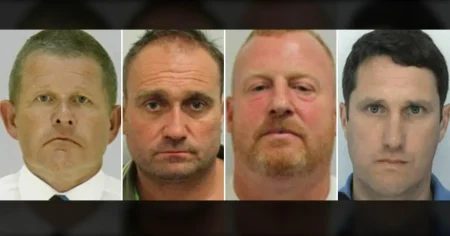
The investigation into the five arrested men, detained on suspicion of explosive and terrorism offences, quickly turned its attention to a familiar and formidable foe: Iran. Geddes, evaluating the available details, pointed to several damning factors. The first was the pre-existing IRGC designation of RAF Fairford as a target for retribution, establishing clear motive. The second was the nature of the suspected plot itself. While authorities have not publicly confirmed the type of potential explosives found in the white vans, Geddes suggested they may have been improvised explosive devices, or IEDs — a tactic he argued “doesn’t fall within the standard Russian profile and modus operandi.” Instead, he said, the operation bore “all the hallmarks of Iran rather than Russia.” There was also the disturbing pattern of how such plots are orchestrated. Iranian sleeper cells operating abroad are known, according to security experts, for hiring “low-level criminals” and allegedly paying them relatively small sums of money to carry out high-risk attacks. This transactional approach is both chilling and pragmatic — it shields the regime from direct accountability while exploiting vulnerable individuals willing to trade their freedom, or even their lives, for modest financial reward. The suspects, in this reading, were not necessarily ideologically driven foot soldiers but rather hired pawns in a broader geopolitical chess game, a reality that makes the threat all the more insidious because it widens the pool of potential operatives and makes detection harder. For the residents of Whelford, the realization that their village had become a stage for such shadowy machinations was deeply unsettling.
When former President Donald Trump weighed in on the incident, his comments added another layer of intrigue to an already complex picture. He stated that the men had been “under view for a long time” and that “we had them under investigation,” suggesting the arrests were not the product of a lucky break but the culmination of sustained intelligence surveillance. Geddes interpreted these remarks as confirmation that the operation was led by intelligence services such as the CIA and MI5, with the actual intervention likely carried out by UK special forces. This was a carefully choreographed takedown, months in the making, designed to neutralize a threat before it could materialize. Yet despite the tactical success, there was a troubling loose end that nagged at the brave farmer who first raised the alarm. She expressed surprise, Geddes revealed, that police made no mention of the other individuals who managed to escape and run into the woods. Her concern was valid. She had seen multiple men; only five were arrested. Where were the others? Geddes warned that the situation was far from over, noting that other individuals connected to the plot may well have escaped. His concerns were underscored by the continued high alert status of two other air bases and other government facilities in the area. The operation may have disrupted one cell, but the network, or remnants of it, could still be at large — a deeply unsettling thought for a community already rattled by the prospect of terrorists hiding in their woods.
As the investigation moves forward, the focus shifts to the painstaking work of tracing the suspects’ connections and intentions. Counter-terrorism detectives are expected to search the arrested men’s phones and homes, painstakingly mapping their communications to establish exactly who they had been talking to and, crucially, who had “tasked them to do this.” This forensic phase is essential not only for building a prosecution but for identifying other potential threats and preventing future attacks. At the political level, the government is preparing to respond decisively. Reports suggest that Prime Minister Andy Burnham could convene an emergency Cobra meeting to coordinate the national response, and there are indications that the UK’s national terror threat level could be raised from severe to critical — a step that signals an attack is believed to be imminent or that one has already occurred. Defence Secretary Wes Streeting, while cautioning that it was “too early to attribute background aims,” struck a resolute tone in the face of Iranian sabre-rattling. He insisted that the UK should not be “cowed” by such intimidation, nor allow Tehran to dictate Britain’s foreign policy. His words were a firm statement of defiance, aimed both at domestic audiences seeking reassurance and at Iran, making clear that attempts to intimidate the country would not succeed. Yet for ordinary citizens, the rhetoric of resilience is cold comfort in the aftermath of a near-miss. The threat level, the emergency meetings, the armed patrols — these are visceral reminders that the danger was real and that the nation’s security apparatus is now operating in a heightened state of vigilance that may persist for many months.
Iran, for its part, has responded with categorical denial, dismissing any suggestion of involvement as “unfounded and malicious.” The regime’s London embassy framed the allegations as part of a campaign to “fuel Iranophobia propaganda in the UK,” a familiar rhetorical manoeuvre that shifts the narrative from evidence to accusation. For the villagers of Whelford, however, the geopolitical blame game feels abstract compared to the very real disruption in their midst. Their quiet lanes are now patrolled by police, their fields bordered by cordons, their small corner of England transformed overnight into a symbol of the global terrorist threat. The hero farmer, who went from anonymous rural worker to unwitting first responder, has become a local legend of sorts — a reminder that ordinary people can make extraordinary contributions to national security through simple alertness and courage. But as the media trucks eventually depart and the world’s attention moves on, the community will be left to grapple with the psychological aftermath of living at the edge of a target. The masked men who fled into their woods may still be out there, or they may have slipped away entirely, taking with them the secrets of a plot that came agonizingly close to fruition. What remains is a new reality for a village that never asked to be on the front line — one where the rustling of leaves might be mistaken for footsteps, where every unfamiliar van draws a second glance, and where the serene Cotswolds landscape now carries an undercurrent of unease. The bomb plot may have been foiled, but for the people of Whelford, and for the nation that now shares their vigilance, the shadow of what almost happened will linger long after the cordons are lifted.