

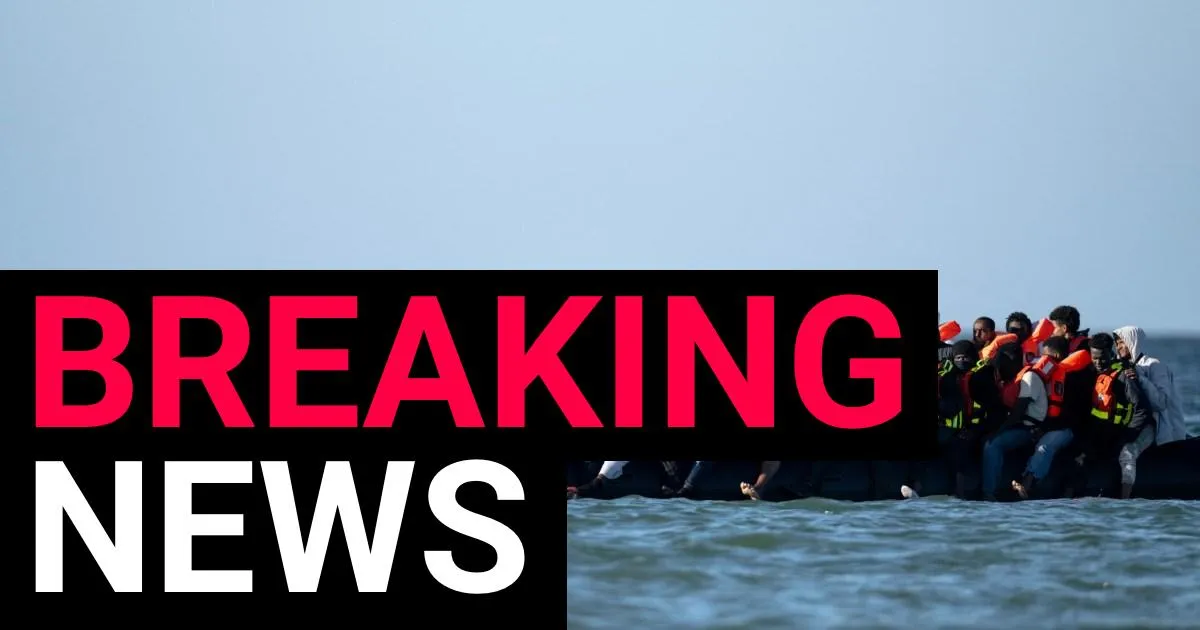
It was the kind of announcement that tends to slip past in the noise of a political conference, but for the people it concerns, it could mean the difference between life and death. In a room filled with delegates, party members, and the hum of political conversation, Shabana Mahmood stood before the Labour Party Conference and delivered a message that cut through the abstractions of policy and went straight to the oldest and most painful realities of borders, boats, and human hope. As she spoke, the English Channel once again lurked in the background, not as a symbol or a metaphor, but as a stretch of cold, unforgiving water where migrants aboard smugglers’ boats had just lost their lives. It was a stark reminder that behind every headline and every government speech lies a family torn apart, a mother’s desperate prayer, and a future thrown into the waves. Mahmood’s words, however, carried a note of something often missing from political debate: a sense of fairness, not just as a slogan, but as a lived, practical idea. The Home Secretary has announced new safe passages for refugees to enter the United Kingdom. Under this plan, charities will be able to sponsor refugees through new safe and legal routes from next month, and applications will be open for both a community sponsorship route and a student sponsorship route. But before anyone gets lost in the technical language, it is important to understand what this means. It means that instead of being forced into the hands of smugglers, instead of paying fortunes for a place on a flimsy dinghy, instead of watching the English coastline from a distance and wondering whether they will survive the crossing, some refugees will be welcomed through a doorway that does not require them to risk everything just to reach safety. It is not a complete answer, and no one pretends it is, but it is a beginning, and for some, that is enough to change the shape of a life.
The creation of these two routes, the community sponsorship route and the student sponsorship route, is not merely an administrative adjustment; it is an attempt to move away from the dangerous, chaotic, and often deadly unofficial crossings that have come to define so much of Britain’s migration debate in recent years. Under the community sponsorship route, charities and local community groups will be given the responsibility and the privilege of sponsoring refugees, essentially acting as a bridge between a person in need and a place to call home. It is a model that has been praised in other countries, one that shifts the relationship between refugees and the communities that receive them from one of suspicion and distance to one of mutual involvement and shared responsibility. Instead of a refugee arriving in a strange country and being placed in anonymous accommodation, they arrive into a network of people who have chosen them, who have committed to helping them settle, learn, integrate, and eventually thrive. The student sponsorship route, meanwhile, opens a door for refugees with educational aspirations, allowing them to pursue higher education in the United Kingdom under the sponsorship of institutions that see their potential, not just their need. This is more than a technicality. It is a recognition that refugees are not simply passive victims, but individuals with talents, ambitions, and a great deal to offer. It gives them a way to build a future that is not dependent on the whims of criminal networks. It also helps to humanize a debate that has, for too long, been dominated by dehumanizing language. When people speak of refugees as statistics, as burdens, as threats, they forget that a refugee is someone who could be a doctor, a teacher, a poet, a future contributor to the country that offered them safety. By allowing charities and universities to sponsor refugees, the government is taking a small but meaningful step toward remembering that truth.
Mahmood’s speech, though, was far from a triumphant victory lap. She used her platform not just to announce new measures, but to speak directly to the frustration and anger that many people feel about a system that has seemed, for years, to be broken beyond repair. “There is nothing fair about a lack of control at our borders,” she said, in words that echoed through the conference hall. It is a powerful phrase, because it speaks to a concern that is not exclusive to any one political party. A border that is uncontrolled is not a sign of compassion, and a country that allows criminal networks to decide who enters is not a country that cares about justice. Mahmood went on to make this point vividly, saying, “It is not fair that criminal gangs determine who comes to this country. It is not fair that they put dangerous boats into the water, with no regard for human life – shown once again today, with three more tragic deaths in the Channel.” Those words hung in the air with a heaviness that no policy document could capture. Three more deaths. Three more families who lost someone they loved. Three more lives that ended in cold water, far from home, all because a legal, safe path to sanctuary remained out of reach. It is a hard truth that while governments debate, negotiate, and announce routes, people die. Every day that passes without a safe way to claim asylum is a day when the smugglers, not the nation, are in control. That is why Mahmood’s framing mattered so much. She did not present compassion and control as opposites. Instead, she argued that genuine compassion requires genuine control, because when the system is chaotic, the ones who suffer are both the public and the very refugees that everyone claims to care about.
The Home Secretary also addressed another issue that is all too often forgotten in the political debate: the burden that has been placed on communities across the country. “It is not fair,” she said, “that those with a genuine need of protection cannot find a safe and legal way to claim asylum. It is also not fair that communities across this country have been asked to bear so great a burden, with around 90,000 people living in asylum accommodation.” This is a crucial point, because fair discussion of immigration must acknowledge that there are two sides to the story. On the one hand, there are refugees who face unimaginable peril and who deserve a chance to rebuild their lives in safety. On the other hand, there are local communities, towns, and cities that have, for many years, been left to cope with the practical and financial consequences of a national asylum system that has often failed to function properly. Housing 90,000 people in asylum accommodation is not a small thing. It puts pressure on local services, on schools, on healthcare, on housing stock, and sometimes on the patience and goodwill of residents who feel that they have been asked to carry a weight that should be shared more fairly across the whole country. Mahmood’s phrase, “to restore fairness, we must restore control,” speaks directly to this. It is an acknowledgment that a system which feels chaotic to the public will eventually produce a backlash, and that backlash will always hurt the most vulnerable. By restoring control, the government hopes not only to reduce the number of dangerous crossings, but also to rebuild public confidence in the asylum system, so that the public is more willing to support the compassionate measures that refugees need. It is a delicate balancing act, and there are no simple answers. But at the very least, the conversation is beginning to move beyond the false choice between open borders and closed hearts.
There were also signs, according to Mahmood, that the approach is beginning to bear fruit. She pointed out that small boat arrivals are down significantly, with this summer recording the lowest number since 2021. This is not a cause for celebration, because every small boat crossing still represents a person in danger, and every summer with too many deaths is still a tragedy. But it is a sign that policy decisions can make a difference. For years, the British public has been told that there are no easy solutions, that the problem is too complex, too vast, too difficult for any government to handle. And while it is true that no country can solve global migration alone, the reduction in small boat arrivals suggests that deterrence, combined with safe routes and international cooperation, can have a real effect. It matters because it gives hope that the system can be stabilized, that the Channel can become less deadly, and that the smugglers can be pushed out of business. It also matters because it undermines the fatalistic narrative that nothing can be done. If this summer really did see the lowest number of small boat arrivals since 2021, then it means that government action, public policy, and international agreements are not useless. They are tools, and they can be used properly. But those who follow the issue closely know that the numbers can fluctuate, and that one good summer does not mean the problem is solved. The work has to continue, and the safe and legal routes announced by Mahmood are an essential part of that ongoing effort. Without them, there is no true alternative to the boats, only a stronger wall, and a wall alone has never been enough to stop a mother from trying to save her child.
Ultimately, this is a breaking news story, and there is much more to follow. The details of these routes, how they will be funded, how many refugees will be able to benefit, and whether they will truly offer an alternative large enough to make a meaningful difference, remain to be seen. The political conference is a place of promises, and promises are easy; implementation is hard. But the announcement in itself is significant because it signals a shift in tone, a willingness to use the language of safety and legality rather than simply the language of deterrence. It acknowledges that refugees are not just problems to be managed, but people to be welcomed, students to be educated, community members to be embraced. For the families who have lost people in the Channel, this announcement does not bring anyone back. For those still waiting in camps, in temporary shelters, in the shadows of Europe, it may offer a glimmer of a path that does not require them to step into a fragile boat and pray. The human heart is resilient, but it is also fragile, and those who have been forced to leave everything behind do not ask for much. They ask for safety, for fairness, for a chance. The government’s message, if nothing else, is that those requests are being heard. There is still a long way to go, but perhaps, for the first time in a long while, the direction of travel is toward something more hopeful, more humane, and more in line with the best traditions of a country that has always, at its best, offered refuge to those who need it most.