



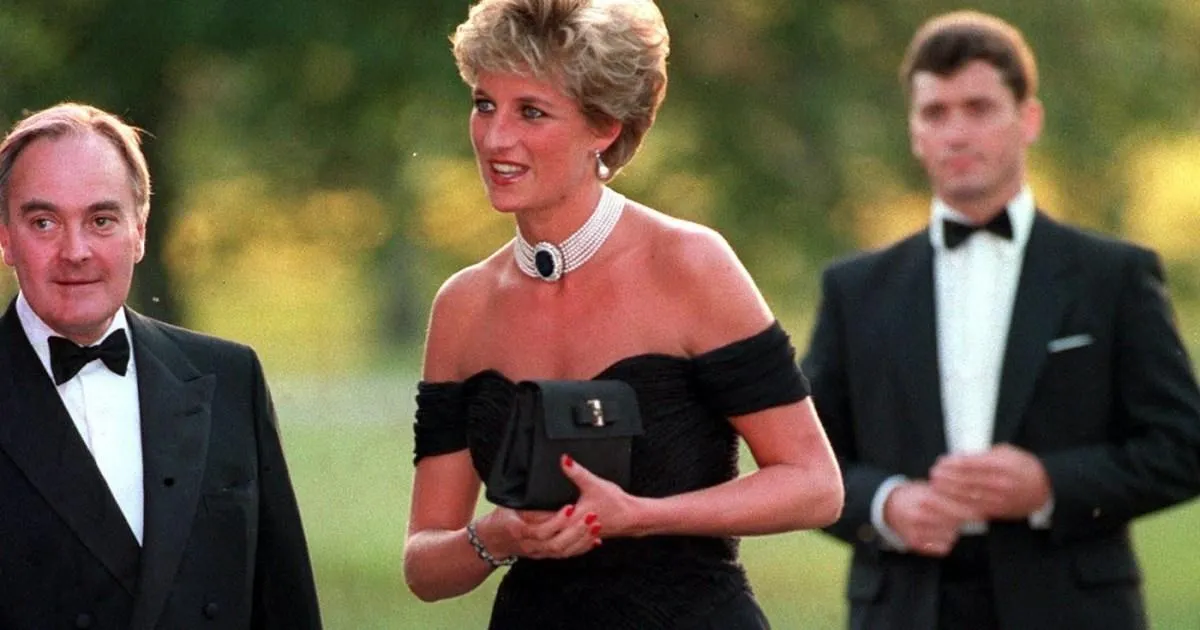
Some dresses are merely clothing; others are history, memory, and meaning sewn into silk. Princess Diana’s legendary “revenge dress” belongs firmly in the second category. More than three decades after it first stunned the world, the iconic black gown is about to step back into the spotlight, and this time it is not just a memory but a prized piece of auction history. The dress is expected to sell for a six-figure sum when it goes under the hammer at Sotheby’s in New York in December, with estimates ranging from £110,000 to £220,000. Before that, it will be displayed in London next month, offering fans, royal watchers, and fashion lovers a rare chance to stand before the very garment that captured a nation’s imagination on one of the most dramatic nights in modern royal history. It was 1994, and the world was watching: on the same evening that Prince Charles publicly admitted his infidelity on national television, Princess Diana stepped out in a black silk gown that seemed to speak louder than any words. The image of her emerging, composed and radiant, in that striking dress became an instant cultural touchstone—a moment of quiet defiance, dignity, and undeniable presence that has never faded.
The dress itself, designed by Christina Stambolian, was a statement long before it became famous. Worn by Diana to a Vanity Fair fundraising dinner at the Serpentine Gallery in London, it defied every traditional expectation of royal attire. Black was considered too bold, the plunging neckline too daring, the above-the-knee hemline too modern for a princess trapped in a world of stiff etiquette and unspoken rules. Yet Diana wore it with an elegance that silenced the critics. She paired the dress with a choker made from a royal brooch, a black clutch, and black pumps, completing an ensemble that has since been hailed as one of the most influential fashion moments of the twentieth century. The dress did not just make headlines; it reshaped how the public understood Diana. She was no longer simply the wronged wife or the shy princess—she was a woman in control of her own image, choosing to show the world exactly what she wanted them to see. The outfit broke rules, but more importantly, it communicated something profound: resilience, strength, and an unshakable sense of self. Decades later, that message still resonates, which is why the dress remains so revered by fashion historians, royal commentators, and everyday admirers alike.
Now, the dress is set to embark on a new chapter as it returns to the auction block for the first time since 1997. That year, in one of the most memorable charitable acts of her life, Diana sold seventy-nine of her dresses to raise funds for cancer and AIDS charities. The upcoming sale, part of Sotheby’s luxury week in New York, will be a moment of both spectacle and sentiment. A portion of the proceeds will be donated to NHS Lothian Charity on behalf of the Royal Edinburgh Hospital, a cause devoted to funding extra care, equipment, and projects that make a real difference in people’s lives. The dress will not travel alone; it will be accompanied by a copy of the original auction catalogue, numbered and signed by both Diana and the Greek designer Christina Stambolian. In a touching and somewhat unexpected detail, the catalogue credits the Prince of Wales with the idea of the charity fundraiser—evidence that even amid the complexities of their relationship, moments of collaboration and shared purpose existed. This fusion of fashion, charity, and royal history makes the upcoming sale particularly moving. It is not simply about owning a piece of clothing; it is about preserving a piece of a story that touched millions of people around the world.
Before the live sale on December 9th, the dress will travel the globe, allowing people from different cultures and generations to witness its power firsthand. Its exhibition tour includes stops at Sotheby’s locations in Hong Kong, Geneva, and New York, but for those in the United Kingdom, there is a particularly special opportunity. The public can view the dress in London from September 18th to September 24th at Sotheby’s auction house in the capital. For many, this will be a chance to stand inches away from a garment that defined an era. It is one thing to see photographs of Diana in that dress, to read about the night she wore it, or to hear the countless stories that have grown around it. It is another to be in its actual presence, to see the silk, the cut, the careful design, and to imagine the twenty-eight-year-old princess who wore it with such poise on one of the most difficult evenings of her life. The tour promises to give the dress a global farewell, allowing admirers to pay their respects to a piece of fashion that became a symbol of survival and self-reinvention.
The current owner of the dress, whose late husband originally purchased it during Diana’s 1997 charity sale, speaks about the garment with a tenderness that captures its true significance. “My late husband and I knew that this dress was something special,” they said. “Princess Diana was walking into the worst night of her life, and you would never know it to look at her. It went from a cocktail dress to a statement in the time it took to photograph her. Thirty years on, you can say the words anywhere in the world, and everyone knows exactly which dress you mean.” Those words are a reminder that the dress is not just about fashion or royalty; it is about human strength. The owner’s decision to part with it now, after holding onto it for nearly three decades, feels like a passing of the torch. By sending it to auction, they are giving others the chance to own a piece of that incredible story, while also contributing to charitable causes that continue Diana’s legacy of compassion and care. It is a poetic end to a remarkable journey—one that began with a private moment of pain and became a public display of grace.
Fashion, as Sotheby’s global head of handbags and fashion Morgane Halimi so beautifully put it, “can be a language when words fail or are simply not enough.” Princess Diana understood that instinctively, and perhaps no single garment proves it more than this dress. What made it extraordinary was not simply that it was worn by a princess, nor that its appearance at the Serpentine event made headlines around the world. It was what it communicated. “What became a global viral moment—long before social media made the term mundane—also gave licence to anyone, but especially women, to use fashion beyond adornment and much more intentionally and meaningfully: as a shield, a weapon or both,” Halimi reflected. “She walked into a moment in which so much of her story was being told for her and, through what she chose to wear, reclaimed the narrative for herself.” Those words capture the essence of Diana’s enduring magic. She was not merely a victim or a style icon; she was a woman who, even in her most vulnerable moments, understood the power of presentation. The black dress was her armour, her declaration, and her masterpiece all at once. More than thirty years later, it still has the ability to stop people in their tracks, to spark conversations, and to remind us that sometimes the truest form of strength is the quiet confidence to walk into the storm wearing your own story on your own terms. And as the world prepares to bid on this unforgettable piece of history, one thing is certain: Diana’s dress will never be forgotten.