
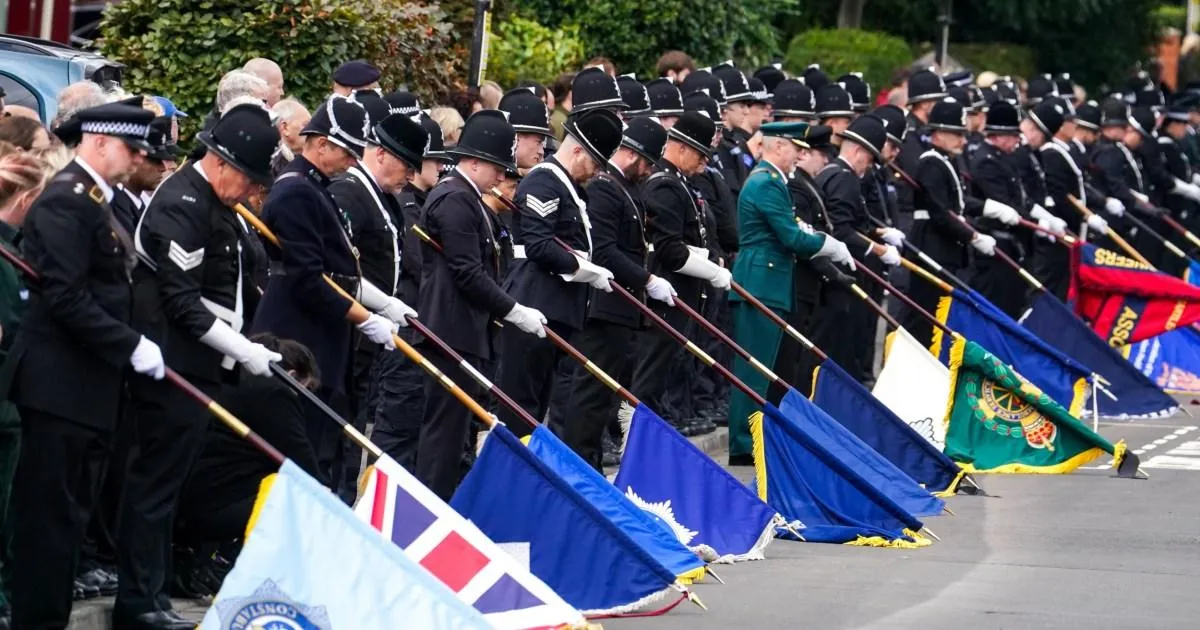
The morning had the weight of grief pressed into every step. Hundreds of police officers stood shoulder to shoulder along Hutton Avenue in Hartlepool, their white caps and dark uniforms forming a solemn corridor outside St Joseph’s Roman Catholic Church. They had come to say goodbye to PC Matthew Blades, an armed response officer whose life was cut short in a devastating head-on crash on the A66. The sight of the hearse approaching, led by a police motorcycle outrider, seemed to tighten the air. On its roof, a floral tribute spelled the word “Dad” in white and red blooms, a heartbreaking reminder that the man being honoured was not only a police officer but a husband, a father, a son, a brother and a friend. Matthew had been killed alongside his colleague PC Tom Clough, 38, when their marked police car was struck by a Passat that had been involved in an aborted pursuit. Five young men in the other vehicle also died. The scale of the loss was almost too much to hold. As the bagpipers began to play and the hearse drew closer, officers in white caps reached for one another, hugging and gripping shoulders, their faces etched with grief. Standard bearers lowered their flags. Four officers on horseback stood guard nearby. And behind the cordons, hundreds of members of the public watched in silence, many wiping away tears. The red-brick church, usually a place of quiet worship, had become the centre of a community’s shared sorrow. Some of the officers lining the pavement wore identity patches on their uniforms that read PC 2443 BLADES and PC 3234 CLOUGH, a quiet way of carrying both fallen men into the service. It was not just a police funeral. It was a community trying to make sense of a tragedy that had taken too many lives and left too many families shattered.
Inside and outside the church, the rituals of a police funeral unfolded with a precision that only made the emotion more raw. Four pipers and a drummer processed in front of the funeral car, their rendition of Amazing Grace rising and falling over the crowd. The coffin, draped in a Union Flag, was carried by pall bearers into St Joseph’s, while officers saluted and members of the public bowed their heads. Traffic officers, many of whom had worked alongside Matthew, hugged each other before the service, their white gloves gripping the backs of jackets as they tried to steady themselves. Black armbands embroidered with the names of both colleagues were worn by many, a small but powerful way of ensuring that neither man was forgotten. Representatives from the North East Ambulance Service and the Great North Air Ambulance stood among the mourners, a reminder that the emergency services are a family that grieves as one. Cleveland Police Chief Constable Victoria Fuller greeted people at the entrance, her presence a quiet sign of the force’s collective loss. Policing minister Sarah Jones and Home Office minister Anna Turley also attended, and political tributes were offered in Parliament. Andy Burnham, speaking in the Commons, said: “I also want to send our sympathies to the hundreds of people who will gather today at the funeral of PC Matthew Blades, including many serving police officers, and we send our thanks to them all for their service and their work to keep our communities safe.” The words from the Diocese of Hexham and Newcastle echoed the mood: “Today we remember in prayer PC Matthew Blades, who gave his life in service to others.” It was a sentence that seemed to hang in the air long after it was spoken, a reminder that the uniform is worn by someone with a name, a family, a story. For the officers standing in the cold, the service was both a goodbye and a promise that their colleague would not be forgotten.
Outside the church, the grief was not confined to those in uniform. Zara Lavender, 30, from Hartlepool, stood among the crowd and said she had come to pay her respects because it was important that people showed up. A former British Army soldier, who asked not to be named, explained that the turnout proved how much the community wanted to come together. “These guys did not deserve what happened to them,” he said. “The police have a hard enough job as it is.” His words captured a feeling that seemed to spread through the crowd: a mixture of anger, sorrow and gratitude. The support had been building since the news of the crash first broke. Flowers were left at police stations. Messages arrived from Australia, France and America. Social media filled with tributes. And a fundraising appeal for the families of Matthew and Tom passed £1.2 million, an amount that Cleveland Police Federation chairwoman Lauren Somerville described as overwhelming. “It’s been comforting,” she said. For the officers standing in the cold, that public support mattered more than they could say. Policing has become a harder job in recent years, with officers often facing suspicion or hostility. But on this day, the crowd was not there to judge. They were there to honour two men who had died doing their duty. The presence of so many ordinary people, standing quietly behind barriers, holding flowers and wiping tears, was a reminder that the bond between the police and the public is not broken. It bends, it strains, but in moments of tragedy it holds. The public’s presence also sent a message to the families of Matthew and Tom: you are not alone in your pain. The donations, the letters, the silence on the street corner — all of it was an attempt to wrap grieving families in a blanket of shared humanity.
Perhaps the most painful part of the day was the attempt to remember Matthew Blades as a person, not just a police officer. Lauren Somerville, speaking on behalf of the federation, shared words from his family that cut through the formality of the occasion. “Matthew was a best friend, husband, father, a brother and a son,” she said. “His family have said the words are not powerful enough to describe how they feel right now.” She described him as the heart of his family, someone who would be remembered beyond words today, tomorrow and always. “His family have said they’re going to miss everything about him more than words can say,” Somerville added. “His laughter and silly jokes made them smile even when they least expected it. He’s been described as bringing light and laughter into every room, and now life feels unbearably quiet without him.” Those details — the silly jokes, the light in a room, the unbearable quiet — are the things that make a loss so real. Matthew was not a statistic or a headline. He was a man who made people laugh, who loved his family, who chose a dangerous job because he believed in protecting others. His children will grow up with stories of their father, with the word “Dad” spelled out in flowers on the roof of a hearse, with the knowledge that their father was loved by thousands of people he never met. The funeral was a chance for the world to honour that life, but it was also a reminder that grief does not end when the service is over. For his wife, his children, his parents and his friends, the silence after the last bagpipe note will be the hardest part. There will be birthdays without him, holidays without him, ordinary Tuesday evenings without the sound of his laughter filling the house. And yet, the family’s words made it clear that his memory will be held close, carried forward in every joke told, every story shared, every moment when someone says, “Matthew would have loved this.”
The tragedy that brought so many people together began in the early hours of August 22, on the A66 near South Bank, close to Middlesbrough. Matthew and Tom were on duty, travelling in a marked police car in the correct direction, when a Volkswagen Passat that had been involved in a police pursuit — a pursuit that was later aborted — collided with them head-on. The impact was so severe that neither officer survived. Five young men in the Passat also lost their lives. In one horrifying moment, seven families were changed forever. The details of the pursuit, the decision to abandon it, and the circumstances leading up to the crash would later become the subject of scrutiny and investigation. But for those who loved the victims, questions could not bring anyone back. The loss of two armed response officers was a particular blow to Cleveland Police, a force that had already faced immense pressure and public scrutiny. Officers like Matthew and Tom are trained to run toward danger, to put themselves between harm and the public. They do so knowing that every shift could be their last. The fact that they died in a collision with a car involved in criminal activity only deepened the sense of injustice. And the deaths of five young men, with their whole lives ahead of them, added another layer of sorrow to a tragedy that seemed to have no limits. In the days that followed, the city and the country tried to process the scale of the loss. But grief on that scale cannot be processed quickly. It lingers in the empty chairs at dinner tables, in the unanswered messages on phones, in the quiet moments when someone reaches for a loved one who is no longer there. It lingers in the police station, where lockers remain decorated with tributes, where colleagues walk past photographs and pause, where the absence of two familiar faces is felt in every briefing room.
Funerals are for the living as much as for the dead. They give shape to grief, a way to stand together and say: this mattered. The funeral of PC Matthew Blades was exactly that — a moment for a community to hold its breath, to lower its flags, to stand in the cold and pay tribute to a man who gave his life in service. But it was also a moment to remember PC Tom Clough, and the five young men who died in the same crash. Their names may not have been on the armbands, but their loss was part of the same terrible story. In the days and years to come, the memory of that morning on the A66 will remain with everyone who witnessed it. For Matthew’s family, the pain will not fade; it will simply become something they learn to carry. For his colleagues, the sight of an empty seat in the briefing room, the silence where his laughter used to be, will be a constant reminder of what was lost. And for the public, the image of hundreds of officers standing together, hugging one another, crying without shame, will serve as a reminder that police officers are human too. They feel fear, they feel grief, they feel love. They do a job that most of us could not do, and sometimes they pay the ultimate price. The £1.2 million raised for the families, the flowers at police stations, the messages from around the world — these are not just gestures. They are promises that Matthew and Tom will not be forgotten. As the last mourners left St Joseph’s and the streets of Hartlepool began to return to normal, the silence was heavy. But so was the gratitude. PC Matthew Blades served his community to the very end. And in the hearts of those who stood along Hutton Avenue, he will always be remembered as more than a police officer — a father, a husband, a brother, a son, and a man who brought light into every room he entered.