
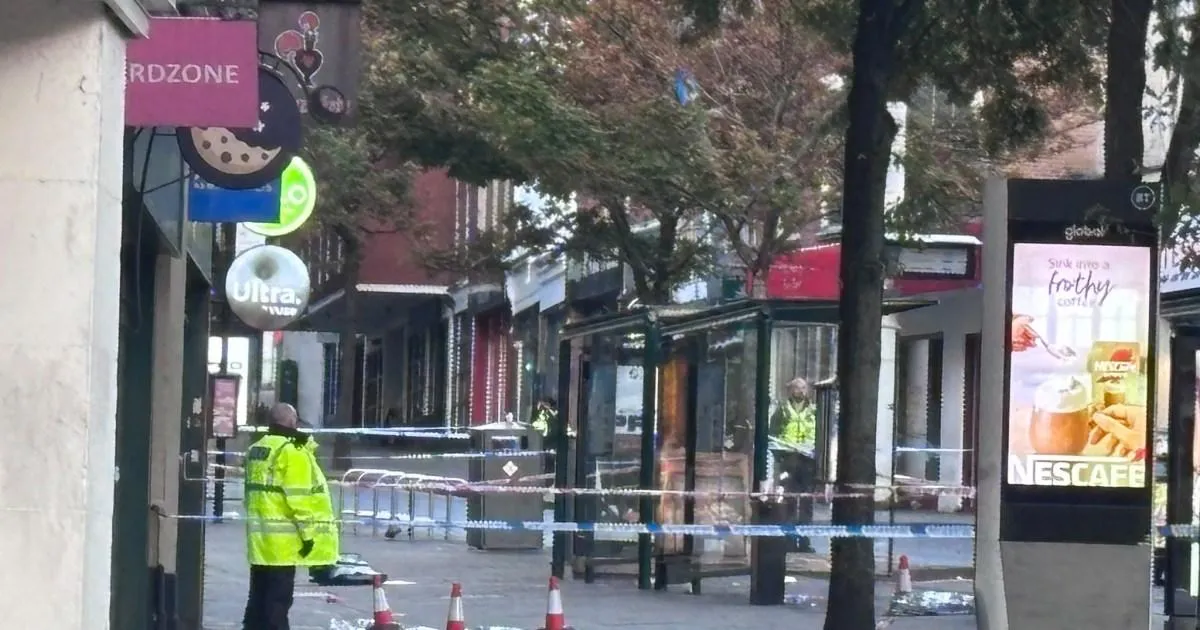
In the long, grey hours before dawn, when the streets of Nottingham should be quiet and still, a sound that no one ever expects to hear shattered the silence: a gunshot. It was not a car backfiring, not a door slamming, not a firework. It was a weapon fired at a police officer, and within seconds, the ordinary morning had become something terrifying. The city was still mostly asleep. Lamplight pooled on damp pavements, and the few people who were awake—night-shift workers, early commuters, insomniacs looking out of windows—could not have known that a young officer was about to become another name in the long, painful history of police officers harmed in the line of duty. At around 4.50am, that officer approached a man and a woman in the area of Angel Row, a street that would be busy with shoppers and office workers just a few hours later. What he expected was probably a simple conversation, a routine enquiry, the kind of interaction that police officers perform every single day without incident. Instead, he was shot in the foot. The suspects did not stay to face the consequences. They turned and ran into the darkness, leaving behind a wounded man, a discarded firearm, and a community that would soon wake to the shocking news. By the time the sun rose, the city centre had been transformed. Police tape stretched across pavements, officers in high-visibility jackets stood at every corner, and forensic teams moved slowly across the ground, looking for clues. The officer was rushed to hospital, his life not in immediate danger but his ordeal only just beginning. A firearm had been recovered, a significant break for investigators, but the two people responsible were still out there, somewhere, free.
The details that have emerged so far paint a chilling picture of how quickly a routine patrol can turn into a nightmare. The officer approached the man and woman at a time when the streets were nearly empty. It is impossible to know what words were exchanged, whether there was a moment of tension, or whether the gun was produced without warning. What is known is that a shot was fired, and the bullet struck the officer in the foot. That injury, while not typically life-threatening, is painful and dangerous. Feet contain dozens of small bones, tendons and nerves, and a gunshot wound to that area can require multiple surgeries, months of rehabilitation, and leave permanent physical and psychological scars. The suspects abandoned the weapon at the scene, a decision that may prove to be their undoing. Every firearm has a history. It can be traced, tested, analysed. Fingerprints, DNA and gunshot residue can link the weapon to the hands that held it. But the recovery of the gun is only the beginning of a much larger investigation. Who were the suspects? Why were they out so early? Were they involved in other crimes? Did they intend to shoot the officer, or did they simply panic? The fact that one of them was a woman complicates the picture, reminding us that violence does not conform to simple stereotypes. Investigators will now be working tirelessly to answer these questions. They will review CCTV footage from the surrounding streets, hoping to catch a glimpse of the pair as they fled. They will visit homes and businesses, speaking to anyone who might have seen something unusual. They will analyse the recovered weapon, searching for any trace of its origin. And they will wait, perhaps with a grim sense of certainty, for the suspects to make a mistake. In a city that is now on high alert, mistakes are likely.
The human cost of this shooting cannot be measured in police statistics or news headlines. Behind the blue lights and the police tape is a real person, an officer who woke up that morning, put on his uniform, kissed his loved ones goodbye and went to work to protect people he had never met. He did not know that within a few hours he would be lying on the pavement, bleeding and in shock, waiting for help to arrive. His family are at the hospital now, their hearts racing, their minds filled with fear and relief and anger. His colleagues are walking the same streets he patrols, looking over their shoulders, thinking about how easily it could have been them. The police service is often described as a family, and like any family, when one of its own is hurt, they all feel the pain. East Midlands Ambulance Service, who responded to the scene, sent a message that was both simple and deeply moving: “Sending our heartfelt thoughts and support to the injured officer, his family, and all our colleagues at Nottinghamshire Police today. We’re wishing him a full and speedy recovery.” Those words reflect a bond that exists between the emergency services, a shared understanding of the dangers they face and the duty they carry. The paramedics who treated the officer did not just do their job; they cared for him as if he were their own brother. In the chaos of the early morning, amidst the sirens and the shouting and the fear, there was also tenderness. There were hands applying pressure to the wound, voices telling him to stay calm, and a stretcher carrying him into the back of an ambulance. That is the human story behind the headline, and it is one that deserves to be told.
Assistant Chief Constable Claire Rukas, of Nottinghamshire Police, described the shooting as “a shocking incident and a sobering reminder of the potential dangers faced by officers as they work to protect and serve the public.” Her words are carefully measured, but they carry an undeniable weight. “Shocking” is the right word, because police officers in the United Kingdom are not routinely armed, and shootings of police officers are rare enough to feel almost unthinkable. “Sobering” is also right, because it strips away any illusion that policing is just a job like any other. Every officer who hears that statement will feel a chill, knowing that they too could face a similar situation on any given night. Rukas continued: “As we investigate what happened and work to apprehend the individuals involved, my thoughts today are with the injured officer, his family and colleagues.” And then she made a direct appeal to the public: “I also ask that anyone with additional information shares this with us without delay. Even the smallest bit of information could make all the difference to this investigation.” This plea is not a formality. In cases like this, members of the public are often the key to solving the case. A taxi driver who saw a couple acting strangely. A delivery worker who noticed someone running. A resident whose doorbell camera captured a flicker of movement. A friend or acquaintance who heard someone bragging about escaping from the police. Any one of these fragments, no matter how small, could help detectives identify the suspects and bring them to justice. But time is of the essence. The longer the suspects remain free, the harder it becomes to catch them. They may leave the city, dispose of clothing, or find somewhere to hide. The police are doing everything they can, but they cannot do it alone. They need the community to stand with them, to share what they know, and to refuse to let fear or silence protect those who fired the shot.
This incident is a reminder of the fragile boundary between safety and danger, and of the silent courage that police officers display every day. Most of the time, we hardly notice them. They are figures on street corners, cars parked in lay-bys, faces behind the window of a police station. But when something goes wrong, we expect them to appear, to take control, to resolve the situation. We ask them to run towards danger while everyone else runs away. We ask them to make split-second decisions with enormous consequences. And we expect them to do all of this with calmness and professionalism, even when their own lives are at risk. The officer shot in Nottingham was doing exactly what we expect of our police. He approached two people in the early hours because that is his job. He did not know they were armed. He did not know that they would be willing to fire. But he approached them anyway, because that is what it means to serve. His injury is a wound not just to him, but to the entire community. It is a reminder that the safety we often take for granted is purchased at a high price, paid by men and women in uniform who cannot know what the next call will bring. Nottingham has known tragedy before. It has experienced violence that has left deep scars and grieving families. This shooting will inevitably reopen some of those wounds, stirring up fear and anxiety. But it also brings an opportunity for the city to show its resolve. Police officers will not abandon the streets because of one attack. They will double their efforts. They will work longer hours, follow every lead, and do everything in their power to make sure that the people responsible are caught. And the public, too, will respond. Captured by shock and anger, they will pay attention, share appeals, and perhaps offer the vital clue that breaks the case.
As the investigation continues and the police cordon remains in place on Angel Row, the city of Nottingham holds its breath and its hope. The injured officer is in hospital, beginning what will likely be a long and difficult recovery. He will have moments of pain, frustration and fear. But he will also have the support of his family, his friends and his entire police family, as well as the gratitude of a public that owes him more than can ever be repaid. We wish him a full and speedy recovery, and we hope that the headlines tomorrow bring news of arrests rather than further questions. The man and woman who shot him are still at large, but they cannot run forever. Their faces will be seen on CCTV. Their voices will be remembered by someone who knows them. Their confidence will crack, and someone will make a call to the police. That is how these cases are solved: not by luck, but by dogged investigation and public cooperation. Assistant Chief Constable Claire Rukas asked for even the smallest piece of information, and she was right to do so. If you were in the Angel Row area in the early hours, or if you saw a man and a woman behaving suspiciously, or if you heard a sound that could have been a gunshot, please contact Nottinghamshire Police. Do not assume that what you know is unimportant. It might be the exact piece of evidence that detectives are missing. This shooting was an attack on one officer, but it was also an attack on the idea that our streets can be safe, that order can prevail over chaos, and that those who serve us can go home at the end of their shifts. We cannot let that idea be destroyed. We must stand with our police, support them in their work, and make it clear that violence against them will never be tolerated. The road ahead will not be easy. The officer’s recovery will take time, and the investigation will require patience. But Nottingham is a resilient city, and it will not be defined by a single moment of darkness. In the days and weeks ahead, healing will begin. The cordon will come down, the forensic teams will leave, and the street will return to its ordinary rhythm. But the memory of what happened will remain, a reminder of the cost of safety and the courage of those who protect us. And in that memory, there will also be hope: hope for recovery, hope for justice, and hope that from this painful moment, a stronger and more united community will emerge.