


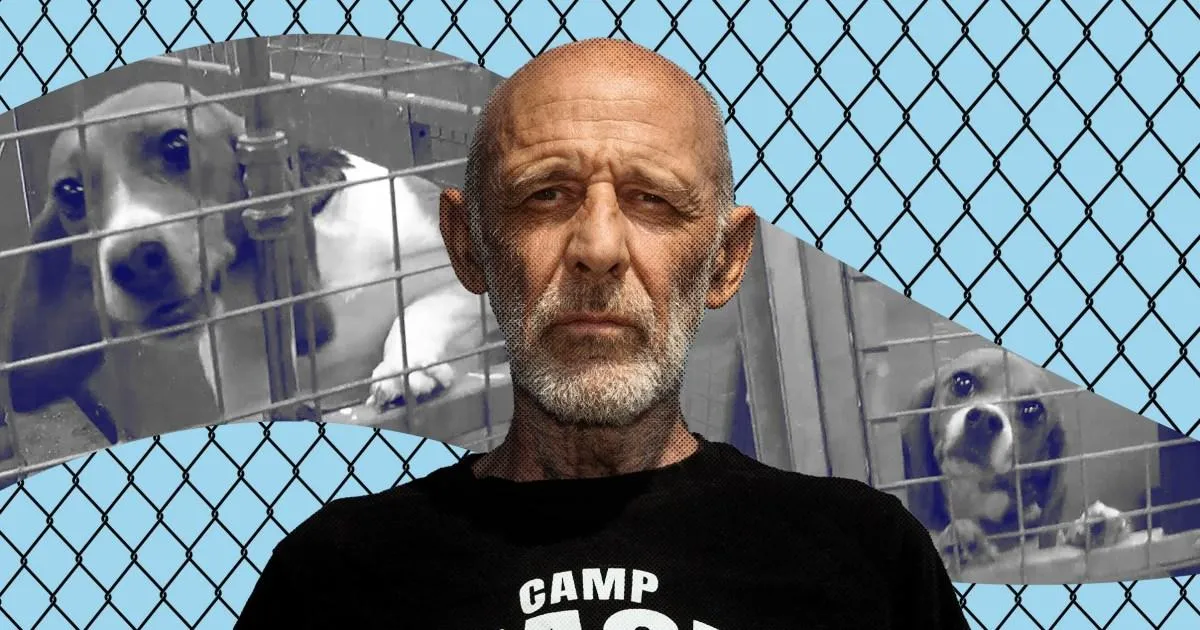
For five years, John Curtin has heard the sounds of dogs whining and whimpering. They are not occasional sounds, and they are not easy to ignore. They drift across the road from MBR Acres, a licensed breeding facility in Wyton, Cambridgeshire, that supplies beagles for laboratory research, and they have become the soundtrack of his life. The 63-year-old animal welfare activist is a long-term resident of Camp Beagle, a legal protest camp set up in 2021 to demand the facility’s closure. The camp began spontaneously, and Curtin, despite his decades of commitment, was wary at first. “When I found out about this spontaneous camp, I gulped. I kept away for the first week – if I go to this thing, I’m going to get trapped,” he says. That first week ended long ago. Today he is one of the first faces new camp-goers see and one of the camp’s “spokespeople.” He is also a permanent camper, a fixed point in a shifting protest community. People arrive from around the world; Sole Iriart, a midwife from Spain, says some travel from as far as Tasmania and Canada to stand with the camp, even if only for a short time. “It’s quite a special place,” she says. It is also a cold and exposed place, a roadside cluster of tents, banners, and makeshift shelters, held together by conviction and routine. For five years it has existed in the shadow of MBR Acres, close enough to hear the animals and far enough from ordinary life to feel like another world. At night, when the road is quiet and the activists are tired, the dogs’ voices drift through the dark. They are not just symbols; they are individual beings, and the campers have learned to know them. Every new arrival is offered a place to sleep and a hot drink, and every long conversation ends with the same unresolved question. It is a community built not around a building but around a shared refusal to look away.
The camp has a curious rhythm, ordinary domestic moments interrupted by moments of intense pressure. Some days are slow, filled with waiting, talking, and making tea. Other days change everything. On October 6, Curtin was in the middle of one of those ordinary moments. A woman had stopped by the camp, and he offered her a cup of tea. Then he saw eight police officers walking toward him. He was arrested on suspicion of conspiracy to burgle, after a number of dogs were allegedly taken from MBR Acres in September. Curtin says he knew it was coming. “I knew they were going to come for me because I’m the face of Camp Beagle.” He denies wrongdoing and has been released on bail. But the arrest was not gentle. He says police “battered” him and forced him to the ground, and that he was trying to arrange care for his own dog, Pepe, as they took him away. There is a heartbreaking detail in that: a man whose life has been devoted to animals, being thrown to the ground in front of his own dog, worried not about himself but about Pepe. The campers watched it happen, and the image has stayed with them. Police told Metro they have not received a complaint about his arrest and have said they are committed to detaining people safely and respectfully, with detainees given the opportunity to complain. For Curtin, the arrest has become part of the protest’s story. It has also made the stakes more personal. He is not just a voice for dogs; he is a man with a dog of his own, living under the threat of the law he has spent years opposing in spirit. The tea went cold. The visit was over. And the camp went back to listening to the kennels, with a little more anger and a little less trust.
At the center of Camp Beagle’s protest is a simple, devastating question: what kind of life do the dogs at MBR Acres actually have? The campaigners describe facilities where dogs are kept in windowless sheds, lit by artificial light for 12 hours a day, with an outdoor area that is never used. They have never seen a tree. They have never felt grass. Curtin asks, “What the hell do those puppies dream of?” It is a question that cuts through arguments about law and science. Undercover footage filmed in 2021 and 2022 appeared to show dogs left alone for up to sixteen hours without human interaction. Puppies were observed eating each other’s faeces and pacing, a behavior that many researchers regard as a sign of distress in captive animals. Campaigners claim that puppies as young as sixteen weeks are transported from MBR Acres to medical laboratories, where they are given test chemicals for months. If that is true, then the brief period between birth and laboratory is not a life at all; it is a waiting room. From the camp, Curtin says, “We’re on the side of the road. We can hear the sounds of the dogs. We see the death vans drive out. It’s horrendous.” For five years, the campers have listened to those sounds and watched those vans. They have not become numb to them. If anything, the sounds have become more unbearable, because they know what they mean. The protest is not a hobby; it is a response to suffering that the campers believe is hidden away behind a licensed gate. The puppies might not know the word “freedom,” but the campers can imagine it for them. They can imagine grass, sunlight, and a human hand that does not come to take them away. That imagination is the reason the camp still exists.
Those who operate the facility describe a very different scene, and the clash between those two descriptions is at the heart of the dispute. Chris Magee, head of policy at the non-profit Understanding Animal Research, says Camp Beagle’s footage is misleading. “What MBR breeds is very healthy dogs – unhealthy dogs give unusable data,” he says. The outside runs are not used, he argues, because the camp has made them unusable, and the animals are distressed by the shouting from megaphones. Marshall BioResources, the parent company that owns MBR Acres and supplies animals for biomedical research, goes further. It accuses the campers of misinformation, trespassing, and stealing dogs. The company’s statement is emphatic: animal welfare is the absolute foundation of its operations. Dogs are cared for every day of the year by trained staff, living spaces are rigorously cleaned, health and behavior are closely monitored, dogs live in compatible social groups, kennel buildings are professionally maintained with environmental control systems, and sleeping areas have appropriate bedding. Inspections have found no critical issues. The company also says it respects peaceful protest but will not tolerate intimidation, harassment, or unlawful behavior. The two versions of MBR Acres could not be more different. One describes a world of artificial light and pacing. The other describes a carefully managed facility where welfare is the priority. The public is left to judge. But the campsite remains, and the campers are not convinced by the official language of cleaned kennels and monitored health. They have heard the sounds for too long. They have seen the vans. They have stood in the rain with banners, and no statement from a parent company has ever made a puppy’s whimper sound different to them.
The legal framework around MBR Acres is part of the reason the camp exists. Animal testing is legal in the United Kingdom. Rabbits, mice, rats, and other mammals may be used to test chemical toxicity before substances can be bought, sold, or used. Recent figures cited in the article put the number of regulated procedures at more than 2.5 million. Of those, 2,889 used 1,706 beagles; 12,101 used 100 horses; 2,236 used 1,856 monkeys; and 91 used 19 cats. These numbers are often used to justify a system, but they also hide the individual animals behind them. Each number is a body, a heartbeat, a creature that may have been bred only to suffer. The government says it is phasing out laboratory animals in favor of alternatives such as artificial intelligence and 3D-printed tissue, a move supported by seven in ten Britons. That shift, if it comes, will be too late for the dogs already at MBR Acres. There is also scientific ambiguity: some studies show that medications with promising results in animals do not work in humans, raising doubts about the usefulness of some experiments. Yet drugmakers and researchers defend animal testing as a vital safety check before human trials, especially for cancer and reproductive tissue. The Medicines and Healthcare products Regulatory Agency has told Metro it is calling for alternatives and has offered to review non-animal study data ahead of full marketing applications. None of this resolves the standoff at MBR Acres. It only adds context. For John Curtin, the context matters less than the dogs he can hear from his tent. He does not need a statistic to know that a puppy has never seen the sky.
After five years, John Curtin says he has no regrets. “Imagine lighting a fire. That’s what we did five years ago. You have to keep this fire burning.” The metaphor captures something essential about the camp. A campfire needs fuel, protection, and people willing to sit around it. It can flicker in the wind, but it can also spread. Curtin has become the fire keeper. His fuel is the memory of the dogs, the sound of their whining, the image of puppies in windowless sheds. It is also the community he has found: midwives from Spain, visitors from Tasmania and Canada, strangers who become friends because they share a conviction. He knows that MBR Acres is still open, that animal testing is still legal, that the arrest has made his life more complicated. But he also knows why he stays. He has his own dog, Pepe, to care for. He has a place beside the road, a purpose, a voice. The question he asks is simple: “What do those puppies dream of?” It is a question that does not need a scientific study or a legal ruling. It needs someone to keep asking it. John Curtin is that someone. He once stayed away from Camp Beagle for a week because he was afraid of being trapped. Now he is there for the long haul, keeping the fire burning, listening to the dogs, and waiting for a world that might one day dream of something better for them. The camp is still a cluster of tents on a roadside, and the kennels are still guarded. But as long as one man keeps asking, the fire is not out.