


Few things reveal the strange limbo of being Prince Harry and Meghan Markle quite like the language used to describe them. For years, the public has reached for convenient shorthand: “working royals,” “former royals,” “senior royals,” “royals who have stepped back.” But according to a friend of the couple, none of these terms sit well with the Sussexes—especially two of them. The phrase “working royals” is a label they actively hate, the friend claims, because it implies they are somehow idle or detached from labor, when in reality they are immersed in their own projects, passions, and responsibilities. The phrase “former royals” is, in their view, even worse: lazy, misleading, and fundamentally untrue. Harry remains the King’s son. He was born into this family, and no amount of distance or privacy will change that biological and historical reality. The friend, speaking to the Sunday Times, put it plainly: “He hates it, she hates it.” Meghan, for her part, reportedly finds the “working royals” designation reductive, as if the only work that counts must be performed under the official banner of the Firm. Yet the couple’s insistence is that they are not former anything; they are royals who are working—just outside the traditional structures of royal duty. The distinction matters to them deeply, not as a matter of vanity, but as a matter of identity. After all, the institution’s “working members” typically include King Charles, Queen Camilla, Prince William, and Kate Middleton—people who attend official engagements on behalf of the crown. The Sussexes stepped back from those duties, yes, but they did not step back from their own ambitions, their charitable commitments, or their sense of purpose. To be defined by the absence of a title, rather than the presence of a life, is a frustration they have carried with them since the day they announced their departure.
Yet for all their dislike of labels, the couple’s lives are anything but idle. Harry, now 42, remains deeply committed to his UK-based charities, with causes close to his heart such as veterans’ welfare, mental health, and the Invictus Games continuing to anchor his public identity. Meghan, 45, has been pouring her energy into As Ever, her lifestyle brand of food and homeware, with plans to expand its reach into the UK market. These are not passive pursuits; they are the same kinds of creative and philanthropic ventures that many modern public figures build their lives around. But the work also extends into the private sphere, where the couple are first and foremost parents to Prince Archie and Princess Lilibet. Raising two young children while navigating the remains of a royal identity is, by any measure, a demanding job. A friend of the couple insists that Meghan finds the “working royals” title lazy precisely because she knows how relentlessly busy their days are: school runs, business decisions, phone calls, planning, parenting, and the endless emotional labor of managing a relationship with a family that remains, at best, complicated. There is something almost absurd, from their perspective, about being told they don’t “work” when their schedule is full in ways that never make it onto an official court circular. The word “royal,” when paired with “working,” suggests a particular institutional role—but the Sussexes have quietly built a parallel version of royal life, one rooted in independence rather than inheritance. It is not the same thing, and they would never claim otherwise. But it is still real work, and they wish the world would see it that way.
Nowhere is the tension between institutional language and personal reality more vivid than in the family dynamics that continue to haunt them. In August, during their return to the UK, Buckingham Palace made a pointed communication: the King wished for the couple to be treated as “private citizens with commercial and charitable interests.” On its surface, that phrase sounds neutral, even respectful. But for the Sussexes, it carries a sting. To be recast as private citizens is to have one’s birthright quietly erased, to be moved from the royal family tree to the footnotes. Harry is not just any private citizen; he is the son of the King, the brother of the future King, and the father of children who hold their own royal titles. And yet the distance between him and his father has grown so wide that the usual rhythms of family life no longer apply. This year, according to another friend, the Sussexes will not attend the traditional royal Christmas gathering at Sandringham. Instead, they plan to spend the festive season in Montecito, California, with Meghan’s mother, Doria, in the warm sunshine that now defines their American life. It is a choice that feels gentle and wholesome on its surface—who wouldn’t prefer a California Christmas to the grey Norfolk countryside?—but beneath it lies a deeper sadness. The friend suggested that an invitation was unlikely anyway, given the tensions between Harry and his father. King Charles has been in Balmoral, Scotland, since Harry’s return, and the two have not meaningfully reconciled. Harry is also thought not to have spoken to his brother, the Prince of Wales, since 2022. The fracture is not simply institutional; it is deeply personal. To be estranged from one’s father and brother while raising your own children is a painful reality, no matter how many millions you have or how beautiful your home is. The holidays, for all their warmth in Montecito, must carry a quiet ache—a reminder of the family table they no longer share.
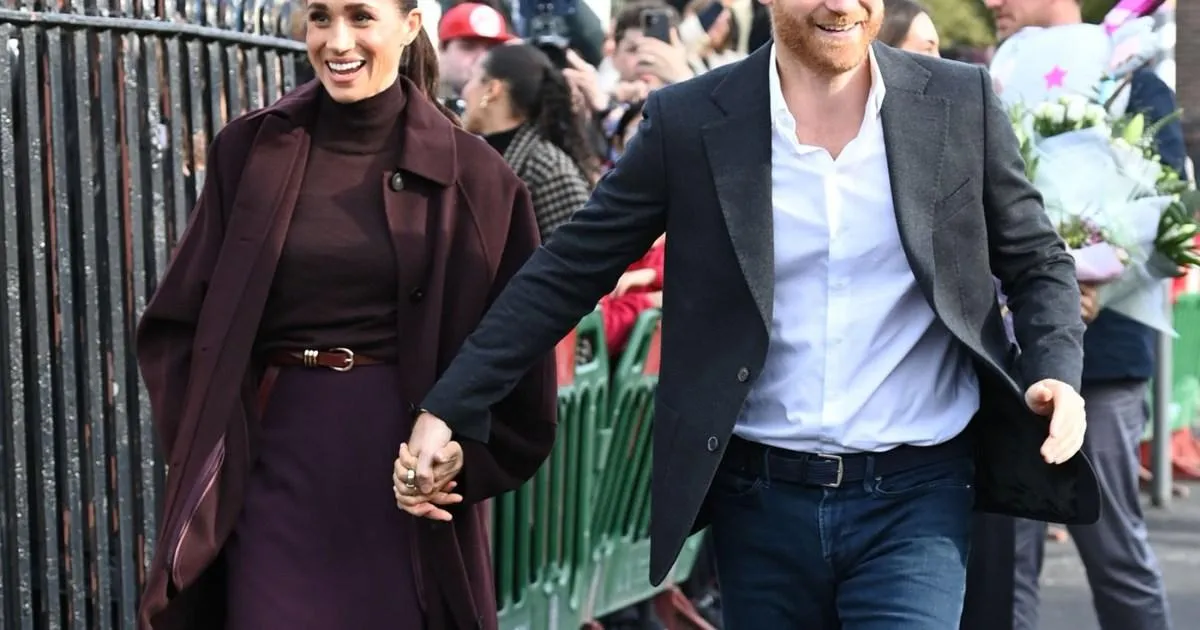
The couple’s return to the UK this week brought all of these emotions into sharp focus during their first public visit since arriving back in Britain. The engagement took place in Nottingham, and it bore all the hallmarks of an official royal event: crowds gathered, cameras flashed, security moved, and the couple stepped into the open air to greet the public. One woman in the crowd shouted, “We love you Duchess Meghan,” a moment of genuine warmth that must have felt affirming after so many months of distance. But not everyone was there to cheer. Others were quick to heckle the couple, and the sound of boos mixed with applause created an atmosphere that was both electric and uneasy. For any public figure, that split reaction is difficult to absorb; for Harry and Meghan, it is a familiar and exhausting pattern. They were reportedly delighted at their reception, focusing on the smiles and the supportive voices rather than the negativity. But the event itself was a strange hybrid: it looked like a royal engagement, felt like a royal engagement, yet was carried out in a private capacity, following the King’s instructions to government stakeholders last month. That distinction is subtle but significant. The Sussexes are no longer official representatives of the crown, but they still draw crowds, still inspire headlines, and still carry the weight of royal expectations. To be cheered and jeered in the same breath is a strange reality for anyone, but perhaps especially for someone like Harry, who grew up watching his mother handle the same dizzying intensity. The Nottingham visit was not just about charity or community; it was about testing a different kind of public life, one where they can exist on their own terms without being swallowed by the institution that once defined them. And if the mixed reaction proved anything, it is that the public is still deeply divided over what they represent.
Looking ahead, the Sussexes are making deliberate, careful choices about their future. Sources say such public appearances will continue to be rare, not out of laziness but out of a desire to control the narrative and protect their family. Meghan, according to reports, is prioritizing her personal and family interests, while also pondering a possible return to acting. Rumors have swirled that she is in negotiations for a role in the hit Netflix series The Gentlemen, a move that would signal a dramatic reinvention from duchess to actress. It is a tantalizing prospect, one that would bring her full circle to the career she left behind when she married into the monarchy. But it also raises questions about how the royal family—and the public—will react. For Meghan, the potential return to the screen is not just about fame; it is about reclaiming a part of her identity that was overshadowed by palace protocol and press scrutiny. Harry, meanwhile, remains anchored to his UK-based charities and his role as a father. Their life in Montecito is built around their children, with Meghan recently sharing a sweet video of Archie and Lilibet during a countryside walk, a glimpse of the simple, joyful moments they now treasure. The couple seems committed to a slower, more intentional rhythm: less official, more organic. They are not performing royalty in the traditional sense; they are living a version of it that feels sustainable. As Ever, Meghan’s brand, continues to grow, with plans to sell products in the UK, and Harry’s charity work continues to carry meaningful weight. The future is not about returning to the old model—it is about creating a new one, on their own terms, while acknowledging that the royal thread can never be entirely cut.
Ultimately, the debate over what to call Harry and Meghan is about more than preference or semantics. It is about how we understand family, duty, and identity in a world that loves tidy categories. “Working royals” feels bureaucratic; “former royals” feels dismissive. Neither captures the complexity of two people who remain royal by birth and marriage, yet have chosen to build a life outside the palace gates. They are not former children of the King; they are not former members of this extraordinary family. They are, as their friend said, “royals who are working”—working in their own way, at their own pace, for their own reasons. That does not make them better or worse than the King and Queen or the Prince and Princess of Wales; it makes them different, and difference is not easily contained by a headline. The human reality is more nuanced: Harry is still a son, a brother, a father, a man trying to find peace in the wake of profound loss and public pressure. Meghan is still a mother, a wife, an entrepreneur, a woman who once dreamed of being a princess and now discovers what that fairy tale actually costs. Their story is not over, and labels will not be able to keep up with the twists and turns. Perhaps the most generous thing we can do is let go of the need to name them so quickly, and instead see them as they are: two people still figuring out how to belong, both to each other and to a world that will always see them as more than just themselves. In the end, the words we use matter less than the grace we extend. And in a family still learning to heal, grace may be the only label that truly fits.