


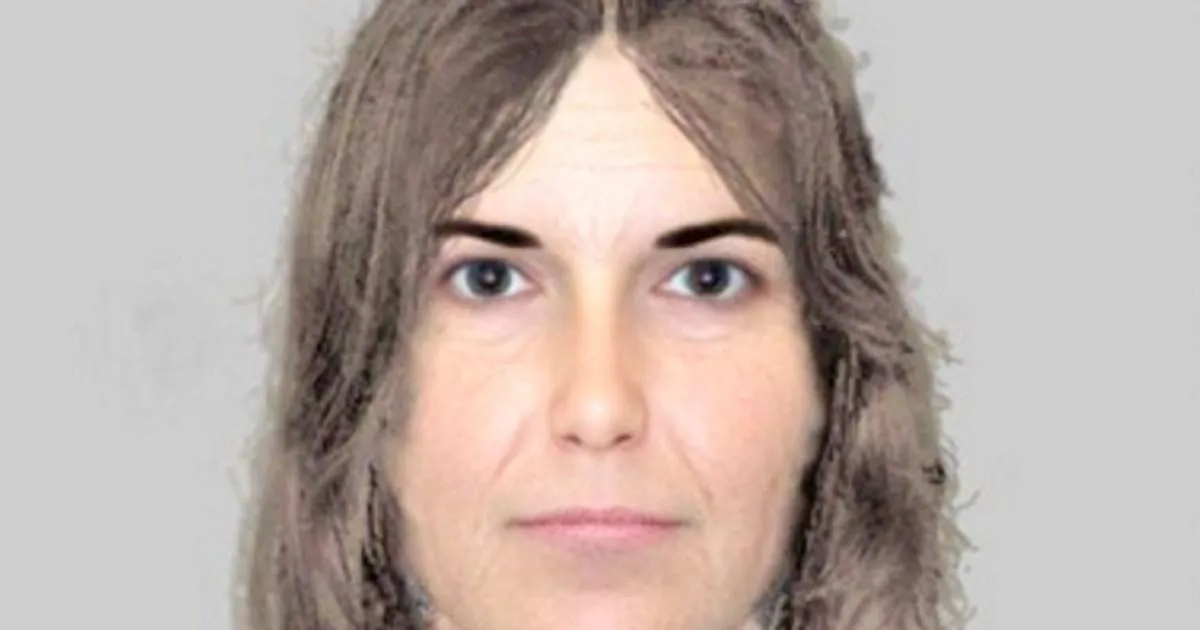
Some mysteries refuse to fade, no matter how many years pass. They linger in the quiet corners of a cemetery, in the memory of a detective who never stopped asking questions, and in the face of a woman who stood alone at a tiny grave, visibly shaken by a grief she could not hide. Earlier this year, on a Sunday afternoon in June, that woman was seen visiting the resting place of a baby known only as Baby April, a newborn found dead more than thirty years ago beside Singleton Lake in Ashford, Kent. Police have now released a computer-generated image of her, hoping that someone will recognise her and help solve a case that has haunted investigators since 1995. The image is not a photograph, but an artist’s reconstruction based on the observations of witnesses who saw the woman at Bybrook Cemetery. She appeared distressed, and her presence at the grave of a child who was never identified has stirred fresh hope that the truth may finally emerge. It is a strange and poignant development in a case that has seen many false starts, and it raises the possibility that someone with a direct connection to Baby April has been living with the secret for decades.
Baby April’s story begins with a tragic discovery on April 3, 1995, when her tiny body was found at Singleton Lake in Ashford, Kent. She weighed just seven pounds, and investigators believe she was born sometime between March 25 and April 3 of that year, meaning she may have lived for only a few days, or perhaps even less than two weeks, before her life was cut short. The exact cause of death was determined to be asphyxiation, a word that carries with it an unbearable weight when applied to an infant. Her body had been wrapped in a Kleenex tissue bag and placed inside a Motaworld bag, a detail that has stayed with everyone who has worked on the case. The image of such a small, vulnerable child being hidden away in this manner is almost too painful to contemplate. Police launched an extensive murder investigation at the time, but despite their efforts, they were unable to identify the baby’s parents or any relatives. She was given the name Baby April, a name chosen simply because of the month in which she was found, and that name became the only identity she would ever have. For the people of Ashford, she became a symbol of a heartbreaking mystery, a child who deserved more than the quiet, anonymous grave she was given.
Over the years, the investigation has never been completely closed, but it has also never produced the breakthrough that so many hoped for. In 2011, in a remarkable step, officers exhumed Baby April’s body from Bybrook Cemetery in an attempt to obtain a full DNA profile. The hope was that modern forensic science, which had advanced so much since the mid-1990s, might finally provide a clue to her parentage. The exhumation was a serious and sensitive undertaking, and it reflected the determination of Kent Police to find the truth. Unfortunately, the new DNA evidence did not lead to a positive identification, and Baby April was later laid to rest once again in the same cemetery. The failure must have been devastating for the detectives who had invested so much hope in the procedure. Yet the case was not forgotten. The grave remained, a quiet marker of a life that had ended almost before it began, and it seems that someone else never forgot either. The woman who visited the grave in June may have been a relative, a witness, or someone with knowledge of what happened all those years ago. Her distress suggests a deep emotional connection, and her decision to visit the grave at all suggests that the memory of Baby April has never left her.
The woman was seen at Bybrook Cemetery between 2pm and 3pm on Sunday, June 21. Police have described her as white, in her forties, no taller than 5ft 7in, with a medium to slim build and a pale complexion. She had grey, shoulder-length hair and was wearing a grey short cardigan, black leggings and trainers. She was carrying two bags: a small shoulder bag and a women’s fabric holdall with a floral pattern. The larger bag was worn across her body and appeared to be quite full. These are ordinary details, the kind of description that could apply to many people, yet they are also the only clues police have to work with. The woman did not approach anyone, and she did not leave her name. She simply stood at the grave, visibly upset, and then disappeared. It is impossible to know what was going through her mind, but one can imagine a lifetime of suppressed emotion finally breaking through. Perhaps she had carried the weight of this secret for decades, unable to speak about it to anyone. Perhaps she had returned to the grave to say goodbye, or to ask for forgiveness, or to finally acknowledge a bond she had never been able to express. Whatever her reason, her visit has given investigators a new lead, and they are appealing to the public to help identify her.
Detective Chief Inspector Neil Kimber, who is leading the current appeal, spoke movingly about the case. He said: “Baby April was named after the month she was born. Despite ongoing enquiries since that time, her parents and true identity to this date have never been found. We believe it is important to find the truth behind this tragic story and this woman might have information which could assist us in finding that.” His words reflect a quiet but unwavering commitment to a case that has spanned more than three decades. They also acknowledge the possibility that the woman at the grave is not a suspect, but someone who has been carrying a heavy burden of grief or guilt. The appeal is not an accusation; it is an invitation. Police are not asking the public to judge the woman, but to help them find her, to speak to her, and to understand what she knows. The hope is that she will come forward voluntarily, or that someone who recognises her will encourage her to do so. In a case this old, compassion is as important as evidence. The woman may have been a baby’s mother, a grandmother, a sister, or simply someone who stumbled upon the grave and was moved by it. But the fact that she appeared distressed, and that she lingered at the grave of a child whose identity remains unknown, suggests that her connection is real and significant.
Anyone with information is urged to contact Kent Police on 01622 652006. The number has been published in the hope that someone will recognise the woman from the computer-generated image, or recall seeing her at the cemetery that Sunday afternoon. Even the smallest detail, a memory of a conversation, a glimpse of her face, a recollection of her floral holdall, could make all the difference. This is a story about a baby who never had a chance to live, a mother or family who may have lived with unbearable pain, and a community that has never stopped caring. It is also a story about the persistence of truth. More than thirty years after Baby April’s body was found, the search for answers continues. The release of the image is a reminder that no case is ever truly closed, and that justice, however delayed, is still worth pursuing. For the woman at the grave, this may be the moment she has been waiting for, a chance to finally unburden herself. For the detectives, it is another step in a long journey. And for Baby April, it is a chance to be remembered not just as a mystery, but as a child who deserved love, protection, and the truth.