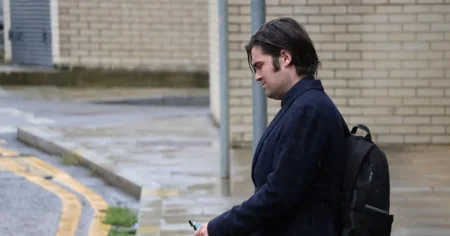




Bronwen James outside Winchester Crown Court
On a grey morning at Winchester Crown Court, Bronwen James stood outside the building with the particular stillness of someone whose life is about to be irrevocably reshaped. At just 30 years old, the PE teacher had arrived at the centre of a story that would shock a school community, breach the most basic boundaries of classroom trust, and expose the quiet, often hidden vulnerability of a teenage boy who thought, at the time, that he was living out “any teenage boy’s dream.” James had been on trial for charges of sexual activity with a pupil from Bitterne Park School in Southampton, and the jury had found her guilty of three charges of sexual activity with the boy. The prosecution’s case was stark: she had “exploited her position to engage in sexual activity” with a child she was supposed to guide, protect, and teach. Outside the courtroom, the word “flirty” from the tabloid headlines felt grotesquely inadequate. This was not a romance, not a lapse of judgment, not an affair between equals. This was a grown woman, a teacher, a figure of authority, who had taken a besotted teenage boy and pulled him into a secret world of Snapchat messages, vapes, and hidden encounters — all while he still called her “Miss” because, as he later told jurors, “I think it was her little fantasy or something.”
The details of the relationship emerged slowly during the trial, each one painting a more disturbing picture. James had exchanged Snapchat messages with the boy after he added her, and the conversation quickly turned flirtatious. She let pupils use their phones in class when perhaps she should have been enforcing school rules, and she “slipped” him vapes in his coursework, small gifts that must have felt thrilling to a teenager but now read as calculated grooming. The boy told police that they would message daily, that she told him she cared about him, that she loved him, and that they even discussed moving in together. It was a fantasy world she had constructed around him — a world in which he was not a student and she was not his teacher, but somehow the dangerous and seductive dynamic that made it so exciting was precisely the one she insisted on preserving. Even when they were alone, she made him call her “Miss.” The word was not just a formality; it was a reminder of her power, the very power she was using to entrap him. The first physical encounter happened after she drove him to Weston Shore, a quiet coastal spot in Southampton, where they parked and kissed in her car. Then she took him back to her house, and they had sex. It happened again, and again — on three or four occasions, the prosecution said. In messages, she reportedly referred to him as “number 8” to hide his identity, a crude cover that suggested she knew exactly how wrong this was.
For the boy, the experience was a tangle of emotions that he was far too young to untangle. In a video interview with police, he said that at the time he was “overwhelmed” and that it felt great, but looking back, he understood it was wrong. He told jurors that he thought it was “any teenage boy’s dream,” but the phrase carried a heavy sadness now, because teenagers are not supposed to have dreams like this, and adults are not supposed to fulfil them. He used the word “groomed.” That word is often associated with younger children, or with strangers in cars, but here it was a PE teacher, someone he looked up to, someone who was supposed to be safe. She told him she cared about him, she made him feel special, she made him feel chosen — and in doing so, she manipulated him in exactly the way grooming works. The school only became aware of the situation when another student showed a teacher text messages that appeared to be between James and the boy. The messages suggested a sexually charged relationship, and her photo was visible on the phone screen. The day after their first kiss in the car, she had sent him flirty banter, saying: “Where were you last night?” It was the language of a girlfriend, not a teacher. And it was the language of someone who knew exactly what she was doing, even as she later tried to paint herself as a people pleaser who simply wanted to be liked.
James’s defence was as troubling as the charges themselves. She described herself as “immature,” a woman who had begun teaching at 21 and never quite felt ready for the responsibility. She said she was a lenient teacher, not strict, that she did not follow behaviour policies such as banning mobile phones because she did not want to upset students or anger them. She said she was seeking validation from the wrong people, that she wanted people to like her, that she found it hard to say no to people she wanted to please. There was something painfully honest about her self-awareness — she recognised her own flaws — but it was also an excuse, an attempt to make her actions seem like a series of unfortunate mistakes rather than a pattern of abuse. She denied flirting with the teenager, denied supplying him vapes, denied that the occasion when he allegedly slapped her bottom ever happened. She suggested the boy might have accessed her Snapchat account when she left her phone on the desk. She told the jury a strange story about walking her dog when the teenager messaged asking for a lift home, and how she agreed because it was on the way, and how she drove to her house first to drop off the dog and use the toilet, and how he never went upstairs, and how no sex ever took place. But the prosecutor, Edward Culver, dismantled this account. Why, he asked, could the boy provide police with an accurate sketch plan of her upstairs if he had never been there? Why would he tell such “horrible, monstrous lies”? James suggested that maybe he wanted to look cool in front of his friends. But the jury did not believe her. They saw the truth: the boy had been in her bedroom, multiple times, and there was no innocent explanation.
The case did not end with this one boy. James had previously pleaded guilty to charges relating to two schoolgirls — a detail that turns her story from a single tragic lapse into something far more alarming. The charges included four counts of engaging in sexual activity and one count of sexual communication with the first girl, and two charges of sexual activity, one count of sexual communication, and making an indecent photograph of a child relating to the second girl. The exact circumstances of those offences were not fully detailed in the same report, but their existence changes the entire narrative. This was not one reckless relationship with one besotted pupil. This was a teacher who repeatedly crossed the line with multiple children, who communicated sexually with young people, who engaged in sexual activity with them, and who, in one case, made an indecent image. She was not a naive young woman who accidentally found herself in an inappropriate situation. She was an adult in a position of power who used that power to exploit vulnerable children. The fact that she could describe herself as a people pleaser, as someone who wanted to be liked, as someone who simply did not want to let people down, while facing charges involving three separate young people, suggests either a profound lack of insight or a deliberate attempt to minimise her own culpability. Perhaps it was both. The court would have to decide what to do with her now, with James facing jail, her teaching career effectively over, and her life in ruins. But the ruins she created extend far beyond her own reputation.
There is something deeply unsettling about cases like this, not just because of the abuse itself, but because of the way society often struggles to understand them. When a male teacher abuses a female student, the story fits a familiar template. But when the teacher is a woman and the victim is a teenage boy, there is a tendency to dismiss it as a boy’s fantasy, or to imply that he was lucky, or to wonder why he did not simply end it. The boy’s own testimony shows exactly why that thinking is so dangerous. He did not understand what was happening to him. He was overwhelmed. He felt special. He thought it was great. It was only later, with distance and maturity, that he recognised the truth: that he had been groomed, that he had been used, that an adult who should have protected him had instead stolen his childhood experiences and twisted them into something secret and shameful. The fact that he still called her “Miss” even when they were alone is perhaps the most heartbreaking detail. It shows that, no matter how much she tried to make him feel like a grown man, a lover, a partner she might move away with, he was still a child. He was still her student. He was still looking to her for guidance. And she used that trust against him. James insisted that she did not want to upset her students, that she wanted them to like her. But in seeking their approval, she lost sight of the fundamental duty that every teacher owes every child in their care. She did not just cross a line; she erased it entirely.
As James waits for sentencing, the justice system now has the task of weighing her lack of genuine accountability against the severity of her crimes. The prosecution made it clear that this was not a relationship between equals, but an exploitation of a position of trust. The defence may point to her immaturity, her own struggles with self-worth, her desire for validation. But none of that changes the impact on the victims. They will carry this with them for the rest of their lives. They will have to unlearn the idea that a teacher’s attention was love, that being chosen was an honour, that the secrecy was romantic. They will have to rebuild their sense of trust in adults, in themselves, in the boundaries that are supposed to keep them safe. The school, too, must ask itself how this was allowed to happen, how a PE teacher could drive a pupil to the coast, bring him home, have sex with him repeatedly, and no one noticed. It is a stark reminder that safeguarding is not just about policies and procedures, but about vigilance, about noticing the small signs, about taking seriously the possibility that a trusted adult could be harming a child. For the public, this case is a painful lesson. It asks us to look beyond stereotypes and see that abusers come in all forms, that victims do not always respond in expected ways, and that the people we trust most are sometimes the ones who betray us most deeply. Bronwen James may have wanted to be liked, but that is no excuse. Her priority should have been the wellbeing of her pupils. Instead, she chose to satisfy her own needs at their expense. As she left Winchester Crown Court, the full weight of that choice was finally beginning to land. The boy, meanwhile, is left to carry the memory of what happened — and the long, slow work of healing.