



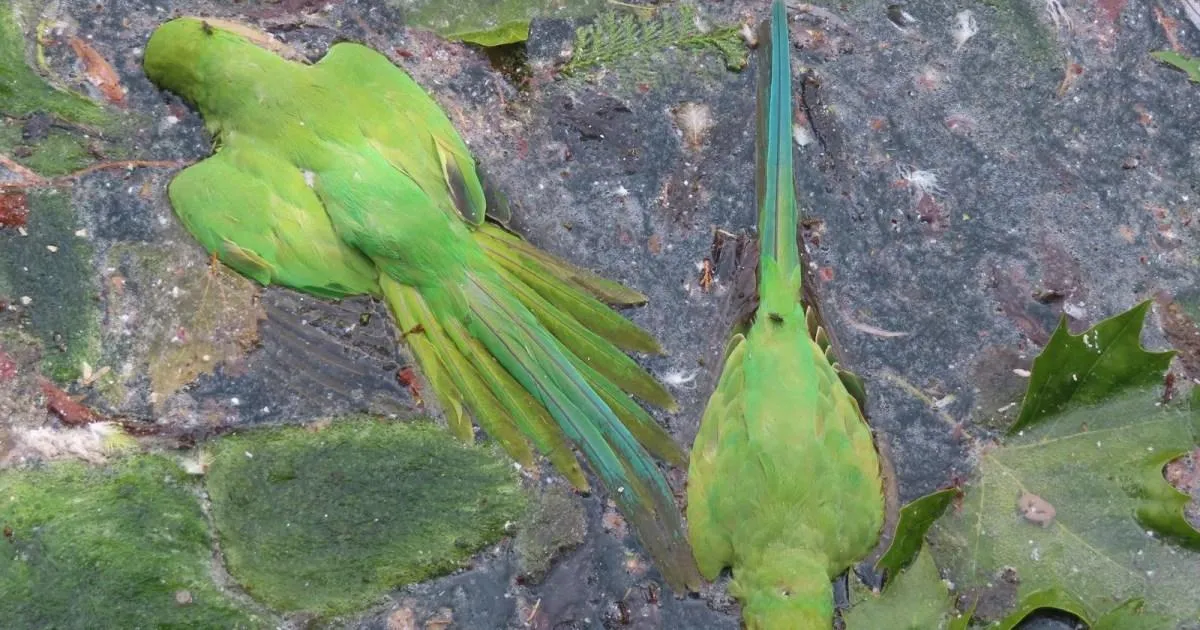
On a grey Monday morning in the quiet London suburb of Orpington, something small and heartbreaking was happening in one of the neighbourhood’s greenest spaces. Early walkers and volunteers in Priory Gardens were met with a sight that has become distressingly familiar: five more ring-necked parakeets lay dead, their vivid green feathers dulled against the damp grass. The discovery pushed the park’s death toll to 43 in just three weeks. For the people who know these birds, every single body carries a weight. They are not just casualties; they are members of a lively, noisy, dazzling flock that has made London’s parks feel a little wilder for decades. The parakeets of Priory Gardens are part of the area’s identity—their joyful squawks and flashes of emerald in the canopy have long been a source of delight for children, dog walkers, and elderly residents alike. Now, that delight is turning to sorrow and anger. What began as an occasional disturbing find has become a pattern, and the community is struggling to understand who would want to harm these birds, and why. The deaths are not natural; they are the result of cruelty, and the evidence points to a disturbing trend in which the birds are being deliberately targeted while they sleep, with weapons that have no place in a peaceful public park.
Rae Gellel, the director of the Greenwich Wildlife Network, has been tracking the deaths with a heavy heart. She explains that ring-necked parakeets have a very particular habit: at night, they roost together in large, tightly packed groups, often huddled on the same branches for warmth and safety. This is a natural behaviour that should protect them—there is safety in numbers, after all. But in Priory Gardens, that very togetherness has become a vulnerability. Gellel describes how youths with torches approach the roosting trees after dark, shining bright lights into the eyes of the sleeping birds. The sudden glare disorients them, freezes them, makes them easy targets. The attackers then use catapults to fire heavy ball bearings, nuts, and other projectiles into the huddled flock. It is a cowardly, calculated act that leaves little chance for the birds to escape. The bodies found on Monday were likely victims of one such night-time raid. Gellel says that the birds are not just being killed; they are being terrorised in their sleep, and the trauma of these attacks ripples through the entire flock. Even the survivors are likely to carry stress and fear, which can affect their feeding, breeding, and ability to thrive. For a species that has adapted so successfully to urban life, this is a cruel reminder that adaptation does not protect them from human malice.
But the darkness does not end at sunset. Gellel and local residents have also witnessed daytime attacks, and this is perhaps the most chilling part of the story. Some of the perpetrators have become brazen, carrying out their assaults in broad daylight while park visitors look on. What makes it worse is that some of them film the attacks and post the footage on TikTok, turning animal suffering into entertainment. The videos, presumably shared among groups of teenagers, show the moment a ball bearing strikes a bird, the flinch, the fall, the indifference. This is not a hidden crime; it is performed for likes and shares, and that adds a deeply disturbing layer to the tragedy. The attacks on parakeets are not an isolated incident either. Gellel says that the cruelty in and around Priory Gardens began as far back as 2020, and the list of victims includes not only parakeets but also squirrels, coots, and ducks. Each species has its own way of moving through the park—squirrels dashing across the grass, coots gliding over the pond, ducks paddling near the reeds—and each has been subjected to the same senseless violence. The park, which should be a sanctuary for urban wildlife, has become a hunting ground. And the fact that the attackers feel so comfortable acting in daylight suggests a worrying lack of accountability, a sense that they can do this without consequence.
To understand why the deaths of these parakeets have struck such a nerve, it helps to know a little about the birds themselves. The ring-necked parakeet is not native to Britain. Its natural range stretches from Africa through the Indian subcontinent, and yet it has become one of London’s most beloved and conspicuous birds. No one knows for sure how they first arrived and flourished, but the most widely accepted story is that they are descended from pet birds that escaped or were released during the mid-to-late twentieth century. Over the decades, they have adapted with remarkable resilience to the British climate, nesting in tree holes, roosting in parkland, and thriving in urban environments where food is plentiful. Today, flocks of these green birds are a familiar sight across the capital, from suburban gardens to the royal parks. Their presence is so common that many people assume they have always been here. But they are still classified as an invasive, non-native species, and that status can sometimes be used to justify harmful attitudes toward them. Gellel is keen to point out that this classification does not diminish their right to be treated with compassion. The law, she stresses, protects all wild birds, whether native or not. Simply being labelled invasive does not strip an animal of its capacity to suffer, nor does it make cruelty acceptable. A parakeet feels pain and fear just as much as a robin or a swan, and the legal welfare standards that apply to native wildlife apply to them too.
That legal distinction is now at the heart of a campaign led by the Greenwich Wildlife Network. The group is calling for stricter regulation on the sale of catapults, particularly to anyone under the age of 18. Catapults are often sold as toys, but in the hands of someone intent on harming animals, they become lethal weapons. The network argues that retailers should be required to verify the age of buyers and that the sale of heavy ball bearings and metal projectiles should be restricted. At the same time, they are urging law enforcement agencies to take wildlife crime seriously. Too often, attacks on birds and other animals are dismissed as minor incidents, something that does not warrant police time. But this is not a victimless crime. It is deliberate cruelty, and it is occurring repeatedly, in full view of the public. The police have now opened an investigation, working alongside Bromley Council, and a council spokesperson has acknowledged that the deaths of the parakeets “continue to be a concern.” It is a carefully diplomatic phrase, but behind it lies a growing awareness that something must be done. The investigation is likely to include reviewing any available CCTV footage, interviewing witnesses, and appealing for information from the public. For the volunteers who have been counting the bodies and reporting the attacks, this official acknowledgment brings a small measure of hope that the perpetrators will finally be held accountable.
Yet the deeper question remains: what drives a person, especially a young person, to harm a creature that has never done them any harm? The answer may lie in a culture that sometimes normalises casual cruelty, where the suffering of animals is reduced to a spectacle for social media. The attacks on the parakeets of Priory Gardens are not just a local issue; they are a reflection of a broader indifference to the lives of the creatures we share our cities with. If we cannot protect a brightly coloured bird in a public park, what does that say about our capacity for empathy as a society? The Greenwich Wildlife Network’s campaign is about more than just regulating catapults. It is about teaching respect for life, about reminding people that urban green spaces are not just for humans, and about building a community that refuses to look away when the vulnerable are harmed. For now, the parakeets that survive still call out each morning, their raucous calls echoing through the trees. They carry on, because that is what resilient creatures do. But every empty branch, every silent nest, is a reminder that they need our protection. The fight to save them is not just about birds; it is about the kind of world we want to live in—one where cruelty is not tolerated, where wildlife is cherished, and where a small green flash in the sky still has the power to make us smile.