


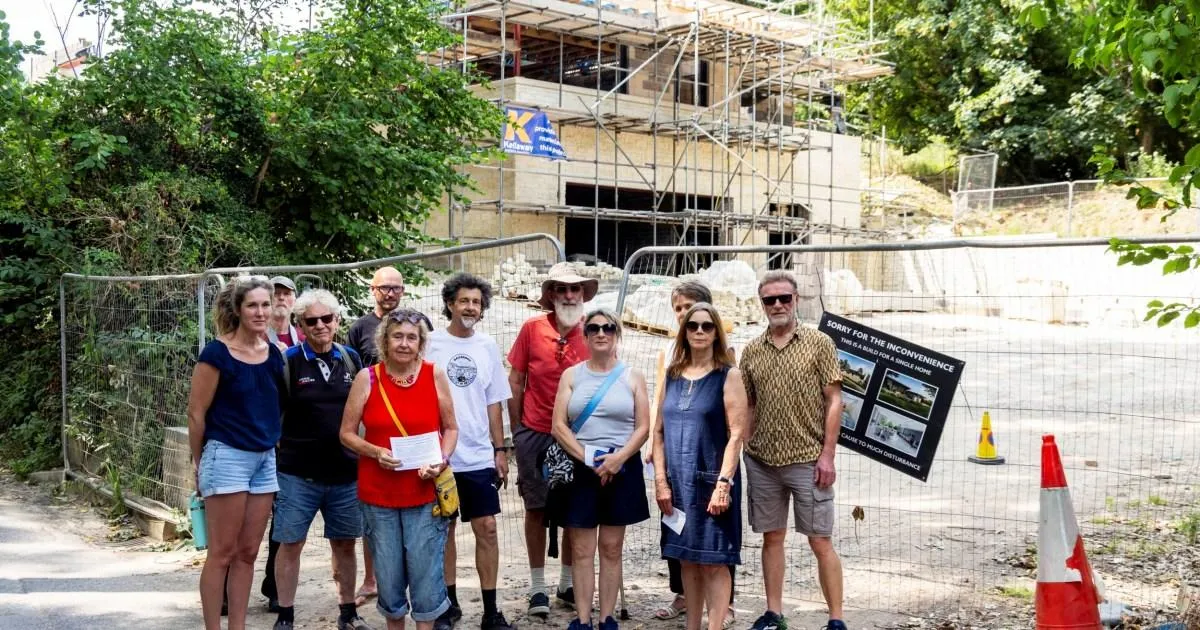
In the historic city of Bath, a simmering, decade-long neighborhood feud has finally reached its conclusion, leaving residents feeling a profound sense of injustice. A “mega mansion” that was built without the proper permissions has been allowed to stay, marking the end of a bitter planning battle that pitted a wealthy developer against the determined residents of a picturesque community. The massive modern home, which developers were permitted to keep after a contentious council vote, stands in stark contrast to the traditional cottages and the quaint tin church that surround it. For the neighbors who have spent ten years fighting this development, the decision feels less like a legal nuance and more like a glaring testament to a broken system where wealth can bend the rules that ordinary people are expected to follow without question.
The saga began in 2013 when initial plans for a five-bedroom home set into the hillside were first submitted, with formal permission eventually being granted in 2021. The approved design was meant to be a respectful, modest addition to the landscape, a building that would blend into the natural beauty of the area. However, what actually rose from the ground was something else entirely. The developer, Thomas Worrall, constructed a sprawling seven-bedroom residence, complete with its own gym and a private cinema room that were absent from the original plans. The neighbors swiftly pointed out that the final building is not only significantly larger in its footprint—approximately 130 square meters bigger than what was sanctioned—but it also stands up to two meters taller, dominating the skyline and towering over the spire of the adjacent tin church. This was not a minor miscalculation or a slight variation; it was a substantial deviation that fundamentally altered the character of the site, turning a charming, modest build into a colossal structure that dwarfs its historic surroundings.
Fueled by over one hundred written objections from the local community, the neighbors watched in disbelief as the council, Bath and North East Somerset, chose to approve a retrospective planning application rather than force the demolition of the offending structure. For the residents, this felt like a betrayal of the very principles that govern local planning law. They argued that the approval of this unauthorized behemoth creates a dangerous precedent, essentially legitimizing a “build first, ask questions later” approach for those with deep enough pockets to fight the system. One neighbor, Paul Raithby, addressed the council directly, highlighting the fundamental unfairness of the situation. “The applicant, their surveyor, and your own case officer all acknowledge that what has been built is an intentional breach of planning control,” he stated, his frustration palpable. “There is zero demonstrated local need for a seven-bedroom luxury mansion to justify overturning planning laws.” His words captured the sentiment of many who felt that a simple apology and a retrospective application should never be enough to circumvent the law.
The council’s vote, which passed 7-2, was arguably more a decision of practicality than of principle, a stark acknowledgment of the difficult position they were placed in by the developer. Councillors expressed their “reluctant” agreement, noting that the building was “policy compliant” and that forcing its removal would potentially result in a derelict, unfinished structure on the site or lead to a lengthy and costly appeal process that the developer might well win. Cllr Tim Warren conveyed this sense of powerlessness with a blunt, resigned statement: “I don’t like it, but I think we have no option but to go along with it.” However, other councillors were deeply troubled by the precedent they were setting. Cllr Saskia Heijltjes drew a sharp contrast between Mr. Worrall’s experience and that of the owner of the tin church next door, who is painstakingly following every rule in the planning book. “If this is approved as built, many will conclude that B&NES has a two-tier planning system: one set of rules for those who follow them, and one for those who build first and ask questions later,” she warned, her words echoing the deep-seated fear of the community that the system has lost its integrity.
For the people living next door, this two-tier system is not an abstract concept; it is their daily reality. Tavis Hamilton, a 48-year-old who lives next to the massive construction site, has spent the best part of a decade watching the structure rise, his life consumed by the battle to hold the developer accountable. From his front door, the sheer scale of the edifice is a constant, towering reminder of the ordeal. “It is enormous and dwarfs all the cottages,” he said, the fatigue evident in his voice. “It just shows how unfair the process is. It seems if you put the wrong guttering on your house or use the incorrect glazing, the council jumps on you for enforcement. But you can build this enormous structure without the right planning permission and no enforcement is carried out until it is too late.” His story illustrates the frustrating asymmetry of the planning system, where the smallest infraction by an average homeowner is met with swift punishment, while a multi-millionaire’s ambitious and unauthorized project is ultimately rubber-stamped to avoid bureaucratic hassle.
Mr. Worrall, the developer at the heart of the storm, maintains that he is merely a victim of circumstances who wants to be a good neighbor. He claims he purchased the plot fully intending to build a home with the existing permission, but was forced to adapt “on the ground” due to an unexpectedly high water table and difficult ground conditions. He asserts that his changes were necessary for a safer build and that the expanded basement was purely for structural purposes. In a public statement, he struck a conciliatory tone, expressing regret and a desire for peace. “I only bought the site to build my own house with planning permission already on it. I just want an easy life. I want to get my house finished and move my family into it,” he said. “I am sorry to everyone for the inconvenience of it all. But I want to be a good neighbour. I want it to be right. There will be no more work on site until they are 100 per cent happy.” His apology, however, offers little comfort to those who have spent a decade—and thousands of pounds—fighting a structure they never approved of and have always found out of place.
Ultimately, the saga of the Bath mega mansion leaves a bitter taste and raises fundamental questions about the efficacy of local governance and the power of wealth versus community will. The neighbors, who fought with such persistent dedication, now face the reality of living next to a building they despise, a symbol of a fight that was ultimately lost. The council’s decision, while pragmatic in the narrowest sense, has egregiously undermined public trust, reinforcing the cynical view that developers can operate with impunity, safe in the knowledge that as long as a completed building stands, it is easier to sanction it than to tear it down. The victory, if it can be called that, belongs to the developer, who has secured his family home. Yet the cost of that victory is a fractured community, a precedent for future breaches, and a lingering, uncomfortable question: if the system can be so openly and successfully bypassed with enough money, what is the point of the rules at all? The building stands as a monument not to good design, but to the power of perseverance—and the unsettling limits of the law when faced with deep pockets and a fait accompli.