


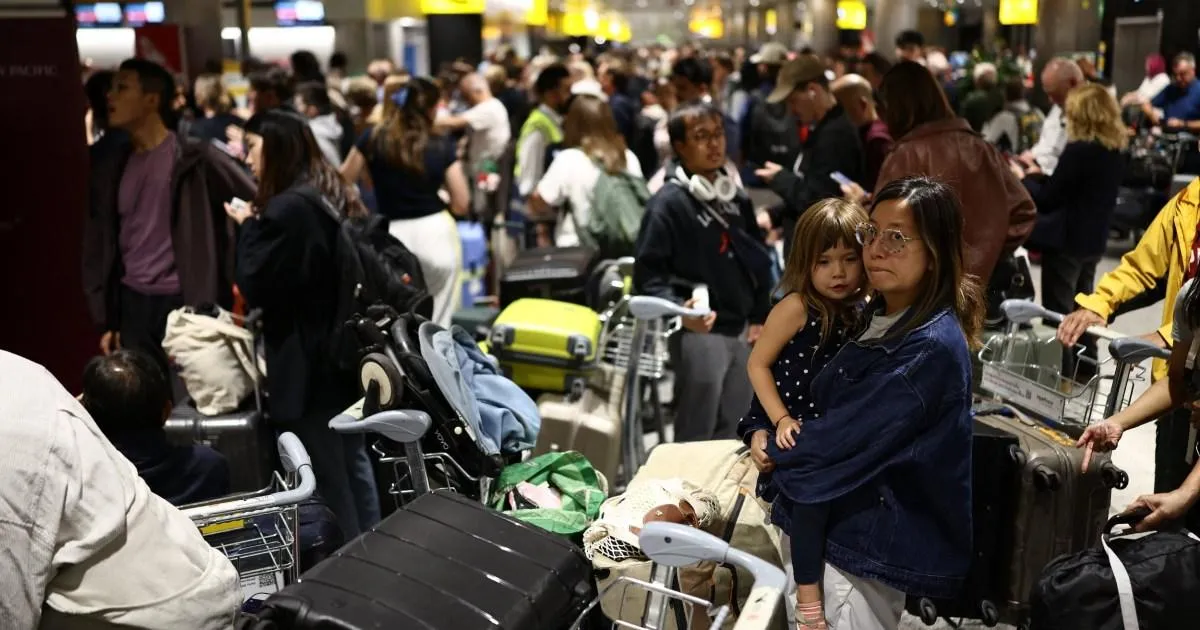
For a second consecutive day, the skies over the United Kingdom remained in a state of turmoil, as the fallout from a major air traffic control system failure continued to disrupt the travel plans of hundreds of thousands of passengers. What began as a technical glitch on Tuesday quickly cascaded into a logistical nightmare, grounding flights, stranding aircraft, and leaving families, honeymooners, and business travelers in a state of uncertainty and frustration. The issue, originating from a fault in the systems operated by Nats, the primary provider of air traffic control services for the UK, effectively paralyzed the nation’s busiest airports. Scenes of chaos unfolded across terminals, with long queues snaking through departure halls and weary passengers slumped on floors, desperately trying to find information about their journeys. The disruption was not just a minor inconvenience; it was a full-blown operational crisis that exposed the fragility of the country’s aviation infrastructure and tested the patience of everyone involved.
The root cause of the pandemonium was a critical technical failure within Nats, the organisation responsible for managing the safe and efficient flow of air traffic across 15 UK airports. This system, which is the invisible backbone of modern aviation, is designed to coordinate thousands of flights daily, ensuring they maintain safe distances and follow efficient routes. When the glitch occurred, the system was unable to process flight plans effectively, forcing controllers to revert to manual processes that are significantly slower and more limited in capacity. The immediate result was a mandatory restriction on the number of flights that could take off and land, a safety measure that, while necessary, had a catastrophic effect on schedules. With the system unable to handle the normal volume of traffic, airports were forced to make the agonising decision to cancel hundreds of flights. According to tracking website Flightradar24, 177 flights had been cancelled by Wednesday morning, with Heathrow Airport, the UK’s busiest hub, bearing the brunt of the cancellations. This followed a Tuesday that saw an estimated 1,300 flights axed across the country, leaving a trail of stranded aircraft and misplaced crew members that airlines would spend days trying to rectify.
For the passengers caught in the middle of this aviation meltdown, the experience was one of profound stress, exhaustion, and, in many cases, desperation. Tens of thousands of people found their long-awaited holidays, crucial business meetings, and once-in-a-lifetime events like weddings thrown into jeopardy. Ryanair alone reported that over 65,000 of its passengers were affected, and the total number across all airlines is likely in the hundreds of thousands. Many travellers described being held on stationary aircraft for hours, sitting on the tarmac with no food, water, or working lavatories, only to be told that their flight was ultimately cancelled and that they would need to return to the terminal to rebook. Former Formula One racing driver Martin Brundle vividly captured the grim reality on social media, describing how he was stranded on a plane at a remote parking bay at Heathrow for over nine hours. He detailed the appalling conditions, noting the lack of food, the blocked toilets, and the desperate pleas of a mother with a baby and a person with a medical condition who were begging to be allowed to disembark. His account, along with countless others, painted a picture of an industry struggling to cope with a breakdown in its core systems, with human welfare often taking a backseat to the immense logistical challenge of re-establishing order.
The political and corporate fallout from the crisis was swift and severe, with blame being directed at the leadership of Nats. Martin Rolfe, the chief executive of Nats, was summoned to meet with the Transport Secretary, Heidi Alexander, to explain the failure and the company’s recovery plan. In a subsequent interview, Rolfe accepted “full responsibility” for the disruption but remained evasive when questioned about his own future, refusing to comment on whether he was considering his position. This did little to appease the anger of the airline industry, which has been left to count the enormous financial cost of the cancellations and to deal with the monumental task of re-accommodating passengers. Ryanair’s chief operating officer, Neal McMahon, was particularly scathing in his criticism, calling for Rolfe to resign and labelling him an “overpaid failure” CEO. McMahon pointed to a similar catastrophic system meltdown in 2023, arguing that the repeated failures demonstrate a chronic mismanagement that has not been addressed. This sentiment reflects a growing frustration within the aviation sector that Nats, as a monopoly provider, is not being held sufficiently accountable for the resilience and reliability of its critical systems, leaving airlines and passengers to pay the price for its shortcomings.
As the recovery process began, the scale of the challenge became clear. Nats confirmed that the immediate technical issue had been resolved, but the knock-on effects were immense. Aircraft and flight crews were scattered across the country and the globe, far from where they were needed for scheduled departures. This logistical puzzle meant that airlines could not simply resume their normal timetables; they had to painstakingly rebuild their operations, repositioning planes and personnel to get the network moving again. A spokesperson for London Gatwick Airport, which was also heavily affected, confirmed that flights had resumed but warned that it would take time for operations to fully return to normal. Nats echoed this sentiment in their own update, stating that the recovery was “very complex” and that it would “take time to recover” for the whole aviation network. They apologised once again for the disruption and advised passengers to continue checking with their airlines for the latest information. The advice for passengers remained to stay in contact with their carriers, as the situation was fluid and could change at a moment’s notice, but for many, the damage to their plans was already done.
Looking beyond the immediate chaos, this event raises serious questions about the future of air travel in the UK and the robustness of the systems it depends on. The 2023 meltdown and this latest incident, occurring just three years apart, suggest a worrying pattern of vulnerability in Nats’ infrastructure. For passengers, the experience serves as a stark reminder of how quickly a technological failure can derail their lives, leaving them with little recourse other than to wait and hope for the best. The rights of passengers in such situations, particularly concerning compensation for expenses incurred during long delays, become a critical but often complicated issue. While airlines are responsible for providing care and, in some cases, financial compensation, the sheer scale of this disruption will likely lead to a lengthy and difficult process for many to claim what they are owed. The incident also places a spotlight on the need for greater investment in more resilient systems and backup plans to prevent such a widespread collapse from happening again. For now, however, the priority is on the immediate task of getting stranded passengers to their destinations, a process that is expected to take several more days to complete. The “second day of misery” that was predicted may yet stretch into a third and a fourth, leaving a lasting impression on all those who were unfortunate enough to be caught up in one of the UK’s most significant air travel disruptions in recent memory.