

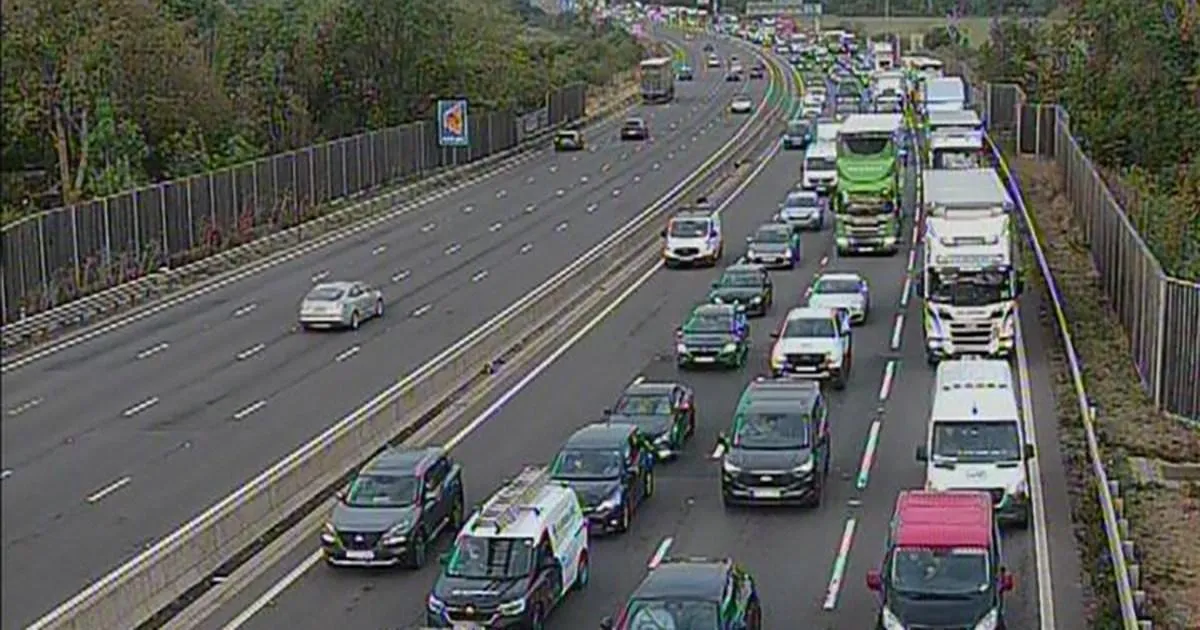
There is a particular kind of quiet that settles over a motorway after a serious crash, and it is not the calm of an ordinary night. It is the tense, unnatural stillness of dozens of engines switched off, hazard lights blinking in the darkness, and people sitting in their cars wondering what has just happened ahead of them. That was the scene on the M4 in Berkshire from around 9.30pm last night, when a collision forced the complete closure of the motorway in both directions between junction 8/9 for Maidenhead and junction 10 for Reading. What began as an emergency response in the dark soon became an all-night operation, and by the time the morning rush hour began, the road was still shut, with National Highways warning drivers that the closure would remain in place for hours. The London-bound carriageway was entirely blocked, and the ripple effects were felt across the region as traffic backed up, diversions filled with frustrated drivers, and anyone who had planned an early journey found themselves staring at a glowing red map on their phone. It is easy to think of a motorway as a piece of infrastructure, as nothing more than tarmac and signage, but on a morning like this it becomes something far more human. It becomes a place where people wait, worry, and hope. One driver who had been stuck for more than two hours described the scene as a terrible accident, with fire engines, ambulances and police everywhere. His words were striking not because of the drama, but because of his humility: “My discomfort is irrelevant. Let’s hope no one was seriously hurt.” In that single sentence, he captured the strange mix of frustration and compassion that defines such moments.
The decision to close a motorway in both directions is never made lightly. It causes chaos, delays economic activity, and tests the patience of thousands of people, but it also protects the integrity of the scene and allows investigators to do their work properly. Thames Valley Police confirmed that a police collision investigation was underway, which meant that every skid mark, every fragment of glass, every vehicle position had to be documented before anything could be moved. That is a slow and painstaking process, but it is also a vital one, because the findings may one day help prevent another family from receiving the worst kind of phone call. The police were clear that the London-bound carriageway, heading from Reading towards London, was likely to remain shut for a number of hours, while the eastbound Reading-to-London lanes could hopefully reopen at some time during the morning. National Highways echoed that message, telling drivers that the road was closed between junctions 8/9 and 10 and that officers were assisting with traffic management. For commuters, the uncertainty was perhaps the hardest part. There is no exact time when the barriers will part, no reassurance that the backup will clear by nine, only the same advice repeated across traffic bulletins: seek alternative routes. That advice, sensible as it is, does little to ease the anxiety of a parent trying to get to work, a driver heading to a hospital appointment, or a lorry operator losing money with every minute lost in congestion. Yet beneath the inconvenience, there is an understanding that the people most affected by this incident are not the ones stuck in traffic. They are the ones involved in the collision, the ones being treated by paramedics, the ones waiting for news at the side of the road or in a hospital corridor.
Just as the morning peak was getting underway, there came a small but significant update from National Highways. In a post on social media, they confirmed that collision investigations had now been completed on both sides of the motorway between junction 8/9 and junction 10, and that the focus of the operation was shifting to clean-up and recovery work. This is the point in any major incident when the mood begins to change. The emergency response is still serious, but the careful, forensic work of the investigation gives way to the physical task of making the road safe again. Clean-up crews move in to recover damaged vehicles, sweep debris from the carriageway, inspect barriers and lighting, and check that the surface is safe for traffic to return. It is unglamorous work, often done in hi-vis jackets and work boots, but it is essential. The update also offered a snapshot of the ongoing disruption: delays of around 20 minutes on the approach, roughly three miles of congestion, and a diversion route that was itself heavily congested. Those numbers may sound ordinary, but they translate into real people sitting in queues, checking their watches, and hoping that the person they are supposed to meet will understand. They translate into delivery drivers trying to outsmart the satellite navigation, and families deciding whether to risk the back roads. They translate into a community pulling together in moments of shared inconvenience. And for the road workers and recovery teams, they translate into another long morning in a job that rarely gets noticed until something goes wrong. It is worth remembering, perhaps, that the closure of a motorway is not just about the crash itself. It is about the slow, careful, often thankless process of restoring order to a chaotic scene.
For those still trying to travel, the diversion information was as simple as it could be under the circumstances. Westbound drivers were directed to follow the hollow square symbol and exit the motorway at junction 8/9 for the A404M. Eastbound traffic was told to follow the hollow circle symbol and exit at junction 10, joining the A329M northbound. These symbols are the quiet language of road management, familiar to regular drivers but easily missed by anyone in a hurry. Yet on a morning like this, they are lifelines. They guide people around the closed stretch, through unfamiliar towns and villages, past schools and shops that suddenly find themselves on an unofficial detour. Local roads that were designed for modest levels of traffic suddenly carry motorway volumes, and the patience of residents, cyclists and pedestrians is tested as much as the patience of drivers. There is something almost surreal about seeing a line of lorries crawling through a quiet residential street, their drivers peering at narrow junctions and low bridges that have no place in a sat-nav’s plans. But diversions work because people adapt. They slow down, they follow the symbols, they try to be courteous even when they are running late. The official advice from the police was to seek alternative routes, and for anyone who could avoid the area altogether, that was undoubtedly the best option. Working from home, delaying a journey, or simply waiting for the afternoon traffic to ease are all small acts of flexibility that make a difference. It is not always easy to change plans at a moment’s notice, but mornings like this remind us that the road network is not a machine. It is a shared space, and sometimes the most caring thing we can do is stay out of the way of those who have to be there, including the emergency services, the recovery crews, and the investigators who are trying to piece together what happened.
Beyond the practical details of closures and diversions, this is a story about the fragility of ordinary life. A serious crash can happen in a heartbeat, on a road that millions of people drive every year without thinking. It can be caused by a moment of distraction, a sudden change in weather, a mechanical failure, or simply the cruel randomness of circumstance. Whatever the cause, the consequences are immediate and profound. For the people involved, their world stops. For their loved ones, there is a terrible period of not knowing, of checking phones, of waiting for news that may change everything. For the emergency services, it is another night of sirens, adrenaline and the constant pressure to make the right decisions under impossible conditions. The driver who spent two hours stuck in the traffic was right: his discomfort was irrelevant. It was inconvenient, yes. It was frustrating, certainly. But it was nothing compared with the experience of the people at the centre of the crash. When he said, “Let’s hope no one was seriously hurt,” he was speaking for all of us. That is the human quality that emerges in moments like this: empathy. It is the ability to look beyond our own delayed plans and see the bigger picture. Every serious road incident is a reminder of our shared vulnerability and our shared responsibility. It is a reminder to slow down, to put the phone away, to wear a seatbelt, to check our own driving habits and to think about the people who share the road with us. The closure of the M4 may be an inconvenience, but it is also an invitation to reflect on what we can do to make sure that the next serious crash never happens. It is an invitation to value the people we love, and to recognise that every journey carries a risk we often forget until it is too late.
As the morning wears on and the recovery work continues, the mood is one of cautious hope. The road has been closed for hours, and the disruption will not disappear quickly. Congestion may linger long after the lanes reopen, and the investigation may lead to questions that take weeks to answer. But in the immediate aftermath, the words of the authorities are measured and steady. Thames Valley Police has promised further updates when possible, and National Highways has asked drivers to remain patient while the necessary work is done. Metro has contacted the police and ambulance service for comment, and the story is still developing. For those who rely on the M4, there is little to do but wait, check official channels, and take a deep breath. But perhaps there is also something else to do. Perhaps, amid the frustration and the delays, we can take a moment to think about the people who spent their night in the flashing lights of emergency vehicles, and the people whose lives have been changed by this incident. Perhaps we can carry the spirit of that anonymous driver, who refused to complain because he understood that his discomfort was irrelevant. That quiet generosity of spirit is what makes communities resilient. It is what turns a traffic jam into a shared experience rather than a selfish one. It is what reminds us that a motorway is not just concrete and white lines, but a place where human stories unfold, sometimes in tragedy, sometimes in unexpected kindness. When the last barrier is lifted and the road reopens, the cars will start moving again, the diversions will clear, and life will return to normal. But the memory of this morning, and of the people caught up in it, will not disappear so quickly. And that is how it should be. Every closed road carries a story, and every story deserves our attention, our patience, and our hope that no one was seriously hurt.