


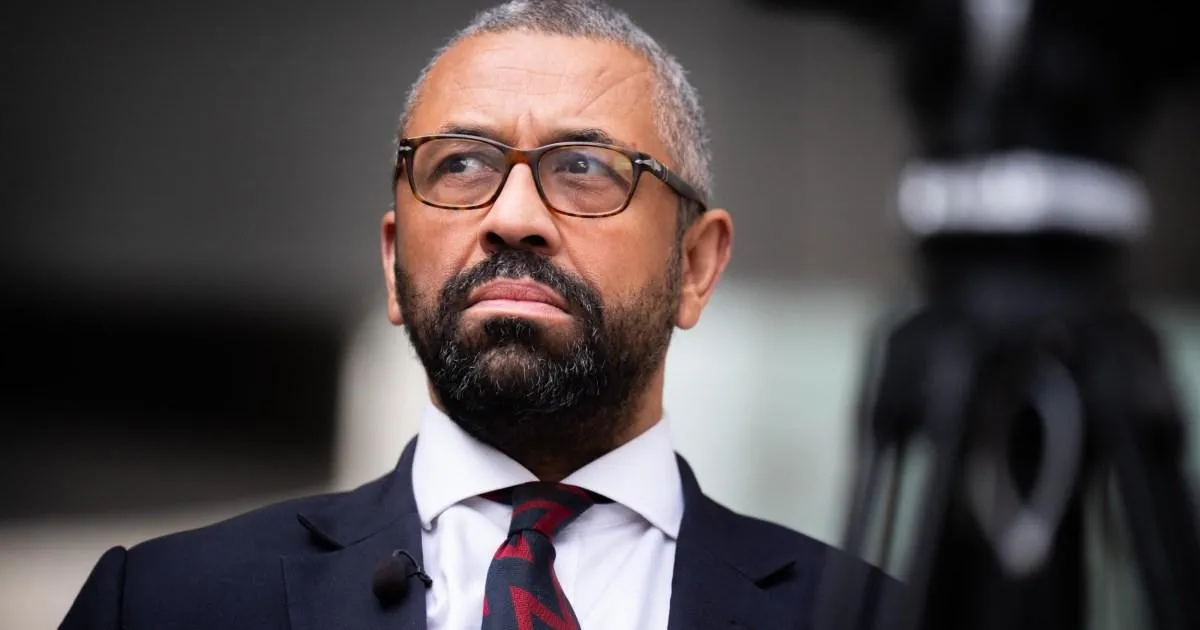
London has always thought of itself as a city that never stops moving—a place of late trains, late licences, and late-night dreams. But according to James Cleverly, the Conservative frontrunner hoping to unseat Sadiq Khan in 2028, the capital has lost some of its spark. The former Home Secretary, who resigned from the Shadow Cabinet at the end of August to launch his bid for City Hall, has spent weeks pressing the flesh with Conservative councillors and local MPs, and has already locked in more than half of the party’s London councillors plus four of the eight Tory MPs representing the capital. The Braintree MP, who grew up in Lewisham, south-east London, presents himself as a son of London who remembers what the city can be at its best. “London is a fantastic, amazing city,” he told Metro. “I want it to fire on all cylinders because I want it to be the best city in the world status that it deserves. Sadiq Khan has not gone at it with the dynamism the city and the role deserves.” That one word—dynamism—is at the heart of his challenge. He is not pretending London is broken, but he is suggesting it has come off the boil, and that the Labour mayor, now in power since 2016, has allowed routine problems to fester while grand promises accumulate. The result, he says, is a city where too many people do not feel safe on the streets and where the cost of living is pushing people out. This is not abstract politics for Cleverly; it is personal. He grew up in Lewisham, worked in Soho, and has watched London evolve from the inside. He says he is running to become the first Conservative mayor in over a decade because he believes in London’s potential—and because he thinks Khan has let it slip. With a pledge to run a “positive, optimistic” campaign, he is nevertheless willing to list the places where he believes London has gone “in the wrong direction”: crime, affordability, nightlife, housing, and the burden of green policies on people who are already struggling. His message is simple: London can be brilliant again, but it needs a mayor with a different kind of energy.
On crime, Cleverly doesn’t lead with statistics; he leads with feeling. Asked whether Londoners feel safe walking down the street, he responds with the testimony of countless conversations: “I have far too many conversations with people who who don’t feel safe. That is particularly true of women. I’ve really focused on making sure that women and girls feel safe and that is a key metric of success.” He acknowledges the official numbers: City Hall figures from July showeda 15% drop in neighbourhood crime, and London’s murder rate per capita last year fell to the lowest since records began. But, he argues, “statistics don’t overcome that fear of crime.” For too many Londoners, especially women and girls, the fear is visceral: the walk home from the station, the phone pulled from your hand, the bag snatched at a bus stop, the uneasy feeling that you could be the next victim. Cleverly’s promise is not to produce another report or a glossy mayoral strategy; it is to have the mayor visibly back the Metropolitan Police in doing their job. “There is no point the mayor putting a whole load of statistics telling people they are wrong,” he says. “What we’ve got to do is demonstrate that the Metropolitan Police and others are doing their job,,and the Mayor backs them doing that job.” He has specifically vowed to crack down on petty crime like phone theft and shoplifting—offenses that may not show up in murder stats but that erode the everyday confidence of the city. In his telling, crime is not just a policy issue; it’s a feeling. It’s whether a woman decides to take the long way home or the short cut; whether a teenager hands over their phone without a fight; whether a shopkeeper can keep goods on the shelves without losing money to organised thieves. Cleverly wants to make the fear of crime a key metric of success—not because he doubts the data, but because he knows that safety is experienced, not merely measured. If London has a reputation as being a safe city, he says, “then I know we’ll have done a good job.” That may be a hard promise to quantify, but it speaks to a deeper frustration with City Hall’s communication style: all numbers, no reassurance; all policy, no presence. For Cleverly, the mayor cannot simply tell Londoners they are wrong to feel afraid; he has to act so that their fear feels irrational.
Cleverly’s answer is partly about making London feel alive again—and that means helping the capital become more of a 24-hour city. He wants better overnight transport, cheaper nights out, and a nightlife economy that doesn’t require a mortgage to enjoy. He speaks with nostalgia about his own time working in Soho on Broadwick Street, and he confesses a “real soft spot” for that part of London. His old haunt was the John Snow pub, the place he used to go “at the end of the month, when money was a little bit tighter.” That detail—being careful with money, choosing a local pub, belonging to a neighborhood—is exactly the kind of London he wants to revive. He also has a soft spot for the DLR, though it is not officially the Tube, because he says the driverless light railway “triggered a transformation of the Docklands,” which “turned an unloved part of London into something really exciting and vibrant.” The problems are well documented: The Night Time Industries Association has warned that there will be no major clubs left at all in the UK–let alone London–by 2030 if venue closures continue at the current rate. Cleverly wants to reverse that trend, and he has linked his ambition for nightlife to a broader agenda on transport and affordability. “Comparing us with other big cities around the world,” he says, “we need to be much more of a 24-hour city, particularly in central London. If people go out for something to eat or drink, getting home shouldn’t cost them the same amount of money as their night out.” In other words, a £6 Uber or a £14 journey can be as prohibitive as the cost of the drink itself. He is proposing a “complete review” of City Hall’s costs and expenditure to see what money can be redirected to “unlock” London. He doesn’t yet have a fully worked-out policy on night tubes or late buses, but he wants to find the money to make central London feel safe, open, and connected after dark. The image he conjures is of a city where a young person can afford to go out, stay out, and get home without anxiety—where the night belongs to everyone, not just those who can afford black cabs or private cars. It’s an economic argument as much as a cultural one: nightlife jobs, hospitality jobs, creativity—all of it thrives when the city feels open. And it’s a personal one: he remembers what it was like to be young and skint in Soho,,and he doesn’t want that experience to become a museum piece. London’s nightlife is not a luxury, in his view; it is part of the city’s identity and part of what makes it desirable to live, work, and visit. With the right transport and the right regulatory environment, he believes, London can once again be a city that doesn’t shut down at 11pm—and that doesn’t punish people for leaving the house.
Underlying all this is a deeper anxiety about the future of London itself. Figures from the Office for National Statistics earlier this summer showed that London was the only region in England to see its population fall. That headline struck Cleverly as a warning sign. “This is not a good sign at all,” he says. “London should be one of the most desirable locations in the world. We should be asking why are we losing people.” His diagnosis is blunt: young people are being priced out of the housing market, house building has “completely collapsed,” and the proportion of a typical salary that goes on housing costs in London is simply too high. When housing eats up disposable income, people don’t have money to go out, to support local businesses, or to put down roots. They leave. And when they leave,,the city loses the very energy that made it great. Cleverly wants to be a mayor with a “powerful voice” who can “really take on the government, who see London as little more than a cash cow.” That line is aimed at both political parties: he wants more resources for London, not just more tax revenue sent to Westminster. He is also willing to question seemingly sacred green policies if they add to the cost of living. Asked about the Ultra Low Emission Zone fee—the ULEZ charge, which has long been unpopular among Conservative voters in outer London—he hedged carefully, saying: “I am passionate about London being clean and green and happy and healthy as anybody else. But at a time when people are genuinely struggling to make ends meet, you have to look at anything might impose additional cost upon them.” That may not be a firm pledge to scrap ULEZ, but it is signal that he would scrutinize every charge that hits household budgets. He treats the cost-of-living crisis not as a national issue but as a London issue with its own local solutions. Housing, transport, nightlife, safety—they all connect. If a young person cannot afford to live in London, they cannot contribute to its economy; if a woman does not feel safe at night, she will not stay out; if a family’s rent eats their wages, they will move to Manchester or Birmingham or abroad. Cleverly’s pitch is that London is is losing its competitive edge because it is becoming increasingly unaffordable and increasingly fearful. He says he wants to reverse both trends by redirecting City Hall money away from bureaucracy and toward things that make the city work: police, transport, housing, nightlife infrastructure. It’s an urbanist vision wrapped in a cost-of-living argument,and it is designed to appeal to Londoners who love their city but are wondering whether they can afford to stay in it—or whether they even feel safe walking home at night.
Cleverly is under no illusions about the scale of the challenge. Sadiq Khan has won three consecutive victories, handily defeating Tory challengers in previous London elections, and the city has been firmly in his grasp since 2016. If Cleverly were to win in 2028, it would be the first Conservative victory in 16 years, since Boris Johnson’s second term. Yet he disputes the idea that London is intrinsically a left-wing city. “London is a broad-minded, open-minded city,” he says. “It’s also a business city. It’s full of people with a side hustle. It has that ambition and energy that transcends the very simply party political bracket.” In his view, Londoners are not ideological; they are practical. They want a city that works—safe streets, affordable homes, decent transport, a lively high street. He believes a Conservative who speaks to those practical concerns and offers a positive, optimistic vision can win over a “wide group” of voters. The Khan campaign is already pushing back. A spokesperson for the Mayor of London pointed to Sadiq’s record: major investments in the Metropolitan Police and positive opportunities for young people as part of his approach of being “tough on crime and tough on the causes of crime. The evidence, they said, shows this approach is working.” The spokesperson also cited record numbers of council homes built, world-leading action to clean up the air, major improvements to public transport including the Elizabeth Line, the Superloop,and the Night Tube, and standing up to NIMBYs to defend London’s nightlife. They highlighted a record £6 billion secured with the new Government for new council and affordable homes, along with more control over skills and education, which would help set young Londoners up for the jobs of the future. In other words, Khan’s team will not simply roll over. They will argue that the city has improved under their watch, that crime is down, housing is being built, and transport is better than ever. Cleverly’s response is that those achievements are not enough if people do not feel safer and do not feel they can afford to stay. He is trying to frame the election not as a referendum on Khan’s record but as a choice about London’s trajectory. Do you want a mayor who tells you crime is down, or a mayor who acts as if your fear is real? Do you want a mayor who celebrates new transport lines, or a mayor who worries about whether you can afford to use them at night? It is a subtle but powerful repositioning,and it may be his best chance in a city that has not elected a Conservative in nearly two decades.
For now, Cleverly is offering more of an attitude than a detailed policy programme. He has no new concrete policies yet; instead, he wants to begin with a “complete review” of all the costs and expenditure of City Hall to see what money can be redirected to “unlock” London. That could mean anything—but it also signals that nothing is off the table, including ULEZ fees, transport spending, planning rules, and nightlife regulation. His campaign is still early, but he has already won the backing of more than half of Conservative councillors in the capital and four of the eight local Tory MPs, making him the clear frontrunner. He is betting that Londoners, whether they voted Labour, Conservative, Lib Dem, or Green in the past, are tired of a City Hall that seems to speak in statistics and slogans. He wants to make the city feel safe, feel alive, feel affordable—and he insists that requires a mayor who treats London as the best city in the world, not just a cash cow. “London is a fantastic, amazing city. I want it to fire on all cylinders,” he repeats, almost as a mantra. The question is whether that message can break through in a city that has become deeply sceptical of Conservative national governments, particularly after Brexit, austerity,and the party’s recent turmoil. Cleverly knows he is not just running against Sadiq Khan; he is running against the ghost of his own party’s reputation. That is why he keeps returning to his biography as a boy from Lewisham, a young man who drank at the John Snow in Soho, someone who loves the city rather than merely wanting to govern it. He speaks like someone who has lived the problems of London—the cramped flats, the crowded trains, the fear of walking home—and who wants to fix them before they drive the city apart. Whether he can actually win City Hall in 2028 remains to be seen. But he has already succeeded in framing the debate: Londoners do not feel safe, Londoners are leaving, and London is not firing on all cylinders. For a party that has spent years on the defensive in the capital,that is no small achievement. The next few years will tell whether his optimistic, human-scaled vision can convince the city to give a Conservative mayor another chance.