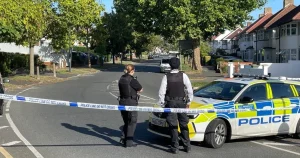

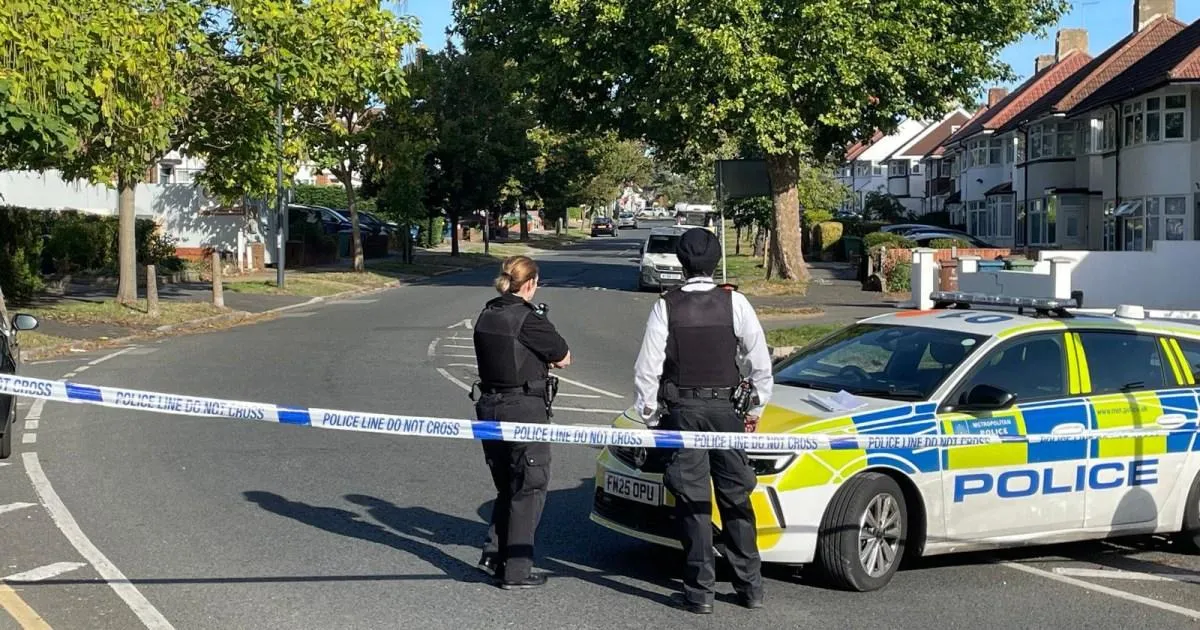
On an otherwise unremarkable Sunday evening in Kenton, a quiet residential corner of northwest London, the night air was broken by the kind of sound that no one ever wants to hear. Witnesses would later describe a car pursuing another vehicle at high speed through the streets, headlights cutting through the darkness and engines roaring, followed by a series of loud bangs that seemed to hang in the air for far too long. Those bangs could have been gunshots. For the people who lived nearby, that uncertainty was terrifying. Within minutes, the familiar quiet of their neighbourhood was replaced by the chaos of blue lights and police radios. Officers arrived in force, closing roads and telling stunned residents to stay indoors. The lockdown was sudden and absolute. Kenton Lane, an ordinary street of semis and front gardens, became the focus of a major incident. Later, the road would remain sealed off for twelve hours, and detectives would treat it as a crime scene. But at that moment, all anyone knew was that something serious had happened, and that they could not leave their homes. The police would not say exactly what they were looking for. They simply advised people to lock their doors and wait. It is hard to describe how unnerving that is, especially for families with young children. A street that had been safe and familiar now felt like a place where anything could happen. In a city like London, police sirens are common, but a full lockdown of a residential area is not. It changes the way you see your own front doorstep. It turns the everyday into something fragile, and it leaves a community holding its breath until someone, somewhere, is willing to explain what has happened.
Among those trapped inside was a mother of four who lives on Kenton Lane. She described how quiet the evening had been before the police arrived. Then, suddenly, “loads of police were on the street.” They started blocking the surrounding roads, and when she went outside to see what was happening, she was told to go back inside. No one explained the danger. That unanswered question was the worst part. She later told reporters that she was frightened for her children, and that uncertainty made the whole experience far more frightening than it might otherwise have been. Her house, she said, was still considered part of the crime scene, which meant that even the most ordinary routines became difficult. The school run, for example, now involved walking through police tape. It was upsetting for the children to see their street cordoned off, and it was difficult for her to know what to tell them. Kids ask questions, and when their parent does not have answers, the fear only grows. The police, she said, were professional, but they were also tightly focused on their job. They were not there to offer reassurance or explanations. They were there to investigate, to secure the area, and to search for evidence. In the middle of that, residents were left to make sense of something that made no sense at all. The mother’s words captured a feeling that many in Kenton shared: this was not supposed to happen here. The safety of home, the safety of the neighbourhood, had been violated. Even after the police tape comes down, that feeling does not simply disappear. It stays in the memory of a child who had to walk under a police line to get to school, and in the mind of a parent who could not promise them that everything was fine.
Another resident, a pensioner who had lived on Kenton Lane for more than fifty years, said there were police officers everywhere and that all you could see was blue lights. “They told us to stay in for our own safety,” she said. After half a century in the same house, she had seen a lot, but this was different. A police presence like that was not something she had ever expected to see on her own street. There was something almost military about the way the roads were closed, the way officers stood at every corner, the way the investigation command post seemed to appear out of nowhere. The pensioner’s voice, calm but troubled, spoke for many longtime residents who suddenly felt like strangers in their own community. The disruption was not just emotional; it was practical. By Monday morning, the police operation was still ongoing, and Kenton Lane remained closed. That meant gridlock. Commuters who had simply been trying to get to work found themselves sitting in traffic, watching officers direct cars away from the scene. Buses had to be rerouted. Parents made detours to drop children at school. The blue lights that had dominated the night were now joined by the red tail lights of the morning rush hour. For the wider area, the incident was an inconvenience, an unexplained delay that stretched into the start of the working week. For the people directly affected, however, it was something more significant. They had not chosen to be part of an investigation. They had not done anything other than live on a street that, for whatever reason, had become the focus of police attention. And the longer it went on, the more the uncertainty began to gnaw at them. What had happened? Why were officers still searching drains? Had a gun really been fired? These were questions no one could answer yet, and in the absence of answers, the imagination took over.
Detectives spent the day working methodically. The focus remained on Kenton Lane, where the scene had been preserved and where a team of CID officers interviewed neighbours and collected any CCTV or Ring doorbell footage that might have captured the cars involved. They knocked on doors and asked the same questions over and over: Did you see anything? Did you hear anything? Do you know anyone who might be connected to this? At the same time, officers carried out searches of drains along the road, a task that hinted at one particular possibility: that a weapon had been thrown away during the chase. The search was painstaking, the kind of work that does not make headlines but is essential to any investigation. It also reflected the gravity of the moment. If police were looking for a discarded gun, then the reports of gunshots had to be taken seriously, even if nothing had been confirmed. Somewhere in the middle of all this, officers found a 30-year-old man who had been involved in a vehicle collision. He was unharmed, which was a relief, but his presence raised more questions than it answered. Who was he? Was he the man being chased, or the chaser? The police were not saying. At this stage, no arrests had been made, and there was still no confirmation that a gun had actually been fired. The Metropolitan Police were careful to describe the investigation as “in its early stages.” That careful language is typical of official communication, but for residents it meant something simpler: we still do not know what happened. The forensic examination of the scene would continue. The video footage would be reviewed. The witnesses would be re-interviewed if necessary. But all of that takes time, and time spent waiting is time spent living with uncertainty.
In a statement, a spokesperson for the Metropolitan Police laid out the facts as they understood them. On Sunday, 20 September, at around 20:50 hours, police were called to reports of a car chasing another vehicle. Shortly afterwards, there was a report of possible gunshots in the same area, and then a report of a collision involving the same two cars. Officers responded within minutes and found the driver of one of the vehicles, a 30-year-old man, who did not report any injuries. The spokesperson said that, while enquiries were still in their early stages, no evidence had been identified to suggest a firearm was discharged. That was an important clarification, but it was not an absolute one. A search of the local area remained ongoing, and a police scene remained in place on Kenton Lane and Curzon Avenue. The increased police presence would continue while enquiries were made. Perhaps the most reassuring part of the statement was this: those involved in the incident were believed to be known to each other, and there was not believed to be any threat to the wider public. For residents who had spent the night scared and confused, those words offered some comfort. It was not a random act of violence. It was not a danger that could affect anyone who happened to be in the wrong place at the wrong time. At least, that was what the police believed. Still, the absence of arrests was striking. It meant that, whatever had happened, the investigation had not yet reached the point where anyone could be held accountable. For the community, that was another reason to feel uneasy. The police also said that local neighbourhood officers would be conducting extra patrols in the area to provide reassurance. That was a welcome gesture, but it also acknowledged that the normal rhythm of daily life had been shaken.
By the time Monday came to an end, the police tape was still up in places, and the residents of Kenton were left to process what had happened in their own ways. Some wanted answers. Some wanted to forget. Most wanted to feel safe again. The police asked anyone with information to call 101, the non-emergency number, and the investigation would continue until every lead had been followed. But for the community, the story was not just about evidence or arrests. It was about the moment when ordinary life stopped, when the street they lived on became a crime scene, when a school run had to be done under police tape, when a fifty-year resident saw blue lights instead of the familiar quiet of her road. It was about the fear that had swept through the area and the slow, difficult task of rebuilding a sense of security. The official line was careful. No confirmation of a gunshot. No arrests. No threat to the wider public. Those are the words of a bureaucracy doing its job. But the reality on the ground was more complicated. Something had happened. Two cars had been involved in a late-night chase. A collision had taken place. People had heard what they thought were shots. And a whole neighbourhood had been locked down for hours. That is not something that can be undone with a single press release. The police would keep searching, keep watching the CCTV, keep looking into the drains. The residents, meanwhile, would keep looking over their shoulders. Time moves on, but the aftermath of an incident like this lingers somewhere between the headlines and the pavement. For the people of Kenton, the memory of that Sunday night may fade, but it will never quite disappear. The best they can hope for is that the investigation provides the answers they deserve, and that the blue lights they saw were a one-time reminder that sometimes the life we think of as ordinary is more fragile than we realise.