


Here is the story of a quiet English village caught at the center of a national debate—a place where ancient history, local fears, and the politics of asylum have collided, leaving residents searching for a way to be heard.
Nestled in the Suffolk countryside, the village of Barnham is the kind of place where time seems to move slowly. It is a settlement so old it was written into the Domesday Book, a community of just under 600 people who know their neighbors by name and value the peace of rural life. That peace, however, has been shattered. The British government has proposed turning a sprawling former RAF base on the village’s edge into accommodation for more than 1,200 asylum seekers—more than double the entire population of the village. The plan has landed like a stone in a still pond, sending ripples of anxiety, anger, and uncertainty through the community. For many residents, it feels not like a policy decision made from a distance, but a fundamental threat to the life they have built. They speak of feeling powerless, of being overlooked by a distant Home Office, and of watching their concerns be reduced to headlines. Now, in a moment of symbolic desperation, Barnham is looking to another village nearly a hundred miles away—a village that decided to fight back in the most dramatic way possible: by voting to secede from the United Kingdom.
That village is Piddington in Oxfordshire, a tiny settlement of just 350 people. Earlier this month, Piddington held its own unofficial referendum on whether to “leave the UK” in protest against government plans to house asylum seekers at a former military site near their homes. The result was staggering: 285 villagers voted in favor of separation, with a turnout of almost 92 percent. While the vote was purely symbolic and carried no legal weight, it sent a powerful message. It captured national attention, sparked intense media coverage, and gave voice to a deep well of frustration felt by rural communities across the country. Now, Barnham’s parish councillors are planning a field trip to Piddington to learn exactly how they did it. John Bauer, chairman of the parish council, has been clear about his intentions. He says the villagers of Barnham were inspired by Piddington’s “fantastic impact,” and that if two villages work together, their voices will be far louder than either could manage alone. “We’re aiming not to duplicate what they’re doing but to learn from it,” Bauer explained. “If a second village were to vote, even symbolically, to secede from the UK, it would be equally powerful.”
For many in Barnham, the issue is deeply personal. Kerri Williams, 51, has lived in the village for half her life. She is not an extremist, and she does not pretend to have easy answers, but she, like many of her neighbors, is genuinely afraid. She admits that if the asylum seekers were women and children, she might feel differently. “It wouldn’t be so bad,” she said, struggling to articulate a position that is both compassionate and cautious. She wants to give people “the benefit of the doubt,” but then she pauses, and adds, “we just can’t.” That tension—between wanting to help and feeling overwhelmed by the scale of change—runs through so many conversations in the village. Hers is not a voice of hatred, but of worry: worry about safety, about the impact on community resources, about what happens when a small village becomes home to a population more than double its size, overnight and without any say in the matter. Behind the placards and the protests are real human emotions, not just political slogans.
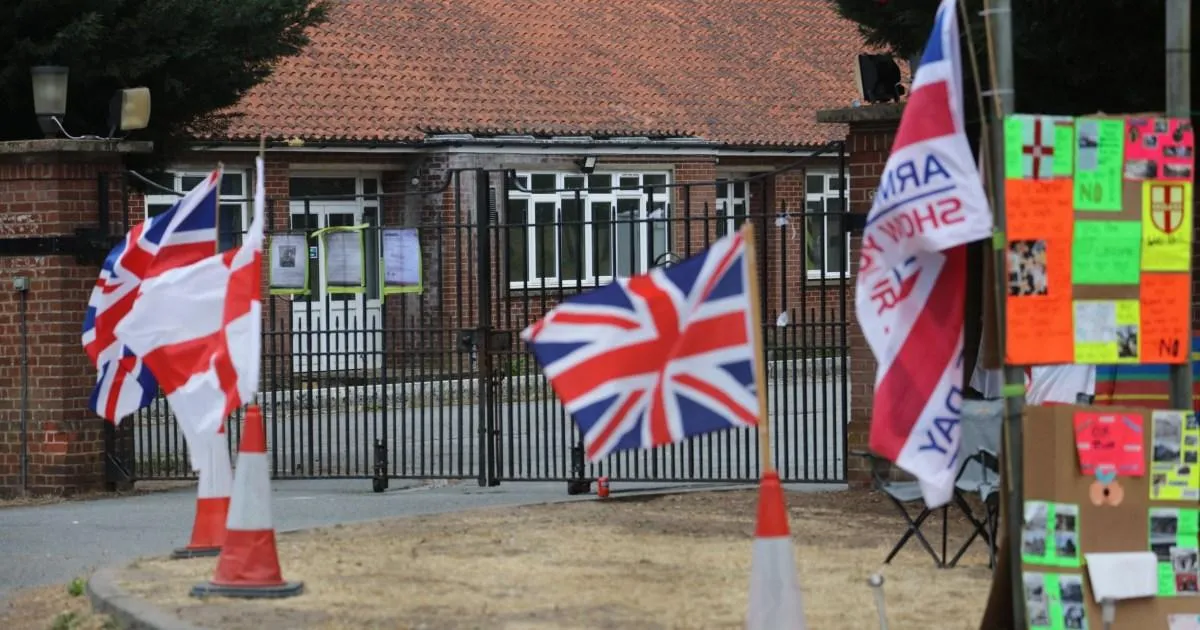
The details of the plan have done little to ease those fears. If the Home Office proceeds, the former RAF Barnham site will be transformed into housing for around 1,250 male asylum seekers, all aged between 18 and 65. The sheer concentration of single men, in the eyes of many residents, makes the proposal feel more threatening, even if those fears are uncomfortable to express. The government, for its part, has insisted that the site will be “largely self-sufficient,” designed to minimize any impact on the local community. But that promise has been met with deep skepticism. A protest camp has already sprung up outside the base gates, along the busy A134 linking Barnham to Thetford. The perimeter fence is now covered with flags, notes, and placards bearing slogans like “Thetford says no!” and “Our kids and women won’t be safe!” For some, this is legitimate democratic expression; for others, it is a disturbing echo of a darker politics that has been simmering across the country. The presence of a placard for the far-right group Restore Britain at the protest site has only added to the unease, raising questions about who is truly leading this movement and for what purpose.
What happened in Thetford earlier this year only sharpened the tensions. In August, the area saw an outbreak of unrest and violence, when protesters against asylum housing threw eggs at homes believed to be sheltering migrants, and a police officer was bitten during the ensuing clashes. The memory of that night hangs heavy over the region. It is a stark reminder that what begins as a local dispute can quickly spiral into something uglier, especially when far-right figures seize on the anger. In Piddington, these same dynamics were on full display. Figures like Danny Tommo and Rupert Lowe from Restore Britain descended on the village during its independence vote, hijacking the narrative and turning a local protest into a national spectacle. Many residents felt their genuine concerns were being exploited by outsiders with their own agenda. Barnham is now trying to walk the same line—drawing attention to its cause without becoming a vehicle for extremism. The challenge is real, but so is the determination to be heard.
At its heart, this is not a story about a military base or an asylum policy. It is about the human need for dignity, control, and a place to call home. The asylum seekers arriving in places like Barnham and Piddington are fleeing war, persecution, and unimaginable hardship. They are looking for safety, just as the residents of these villages are looking for security. The tragedy is that so many ordinary people on all sides feel voiceless, caught between a government that sendsdown plans from London and extreme voices who exploit their fears for power. For the residents of Barnham, the decision to consider their own symbolic vote of independence is not a declaration of war—it is a cry for help. It is a way of saying that their concerns matter, that their lives cannot be brushed aside, and that the government cannot simply parachute thousands of people into a small community and expect everyone to accept it silently. As John Bauer and his councillors prepare to make the journey to Piddington, they carry with them the hopes and anxieties of their village. They know that secession is impossible. But they also know that standing still is no longer an option. In a democracy, the loudest message is often a symbolic one. Whether the government is listening, however, remains the question that now hangs over Barnham like the East Anglian mist.