

Paragraph 1: The Sudden Call on a Wild Coastline
On a windswept Sunday afternoon, the rugged and famously beautiful coastline of Northumberland, England, became the stage for a desperate and heart-wrenching emergency. The British Divers Marine Life Rescue (BDMLR), a charity dedicated to saving marine wildlife, received an urgent alert that a pod of pilot whales had become trapped in the shallow, rocky waters near Warkworth. These are not small creatures; pilot whales are formidable, powerful animals, often reaching lengths of up to twenty feet and weighing several tons, and to find them so close to the jagged shore is a stark sign of immense distress. As the medics scrambled to the scene, they were confronted by a sight that is every marine rescuer’s nightmare: a group of these magnificent, dark leviathans lying motionless in the surf, their bodies scraping against the unforgiving rocks. The air was thick with the smell of brine and the mournful, high-pitched whistles of the stranded animals. Adding an almost surreal layer to the unfolding tragedy, the rescue team learned that hundreds of miles away, in the heart of urban London, a separate pod of pilot whales had been spotted in the murky waters of the River Thames. This bizarre and heartbreaking coincidence highlighted a profound and alarming reality: these deep-ocean nomads were somehow losing their way, turning up in the most inhospitable and alien environments imaginable—from a rocky British isle to the concrete banks of a metropolitan river.
Paragraph 2: The Unbreakable Bonds of Family
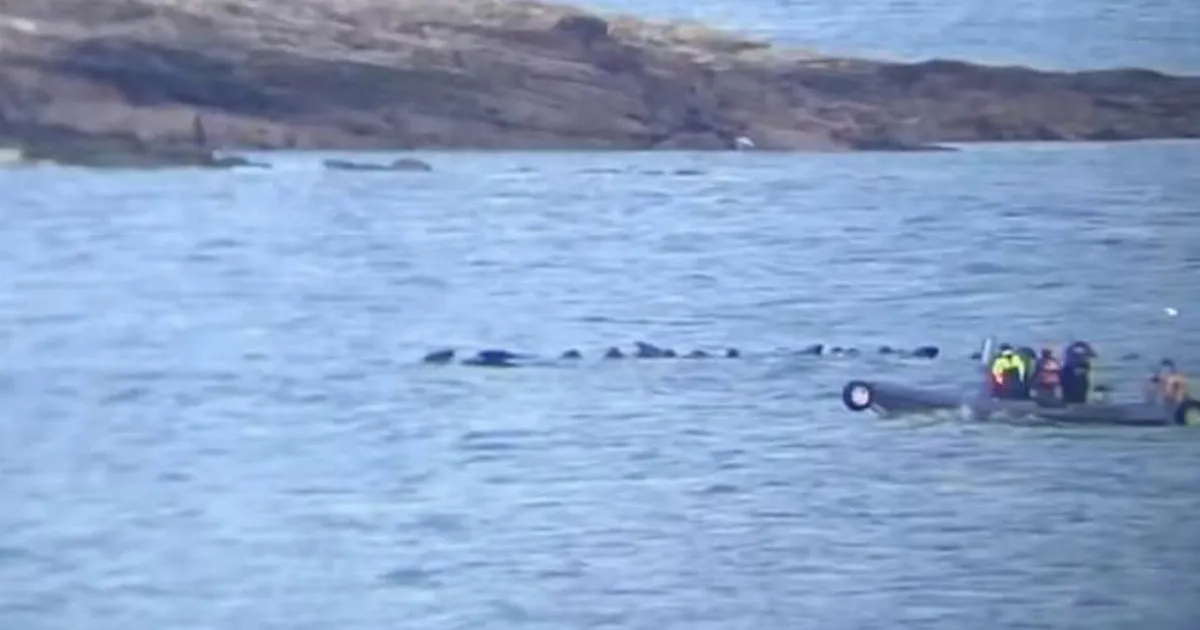
The initial rescue plan was as simple as it was urgent: the medics needed to lure the frightened whales away from the rocks and guide them back into the safety of deeper water. Using vessels and acoustic signals, they attempted to gently “herd” the pod out to sea, a technique that has occasionally proven successful in such situations. However, the rescue team quickly realized they were fighting not just the tide, but millions of years of social evolution. Pilot whales are the epitome of family loyalty. They live in tightly bonded, matrilineal social groups where the cohesion of the group is the absolute priority, often trumping the individual’s own survival instinct. This dedication, which serves them so well in the vast expanse of the ocean, becomes a fatal flaw in the shallow waters of a coastline. The rescuers watched in frustration and profound sadness as a number of the whales steadfastly refused to leave the side of the largest members of their group, which lay motionless, tipped onto their sides. These dominant individuals—likely the matriarchs or group leaders—were clearly unwell or injured, and their devoted followers would not abandon them. The whales remained “tightly packed” together, a tight cluster of solidarity that made it physically impossible for the rescuers to separate them from the beached leaders. As the grey afternoon light faded into a cold, dark evening, visibility vanished. The herding attempt had to be stood down. The team was forced to make the agonizing decision to leave the whales overnight on the rocks, hoping against hope that the high tide might mercifully lift them back to safety, but knowing all too well that their loyalty might once again keep them stranded until morning.
Paragraph 3: A Morning of Heartbreak on Coquet Island
When Monday morning dawned, it brought a grim confirmation of the night’s fears. The Royal Society for the Protection of Birds (RSPB) reported that up to a dozen whales were now stranded on the treacherous, rocky ledges of Coquet Island, a remote and uninhabited outcrop just off the Northumberland coast. The terrain there is brutally unforgiving: slippery, jagged rocks extending into cold, churning waters, making any kind of rescue operation a logistical nightmare. The BDMLR team, returning with fresh resolve and any additional help they could muster, were given a heartbreaking update: they had found six whales, with five lying ashore and one afloat in the shallows. Of those six, two were already dead. The conditions were almost impossibly difficult. The tide, which governs all life in this intertidal zone, only permitted access to the island for a few precious hours either side of high water. There was no place for the rescue teams to remain overnight, meaning every second counted. They threw themselves into the physical struggle, attempting to refloat the live animals by pushing and guiding them, desperately trying to catch the water as it rose. Yet the combination of the treacherous, uneven terrain underfoot and the sheer, immense size and power of the animals made the task a perilous one, not just for the whales but for the human beings trying to save them. The risk of a rescuer being crushed or swept away was monumental. As the tide began its relentless retreat, pulling the life-giving buoyancy away from the stranded giants, the team had to face the unavoidable, crushing reality: they could not lift these animals, and they could not move them. For their own safety, they were forced to withdraw, leaving the surviving whales behind to the mercy of the elements, a decision that weighed heavily on every person who had to walk away.
Paragraph 4: A Tale of Two Tragedies and a Persistent Vigil
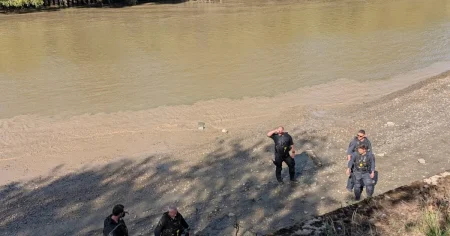
While the drama on Coquet Island reached its agonizing conclusion, a separate, parallel narrative unfolded in the heart of the British capital. Over the weekend, a distinct pod of pilot whales had been spotted in the River Thames, an event so rare it captured national headlines. The Port of London Authority and the British Divers Marine Life Rescue had been working tirelessly on an effort to “herd” these whales out of the busy, shallow urban river and back towards the open sea. Their work was painstakingly slow, requiring a delicate balance of vessel placement and sound to gently encourage the animals downstream. One of these Thames whales was observed looking visibly ill and separated from its group, adding a further layer of concern to that operation. Despite the success of the London operation in nudging the pod towards the sea, maritime experts were quick to clarify that this was a completely different group from the one stranded in Northumberland. It would be biologically impossible for a whale to swim such a vast distance, navigating busy shipping lanes and estuaries, in just twenty-four hours. Back on the Northumberland coast, the BDMLR team refused to give in to despair. Their mission shifted to a persistent, hopeful vigil. They began patrolling the entire coastline, scanning the grey, choppy waters for any other members of the fragmented pod that might still be swimming in the area or might wash ashore at any moment. They stood ready to provide immediate medical care and to refloat any other animals that might be found alive, clinging to the slim possibility that some of the family had managed to escape the deadly pull of the rocks.
Paragraph 5: Understanding the Giants and Their Perils
To truly understand the scale of this tragedy, one must appreciate the nature of the pilot whale. With an estimated population of around 700,000 in the North Atlantic, they are not an endangered species globally, yet they are exceptionally prone to mass strandings. This vulnerability is not a biological flaw but a testament to their complex social structure. They live in large, closely bonded groups, often travelling for decades with the same family. Relationships are paramount, and the group often behaves as a single entity. This “togetherness” is a survival advantage in the open ocean, where cooperative hunting and mutual protection are key. However, if one individual—perhaps a leader or an elder suffering from navigational disorientation due to an undersea geological event, a storm, or internal illness—makes a fatal error and heads towards a shallow shoreline, the rest of the pod will blindly follow, their ingrained loyalty overriding their own warning instincts. This “fatal collective” phenomenon leads to the mass strandings we often read about. Beyond this inherent vulnerability, pilot whales face a litany of man-made threats that amplify the risk. They frequently become entangled in fishing gear, which can drown them. Their bodies often show high concentrations of pollutants, including polychlorinated biphenyls (PCBs) and other toxic contaminants, which accumulate in their blubber and compromise their immune systems and reproductive capabilities. Finally, and perhaps most insidiously, the modern ocean is becoming a noisy place. The constant roar of commercial shipping, the low-frequency sonar used by naval vessels, and industrial activity can all interfere with their delicate echolocation abilities, effectively blinding them in their own habitat and causing them to stray far from their natural migratory paths.
Paragraph 6: The Quiet Courage of Rescuers and the Call to Remain Human
In the cold, unforgiving light of day, the sight of those whales lying on the rocks of Coquet Island served as a somber monument to the sea’s indifference. For the tireless volunteers of the BDMLR, and other rescue organizations like them, these events are not just career obstacles; they are profound personal losses. They are the men and women who leave their families, don ill-fitting wet suits, and wade into freezing, dangerous water to fight for the lives of creatures that will never understand their kindness. The failure to successfully refloat the whales represents a devastating emotional toll, a stark and humbling reminder that despite our technological prowess, we are often powerless against the raw forces of nature. Yet, the story of this stranding is not merely a tale of defeat. It is a powerful call to awareness and a reminder of our shared, fragile existence on this planet. The ocean, which covers most of our world, is still a vast and mysterious frontier, teeming with creatures that experience loyalty, fear, and pain just as we do. The sight of a loyal family refusing to abandon its sick leader is a lesson in devotion that transcends the animal kingdom. It underscores the vital importance of the human network that surrounds these events—the local residents who spot the animals first, the birdwatchers who report the distress, and the trained professionals who rush to the scene. For anyone who sights any pilot whales in the coastal waters of the UK, or finds any stranded along the shore, the lifeline is the British Divers Marine Life Rescue at 01825 765546. Every minute counts. While we cannot reverse the pull of a receding tide or alter the fierce, unbreakable loyalty of a whale to its stricken kin, we can ensure that when these moments of crisis arrive, we as a society are ready to respond with compassion, expertise, and profound respect for the wild, beautiful, and often heartbreaking world that exists right beneath the waves.