
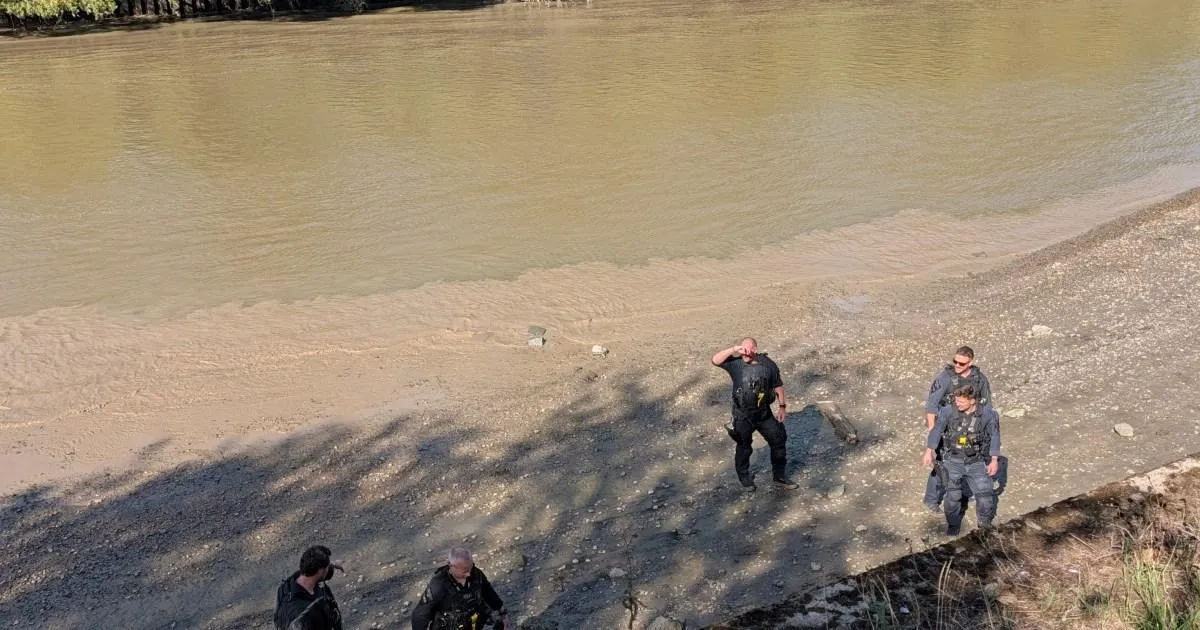
Sunday afternoons beside the River Thames usually promise a kind of quiet English peace: families strolling back from Kew Gardens, couples pausing to watch the water slide beneath the old stone arches, the distant hum of the city softened by a wide, pale sky. On this particular Sunday, however, that peace was torn apart by a scene so strange and sudden that many passersby would struggle to make sense of it. A topless man, his skin streaked with river mud and his chest heaving, was being held firmly by police officers on the muddy banks of the Thames, his hands bound in cuffs and his face turned toward the ground. Above him, on Kew Bridge, the wreckage of a three-car collision had turned the road into a jigsaw of crumpled metal, shattered glass and emergency lights, while officers in high-visibility jackets worked quickly to secure the area. What had begun as a routine patrol near Heathrow Airport had somehow spiralled into a ten-mile pursuit, a violent crash, and a desperate attempt to escape by jumping into one of the most famous rivers in the world. The Metropolitan Police later confirmed that the drama reached its climax at around 2pm, and by then the riverbank had become a tableau of flashing blue lights, shouted commands, and the hushed disbelief of ordinary people who had simply gone out to enjoy the afternoon. Some of them were still holding admission tickets from Kew Gardens; others had been walking their dogs or pushing prams. They had not expected to witness a man being dragged out of the water, soaked and exhausted, after allegedly choosing to fling himself into the cold embrace of the Thames rather than face the consequences of what had happened on the road. It was one of those moments when the boundary between ordinary life and raw human desperation becomes shockingly thin, leaving strangers to look at one another with widened eyes and ask, again and again, “What on earth happened here?”
The sequence of events, pieced together from police statements and eyewitness accounts, reads like the plot of a thriller that no one would believe if it had been written for television. Officers on patrol in the M4 area near Heathrow Airport attempted to pull over a car that had already failed to stop for police on a previous occasion. The driver, a 25-year-old man, refused to comply. Instead of pulling over, he accelerated away, sending police on a chase that would stretch for approximately ten miles through the western edges of London. The pursuit carved its way along main roads and side streets, through traffic that must have parted in panic as the stolen or at least suspect vehicle weaved through cars. At some point, according to witnesses, the car’s tyres had been burst, perhaps by stinger devices or by the sheer force of the chase; the vehicle was reportedly making a sound like it was “driving on rims” as it came over the bridge. The metallic screech must have been unmistakable, a terrible wail of grinding metal against tarmac that announced trouble long before the impact. On Kew Bridge Road, the chase came to a brutal conclusion. The fleeing driver was involved in a collision with three cars, a crash that sent shockwaves through the area and left vehicles mangled in the middle of the road. Inside one of those cars sat a woman in her eighties, who was treated at the scene by paramedics before being taken to hospital. Police later said her injuries were not life-threatening and not life-changing, but for a woman of that age, even a lesser collision can be a terrifying and unsettling ordeal. A man in his fifties was also taken to hospital as a precaution, his body perhaps shaken and bruised but, mercifully, without serious harm. The sheer randomness of the crash is hard to ignore: these were people who had simply been driving along a bridge, perhaps heading home from a visit, perhaps running errands, when their day was suddenly hijacked by someone else’s flight from justice.
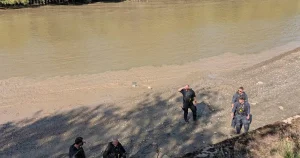
Then came the strangest chapter of the whole affair. After the collision, the driver did not stay in his car. He did not wait for the airbags to deflate or for the police to swarm in. Instead, he fled the wrecked vehicle and ran toward the river, apparently determined to slip beneath the surface and disappear. Onlookers saw him plunge into the Thames, and for a few agonising moments the water closed over him. Police were in hot pursuit, their boots sliding on the muddy banks as they scrambled to reach him. The image that emerged afterward captures everything extraordinary about the incident: a topless man, his torso pale and streaked with mud, held by officers on the riverside, his head bowed, his body evidently exhausted. How far he swam, how long he was in the water, and whether he attempted to hide in the reeds or beneath the bridge are details that may never be fully known. What is known is that he was detained on the muddy banks of the river, cold and wet, with nowhere left to run. One witness, Ethan Connelly, described coming back from a visit to Kew Gardens when he and his companions noticed the disturbance unfolding along the Thames path. “We were walking along the Thames path back from towards the bridge,” he said. “Along the way we passed three or four groups of officers and also the group with the man in handcuffs on the bank. We saw him get taken away. We heard that he had crashed on the bridge and jumped into the river. I hope everyone involved is okay.” His words carry the quiet understatement of someone who has just seen something deeply unsettling: the hope that everyone involved is okay, even as the memory of a man being hauled out of the river lingers in the mind. For the officers involved, the arrest was the culmination of a dangerous and unpredictable chase, but for the public it was a bewildering spectacle, a glimpse into a world of poor decisions, panic and survival instinct colliding in a single afternoon.
The Metropolitan Police’s official account of the arrest offers a more clinical but no less dramatic picture. A spokesman said: “Officers on patrol attempted to pull over a car on the M4, near Heathrow Airport, which had previously failed to stop for police. The driver of the vehicle failed to stop. He was pursued by officers before being involved in a collision with three cars on Kew Bridge Road. Following the collision, the driver, 25, fled the vehicle and entered the river before being detained by officers.” The bare paragraphs of a police statement do not convey the sheer terror that a high-speed pursuit on public roads can generate, nor the chaos of a multi-car crash on a busy bridge, nor the strange instinct that drives a person to jump into a cold, wide river rather than face handcuffs. But the statement does confirm the gravity of the situation. The driver was arrested on suspicion of failing to stop, dangerous driving, causing serious injury by dangerous driving, theft and possession of an offensive weapon. The list of charges reads like a catalogue of escalating trouble: a stolen vehicle, a weapon, a determination to outrun the law, a crash that could easily have killed someone, and then a flight into the water that turned an already dangerous situation into something almost absurd in its recklessness. He remains in custody, and the investigation continues. The fact that the Metropolitan Police’s Directorate of Professional Standards has been informed is significant; whenever a pursuit ends in a collision and injuries, there is a formal process to examine whether the chase was lawful, proportionate and necessary. This is not to suggest that anyone acted improperly, but rather to acknowledge that any incident involving such high stakes deserves careful scrutiny. The whole episode raises difficult questions about policing, public safety and the lengths to which some people will go to avoid being caught.
Beyond the official statements and the legal aftermath, there is the human dimension that is often lost in the noise of sirens and the flash of cameras. The woman in her eighties who was taken to hospital after the crash on Kew Bridge did not set out that afternoon expecting to become part of a police pursuit. She was probably doing something ordinary, driving along a familiar route, perhaps listening to the radio, perhaps thinking about dinner or a phone call she needed to make. Then, in an instant, her day turned into a nightmare of shattering metal and emergency services. That she escaped without life-threatening injuries is a relief, but the emotional impact of such a collision can linger long after the bruises have faded. The man in his fifties who was taken to hospital as a precaution also carries with him the memories of a moment when his life hung in the balance because someone else decided to flee from the police at high speed. And what of the driver himself? A 25-year-old man, young enough to have his life ahead of him, now sitting in a police cell facing a list of serious charges. What drove him to run? Was it fear, desperation, arrogance, or some combination of all three? Jumping into the River Thames in late May, even on a mild day, is not a rational act; the water is cold, the currents are unpredictable, and the river is no place for a desperate swimmer. It was the action of someone thinking on pure instinct, someone who saw the river not as a danger but as an escape route, and who found himself, moments later, shivering and handcuffed on a muddy bank while the evidence of his flight lay strewn across the bridge above him. In the hours and days that follow, he will have plenty of time to replay every decision, every moment of acceleration, every glance in the rearview mirror, and to wonder whether any of it was worth it.
As the water on the Thames flows onward and the tyre marks on the bridge are washed away, the aftermath of this extraordinary incident continues to ripple through the community. Residents of Kew and Chiswick, people who chose to live in that leafy corner of west London for its quiet beauty and its proximity to the river, have been left to process the shock of watching a police pursuit end so dramatically outside their doorsteps. The bridge itself, with its elegant Victorian ironwork, is not meant for such chaos; it is a crossing for commuters and tourists, a place where people pause to photograph the riverscape and admire the view. Now, for a brief moment, it became the setting for a tableau of broken cars, running officers and a man in the water. The investigation will continue in the coming days. Police have appealed to anyone with information to contact them on 101, and the Directorate of Professional Standards will review the actions of everyone involved. Meanwhile, the driver remains in custody, his future uncertain, his alleged actions laid out in charge sheets that will be examined in a courtroom. For the rest of us, the story is a reminder of how fragile the boundaries are between order and disorder, between a peaceful Sunday and a scene of pure chaos. It is also a reminder of the strange and sometimes inexplicable choices that human beings make when fear takes over. A man ran from Heathrow to Kew, crashed into three cars, threw himself into the Thames, and was finally pulled out of the mud, wet and exhausted, to face the consequences. In the end, the river did not save him, and the hundreds of people who witnessed the spectacle were left not with answers, but with a single, lingering image: a topless man, held by police, his escape ending not in freedom but in the cold, unforgiving earth at the edge of one of the most beautiful rivers in the world.