


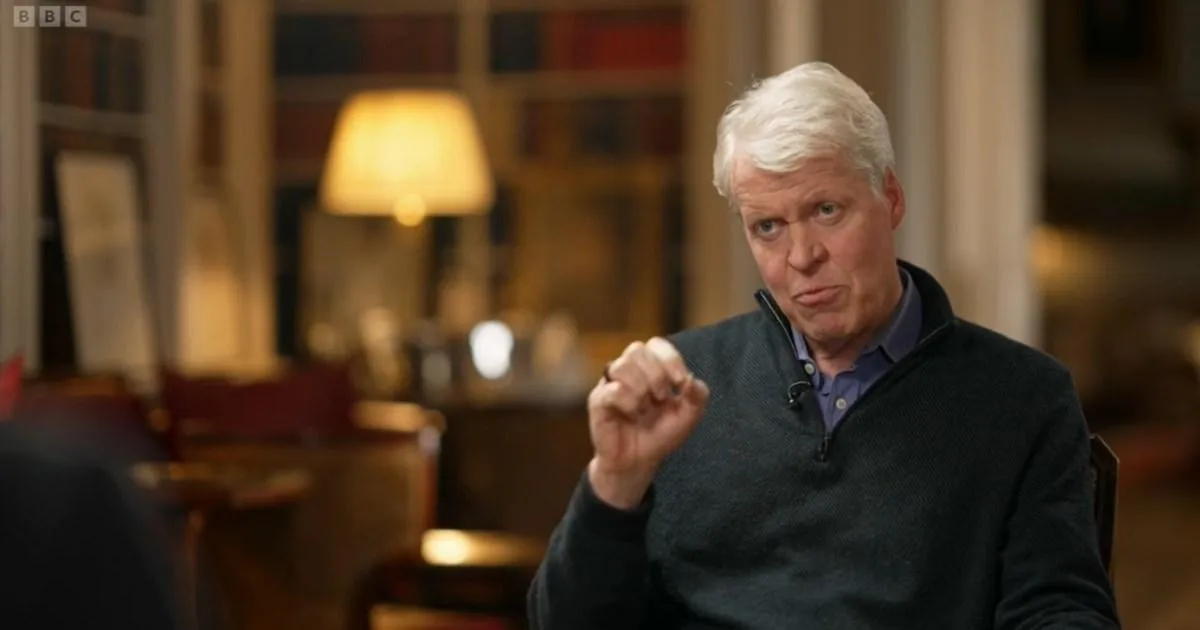
On a quiet Sunday evening, Earl Spencer sat down with the BBC’s Laura Kuenssberg, not as a man looking for sympathy, but as someone who seemed determined to set the record straight on his own terms. The interview was charged with the weight of decades-old grief, and it did not take long for the conversation to return to the raw, painful days following the death of his sister, Princess Diana. Spencer repeated his incendiary claim that King Charles, then Prince of Wales, sounded “giddily elated like a lottery winner” after hearing the news of Diana’s fatal car crash in Paris in 1997. Even more startling was his insistence that Charles told him, “Rest assured, we’ll forget her soon enough,” words that have echoed through royal history ever since. The Earl was not merely revisiting old wounds; he was defending his newly published memoir against a blistering statement from Buckingham Palace, which suggested that “the pain of fraternal grief can cloud reason, affect judgment and colour memory.” That phrase hung over the interview like a shadow, challenging the credibility of everything Spencer had written and said. But the Earl appeared ready for that challenge, sitting forward, making eye contact, and speaking with a kind of careful intensity that suggested he wanted viewers to see not just his anger, but his certainty. It was a moment of high emotion, family legacy, and contested memory, all played out on a public stage.
Body language expert Judi James watched the interview closely and noticed something that added a fascinating layer to Spencer’s testimony. She identified a repeated gesture that she called the “precision pinch,” made by bringing his index finger and thumb together as if holding something small and delicate. This is not a random or nervous habit, James explained, but a gesture that implies accuracy, exactness, and attention to detail. Spencer used it almost like a conductor’s baton, punctuating his sentences with a subtle but deliberate motion that seemed to say, “What I am telling you is measured, precise, and true.” The gesture became especially prominent when Spencer was challenged directly about his claim that Charles was elated after Diana’s death. Rather than backing down or softening his words, Spencer pinched his fingers together and said, “Every word I report exactly as I saw it and felt it at the time.” For James, this was a powerful visual cue. It suggested that Spencer believed he was being forensically accurate, even when his recollections were being questioned by the palace and, potentially, by the public. The precision pinch, she noted, is a gesture often used by people who want to emphasize that they are choosing their words carefully and that those words should be taken seriously. It is not proof of truth, of course, but it is a signal of conviction, and Spencer deployed it with remarkable consistency throughout the conversation.
Perhaps even more striking than the precision pinch was the way Spencer seemed to physically relive the events he described. At several points during the interview, he did not simply tell the story; he acted it out. When he spoke about receiving two phone calls from Charles after Diana’s death, Spencer mimed picking up a phone, holding it to his ear, and later hanging up. It was a small but powerful piece of storytelling that made the conversation feel immediate and visceral, as if he were transported back to that moment of shock and disbelief. James highlighted this as a key part of his body language vocabulary. “His delivery of his conversations with Charles also comes with that style of reliving the incident, complete with an upwardly pointed index finger and the precision pinch gesture before he mimes hanging up the phone,” she said. The combination of these gestures painted a vivid picture of a man who is not merely reciting facts from a distance, but who still feels the emotional weight of those moments. When Spencer recounted telling Charles, “You cannot believe you just said that, and I hang up on him,” his hands completed the action, closing the conversation just as he had closed it all those years ago. It was a moment that blurred the line between memory and present reality, and it made for compelling television. Whether or not every detail is exactly as Spencer remembers it, there was no mistaking the intensity with which he inhabited his own story.
James was careful to note that body language cannot distinguish between truth and lies, and that point is important. A person can gesture confidently and still be mistaken, or even deliberately misleading. But she also observed that Spencer’s overall display appeared “generally congruent.” In other words, his words, his facial expressions, and his movements seemed to align in a way that suggested authenticity, at least in that moment. His posture was open, his eye contact was direct, and he appeared willing to bare himself emotionally to the camera. Perhaps the most moving evidence of this came when Spencer’s eyes filled with tears at the thought of his happy childhood with Diana. In that moment, the guarded, argumentative tone softened, and viewers were given a glimpse of the brother behind the Earl, the man who had lost a beloved sibling far too soon. James described how the tears were accompanied by visible physical changes: his eyes reddened and moistened, and his voice crumbled and broke. These are difficult to fake convincingly, and they suggested that beneath the carefully chosen words and precise gestures, Spencer is still a grieving brother. It is one thing to make accusations about a king or to defend a controversial memoir; it is another to sit in front of millions of people and allow yourself to be seen in a moment of genuine vulnerability. For many viewers, that moment may have done more to humanize Spencer than any of his verbal arguments.
Beyond the body language analysis, the interview was packed with revelations that went to the heart of Spencer’s relationship with his sister and his own place in the royal story. He claimed that the secrets he revealed in his book would not come as a surprise to Prince William and Prince Harry, suggesting that the brothers already knew the darker details of their parents’ marriage and the difficult dynamics that surrounded their mother’s life and death. Spencer also recounted the harrowing night he learned of Diana’s accident, beginning with a call from his sister Lady Jane Fellowes, who told him that Diana had been in a crash but that it was “not too serious.” Those words, so ordinary and reassuring, soon proved tragically wrong. Spencer described how the news worsened step by step, from “a little prang” to a broken leg, then perhaps a head injury, and finally death. His retelling captured the cruel uncertainty of that night, the way hope slowly drained away as the reality became unbearable. Perhaps most explosively, Spencer shared a conversation in which Diana told him that the reason she was getting divorced was that “my husband is in love with his valet.” He also recalled his own warning to Diana that the public might be angry with her for “killing the fairy tale” they had all subscribed to. Those words, spoken in private between siblings, now carry an almost prophetic weight.
In the end, Spencer hinted that there may be more royal secrets that have remained hidden, but he seemed unwilling to be the one to reveal them. When Kuenssberg suggested that perhaps some family secrets are better left unsaid, Spencer agreed, adding, “They certainly are, and they have been left unsaid.” Yet he immediately closed the door on any further revelations, insisting, “Nope, that’s it. That’s me done.” It was a strange mix of openness and finality, as if he had said everything he needed to say and would now retreat into the quiet of his own memories. For viewers, the interview was a reminder that the story of Princess Diana is not just a public tragedy or a royal scandal; it is also a deeply personal story of love, loss, and the complicated bonds of family. Spencer’s gestures, his tears, his precise finger movements, and his insistence on accuracy all pointed to a man trying to reclaim control over a narrative that has been shaped by others for decades. Whether his version of events will be accepted as truth remains an open question. But on that Sunday evening, he made his case with all the tools at his disposal: words, memory, emotion, and even the subtle language of his hands. In doing so, he reminded us that grief does not always fade neatly with time, and that the past, however painful, has a way of demanding to be heard.