

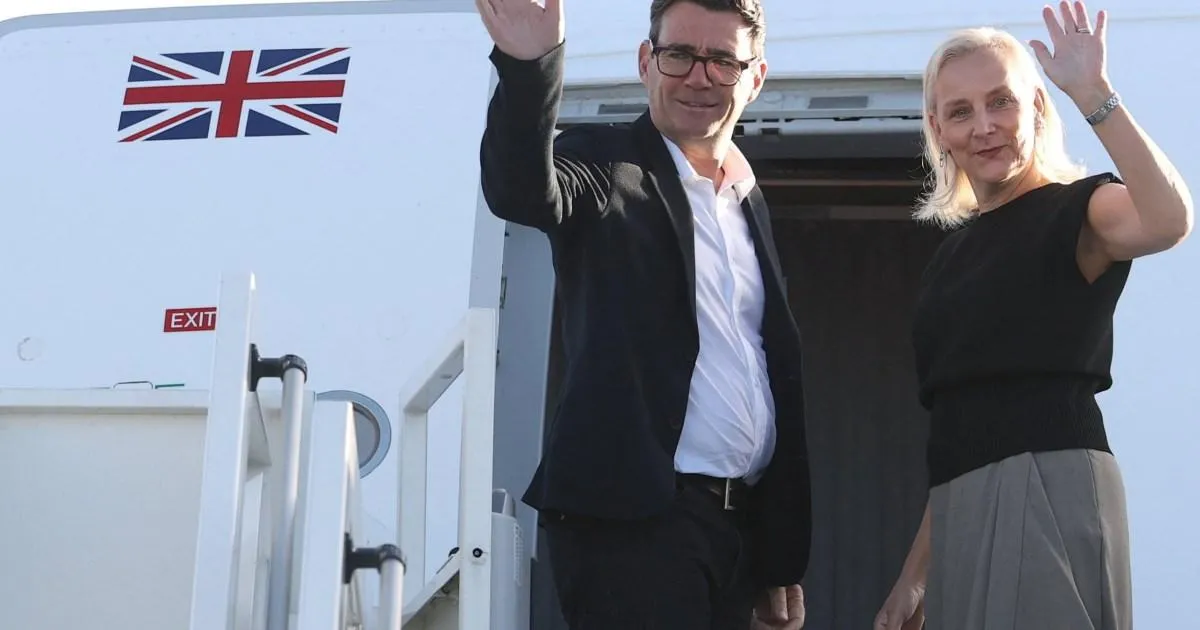
There is a particular kind of quiet that settles over a plane when you are flying into a crisis. The cabin hums, the coffee cools, and the world outside the window looks deceptively calm. For Andy Burnham and his wife, Marie-France Van Heel, the journey to New York for the 81st United Nations General Assembly should have been a moment of diplomatic ritual—another speech, another handshake, another round of talks about the future. But this time, the Prime Minister was carrying something heavier: a decision about war and peace. As he prepared to take his seat, the British public was beginning to understand what he had already agreed to. The UK would support Saudi Arabian fighter jets in their struggle against Houthi rebels in Yemen. British planes would provide air-to-air refuelling, allowing Saudi jets to stay airborne longer and travel further than they otherwise could. It was not a full military intervention. It was not even a bombing campaign. But it was a commitment of British military resources to a volatile and bloody conflict, and it had been made just hours before the Prime Minister left the ground. Burnham had not wanted to make this journey with a military mission already in motion. He had wanted to talk about global cooperation, about the ordinary concerns of ordinary people, about the kind of world-building that happens when leaders sit together in New York. But events had a different agenda. The Houthi rebellion had reignited, Saudi Arabia had asked for help, and the request had landed on his desk with a clock ticking. As the plane climbed into grey skies, the formalities of a UN gathering felt almost surreal. Here was a leader on his way to talk about a better world, carrying with him a decision to support a war. For Marie-France, the familiar squeeze of his hand may have said more than any briefing. Leadership is often lonely at 30,000 feet, especially when the ground below is still on fire.
The mechanics of this support are worth understanding, because they tell you something about the way modern conflicts are fought. The Voyager tanker is not a fighter plane. It is a flying fuel station, a giant, lumbering presence in the sky that exists to keep other aircraft flying. Based on the civilian Airbus A330-200 airliner, it has been reborn in the Royal Air Force as the Voyager KC2 or KC3, depending on the exact configuration. Its job is not to drop bombs or fire missiles. Its job is to meet up with other aircraft mid-air, connect a fuel hose, and transfer thousands of litres of jet fuel so that fighter jets can remain on patrol for longer. In the context of this mission, that means Saudi jets defending the kingdom against drones and missiles are able to stay in the sky for hours, waiting for threats that might come at any moment. Without refuelling, they have to return to base, leaving gaps in the defence. With a Voyager overhead, those gaps disappear. This is the line that Burnham and his advisers drew. The UK is not joining the fight against the Houthis. It is helping Saudi Arabia protect itself. The mission will be limited to supporting Saudi aircraft defending the country from attack from drones and missiles, rather than supporting strikes against the Houthis. That distinction matters. It means the UK is not helping to bomb Yemen. It is helping to protect a partner nation. It is a narrow, carefully defined role, and the Prime Minister was at pains to make that clear to anyone who would listen. A tanker is not a weapon, but it is a force multiplier. In a war where every minute of flight time counts, fuel is as crucial as ammunition. The RAF knows this well. The Voyager has been deployed in missions from the Mediterranean to the South Atlantic, and now it would be flying in support of Saudi Arabia. It is a role that requires precision, patience, and nerves of steel, especially when the skies are full of drones and the horizon can turn from calm to chaos in seconds.
Burnham was candid about how the decision came together. He said he had received a request from the Kingdom of Saudi Arabia for military support. On the advice of the Defence Secretary and the Foreign Secretary, he agreed to that request for defensive air-to-air refuelling. “That’s the agreement we’ve given,” he said, in the flat, matter-of-fact tone of a man who has spent hours in meetings and wants the public to understand the bottom line. The phrase “on the advice” does a lot of work. It separates the decision from personal instinct and puts it into the machinery of government. But it also reminds us of the weight. A Prime Minister is not an island. He needs people who know the risks, who have read the intelligence, who understand what the military can and cannot do. The Defence Secretary, Wes Streeting, and the Foreign Secretary, Ed Miliband, were by his side in that decision. What made it difficult was not just the conflict itself, but what it means for the British people. There are fears that the deepening Middle East crisis will add to cost pressures facing households. When you have a conflict in the Red Sea, a blockade on shipping, and a threat to oil exports, those things have a way of arriving on energy bills. Burnham was not just thinking about the skies over Saudi Arabia. He was thinking about the cost of heating a living room, the price of a tank of petrol, the inflation numbers that keep families awake at night. That is the uncomfortable arithmetic of modern foreign policy. Every decision to help fight a war abroad also has to be measured against the cost of living at home. The Prime Minister’s words were careful, but the anxiety behind them was real. He was trying to balance Britain’s role in the world with the quiet fears of ordinary people who do not want to see their bills rise because of a conflict thousands of miles away. And that balance, as any leader will tell you, is never easy to hold.
To understand why a British Prime Minister would say yes to such a request, you have to look at the conflict itself. The Houthis, backed by Iran, control a great deal of Yemen and have a stranglehold over the country and its maritime trading routes. In recent weeks, the war between them and Yemen’s Saudi-backed government has reignited. The Houthis have aimed missile and drone strikes at Saudi Arabia, including one that targeted Riyadh. They have also declared a blockade on Saudi shipping in the Bab el-Mandeb Strait and the Red Sea. That strait is one of the narrow points of global commerce. Nearly every ship moving through the Suez Canal has to pass through it. If the Houthis can threaten that threshold, they can threaten the entire world’s supply chain. They have attacked vessels linked to Saudi Arabia and oil facilities inside the kingdom, which remains the world’s top oil exporter. A strike on a refinery, a missile over the capital, a drone buzzing over a port—these are not just regional incidents. They move the price of energy across the globe, and that means they move the price of everything else too. For Britain, a country that imports a great deal of its energy, this is not an abstract problem. When the Red Sea burns, British bills rise. When a cargo ship is attacked, insurance rates climb. When oil production is threatened, the global economy shudders. The Houthis know this. It is part of their strategy. They are not simply fighting to control Yemen. They are fighting to have a say in the global order, and they have chosen the world’s most important maritime artery as their battleground. Saudi Arabia, which has long seen itself as the guardian of stability in the region, cannot simply ignore that challenge. It has asked for help, and the UK has agreed to provide a limited, defensive form of assistance. The hope is that this show of support will be enough to deter further attacks, without dragging Britain deeper into a war that has already caused so much suffering.
The mission itself will not be open-ended. The RAF’s Voyager tanker is expected to begin its role within days. Officials say the mission will be time-limited, with some suggesting it could last for weeks. But in a conflict this volatile, “weeks” is an eternity. It is also a careful piece of language, because it reassures everyone that Britain is not being drawn into another endless war. The moment the mission begins, crews will be flying sorties over the region, meeting Saudi jets in the air, linking up with hoses, transferring fuel. It is delicate, dangerous work. Flying close to another aircraft in the sky requires skill and trust. Doing it in a warzone, where drones are buzzing and missiles are flying, raises the stakes considerably. But the tanker’s role is defensive. It is not supporting strikes against the Houthis. It is supporting Saudi aircraft defending the country from attack from drones and missiles. That is the boundary Burnham has set. It is a line that can be defended in Parliament, in the press, and in the living rooms of voters who are tired of war. It says: we are not choosing sides in the broader battle for Yemen. We are helping a close partner defend itself. Whether that boundary holds remains to be seen. Conflicts have a way of blurring lines, and the Middle East has a long history of drawing in outside powers despite their best intentions. But for now, the parameters are clear, and the decision has been made. The Voyager is based on a civilian airliner, which means the crew will be operating a familiar aircraft in an unfamiliar environment. It is one thing to fly a tanker over Europe. It is another to fly it over the Red Sea, where the Houthis have already shown they can reach out and touch their enemies. The mission will require constant communication, not just with Saudi forces, but with other allies in the region. It will also require a clear exit plan. The government has promised this will last weeks, not years. But in the past, such promises have been broken, and that is why the Prime Minister is likely to face sharp questions at home as well as at the UN.
As the plane continued toward New York, the weight of the decision followed Burnham into the sky. New York is a city of speeches, and the UN General Assembly is where world leaders perform their best versions of themselves. But behind the polished phrases, there is always the burden of what has already been decided. Burnham will be asked about Saudi Arabia. He will have to explain why the UK is helping the Saudis, why now, why not more, why not less. He will face activists who believe Britain should not be involved at all, and allies who wish it would do even more. Those are not easy conversations. But he will also be carrying the memory of Marie-France’s presence, a familiar hand in an unfamiliar pressure. She has been with him through many political storms, and she knows what these trips cost. For Burnham, the human side of the conflict is never far away. Yemen has suffered years of war, and the Houthi threat has made it worse. Saudi Arabia lives under the constant threat of missiles. British families are worried about the cost of everything. There is no clean answer, no decision that makes everyone happy. But there is something to be said for a leader who is willing to make the call, to set a limit, and to take responsibility for it. The Voyager tanker that will soon take off represents a careful, defensive role. It is not a declaration of war. It is not a blank cheque. It is a response to a request, made in real time, on the advice of ministers, with the cost of living in mind. As the lights of New York appeared on the horizon, the easy part was over. The plane was still moving, but the decision had already landed. And somewhere in the quiet hum of the cabin, Andy Burnham knew that the hardest part was not the decision itself, but explaining it to the world—and to himself.