
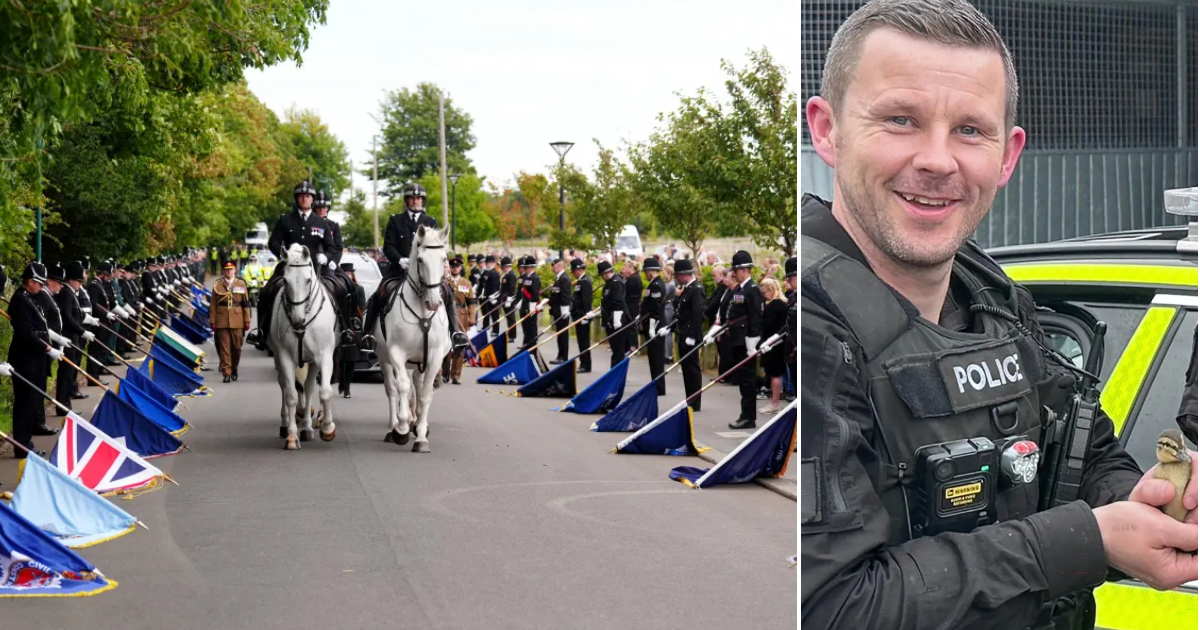
It began in silence, a silence so heavy it seemed to hold the whole town still. Hundreds of police officers lined Plantation Road and the road leading into Kirkleatham’s Walled Gardens, their faces fixed, their polished boots gleaming in the soft English light. They had travelled from force after force, not because orders demanded it, but because something deeper compels those who wear a uniform to say goodbye to one of their own. Beside them stood Army veterans in dark suits decorated with medals, and soldiers in ceremonial dress, all waiting to honour a man whose life was cut short on the A66. Tom Clough had served in the British Army from 2006 to 2012 as a lance corporal with the Royal Logistic Corps, and his final Army posting was with 11 Explosive Ordnance Disposal and Search Regiment. He had then continued to protect the public in the Civil Nuclear Constabulary, the British Transport Police and, finally, Cleveland Police. Now his coffin, draped in the Union Flag with a police helmet resting on top, was being carried past them through an avenue of respect. Standard bearers from every force in the country held their banners in solemn stillness and lowered their flags as the hearse approached. Four mounted police officers led the cortege, their horses calm and steady, while police motorcycle riders and a marked Cleveland Police Audi followed with blue lights flashing but no sound. The procession moved at a walking pace, as if trying to hold back the final goodbye. Then a piper began to play a lament, and its notes carried over the crowd, through the gardens and into the silence of the afternoon. The road into the Walled Gardens had become a corridor of memory, a living guard of honour made of hundreds of men and women who understood the cost of protection. There were no cheers, no applause; just a collective breath, held by a community that had lost a protector. The young, the old, the retired and the active all stood together, proving that grief can bind strangers, and that the death of one officer can shake thousands of hearts.
Tom Clough’s story was never only about the final tragedy. It was about a life lived in service, and about the small moments that made him so loved. After leaving the British Army in 2012, he joined the Civil Nuclear Constabulary and worked at Sellafield in Cumbria, where he helped guard one of the most sensitive sites in the country. He later transferred to the British Transport Police, before finding a permanent home at Cleveland Police as an armed response officer. Each role required courage, alertness and a readiness to put himself in danger for people he had never met. His military service shaped him, but it did not harden him; it taught him discipline and teamwork, and it gave him a deep understanding of what it means to protect others. Yet those who knew him remember more than his professional record. They remember a funny, loyal man who would give everything to everybody; a colleague who was deeply loved; a man whose friends from years earlier reached out to say how much he had meant to them. Lauren Somerville, chairwoman of Cleveland Police Federation, put it plainly: every place Tom served was privileged to have him. She also spoke of the family’s grief, and of the comfort they had drawn from the public’s support. But perhaps the most human detail is his little sausage dog, Frank. Tom was not just Frank’s owner; he was Frank’s “father,” a man whose kindness extended even to a small, loyal dog with a wagging tail. He was also a partner, a son, a brother, and a fiancé. In a moment of modesty, Tom once joked that there would not be anyone at his funeral. It was the kind of joke that says more about a person than any medal: he genuinely had no idea how many lives he had touched. The immense turnout, the hundreds of officers, the veterans, the families and the strangers who travelled miles to stand in silence, all testified that he was wrong. His death, when it came, was shockingly sudden, but his life had been full of meaning. The man who had prepared for every threat on the roads and in the streets could not have prepared for the outpouring of love that followed him to his final resting place.
The funeral service itself was a study in quiet, overwhelming dignity. It took place at Kirkleatham, where the Walled Gardens offered a serene and beautiful setting for a day of sorrow. The cortege had been flanked by soldiers in ceremonial dress and veterans displaying their medals, and the procession was led by four mounted police officers, their horses perfectly trained for an occasion that required nerves of steel. Behind them came police motorcycle riders and a marked Cleveland Police Audi, its blue lights flashing in silence. There was no hurry, no urgency; every step was measured, every movement deliberate. Standard bearers from every force in the country lowered their flags as the hearse passed, a wave of colour bowing in respect. Inside the crowd were dignitaries who had set aside politics to pay tribute: Policing Minister Sarah Jones, Redcar MP Anna Turley, and Tees Valley Mayor Lord Houchen. Their presence was a reminder that Tom’s service had been recognised far beyond the boundaries of Cleveland. But the true power of the day came from the ordinary people, the residents who lined the streets, the acquaintances who had never met Tom but felt the loss all the same. The slow procession started in silence, and the silence was broken only when a piper began to play a lament. The sound of the bagpipes, mournful and ancient, seemed to echo off the walls and wrap itself around the mourners. Inside, stories were told that made people smile even as they wiped their eyes, for Tom had been known for his humour as much as his dedication. At the heart of the service, Tom’s coffin, draped in the Union Flag with his police helmet on top, was carried by colleagues and comrades, the weight of it heavy in every sense. For the officers standing at attention, this was the second such funeral in as many days, because PC Matthew Blades had been laid to rest in Hartlepool the previous afternoon. The emotional toll was visible on many faces. Afterwards, mourners lingered, reluctant to break the spell of shared remembrance. Many reached out to touch the shoulders of officers in uniform, a gesture of solidarity that did not need words. It was a farewell worthy of a man who had worn two uniforms and given both his country and his community everything he had.
The words spoken after the service, especially by Redcar MP Anna Turley, captured the collective heartbreak. Her voice, steady but clearly moved, gave a human face to official grief. She stood outside Kirkleatham and described the turnout as “truly incredible.” Huge numbers of local people, she said, had joined Tom’s police and Army colleagues in a fitting display of respect and gratitude. It was an honour, she added, to join Tom’s family, friends and colleagues in remembering him. But her remarks went deeper than the formalities of a politician. She spoke of the insight the service had given into the funny, loyal, brave and kind person Tom was. She spoke of the enormous love so many had for him, and the deep respect in which he was held throughout all the roles he had taken on in public service. “Tom served our country and our communities with commitment and courage,” she said. “His service will never be forgotten.” Her thoughts were with those closest to him, especially his mother, father, brother and fiancé, as they came to terms with a loss that no family should have to bear. And then, with a tenderness that made the grief feel intimate, she added: “not forgetting their little dog Frank.” That simple mention of the dog, the animal Tom had doted on, brought home the reality that grief lives in small things. There would be no more walks with Frank, no more quiet evenings with the little dog curled at his feet. The public may remember PC Clough as a hero, but his family and fiancé have to live with the absence of a man who was funny and loyal, who made ordinary days feel brighter. Anna Turley’s tribute ended with a simple “Thank-you for your service, Tom.” Those words, directed at a British Army veteran and a police officer, were spoken on behalf of a grateful country. They were a reminder that although Tom may have joked that nobody would come to his funeral, that joke was answered by an entire community standing in the cold to prove him wrong. In the days before the funeral, Tom’s family had said that the public’s support had brought them so much comfort; those words made it clear why. It was not a speech built from talking points, but a tribute from the heart, and it gave the mourners permission to let their own grief spill over.
The public’s response was a powerful reply to those who feel that police work goes unappreciated. Brian Dunn, 89, and his wife Iris, 87, had taken a train, then a bus, then walked from their home in Stockton just to be there. Mr Dunn, who proudly remembered doing national service, said it was heart-warming to see so many people. Mrs Dunn was just as clear: “The police work so hard, they do their best, and it is never appreciated, we all know that.” For them, and for many others, this funeral was not only about one officer; it was about every officer who puts on a uniform and never knows what the day will bring. A woman from Redcar, who preferred not to be named, said she had come to pay her respects because what happened was terrible. “I came to show the police that the right part of society is behind them, most definitely.” That sentence was direct and powerful. Meanwhile, the police family itself was still trying to make sense of the loss. Lauren Somerville, chairwoman of Cleveland Police Federation, said that Tom was deeply loved by his colleagues and that people who had worked with him years earlier had contacted her to express their grief. “It would be an understatement to say that every single place that he served was privileged to have him with them,” she said. She also revealed that Tom had described himself as the “father” of his beloved sausage dog Frank, a small detail that made his loss feel very human. “Tom used to say there wouldn’t be anyone at his funeral and he couldn’t have been more wrong,” she added. “Tom was described as giving everything to everybody.” Those words captured the essence of a man who never stopped putting others first. The presence of so many people, from so many different walks of life, was proof that the love he gave came back. For every uniformed officer on the street, there were residents who shook their hands or simply nodded, a quiet expression of solidarity that needed no words. It was a humbling sight, ordinary people standing in extraordinary silence. The elderly couple stood among a crowd of strangers, yet they were united by shared grief.
The tragedy on the A66 in the early hours of August 22 is one that will not fade quietly. PC Clough was killed alongside his colleague PC Matthew Blades when a VW Passat, which had been involved in a police pursuit, collided head-on with their vehicle near Middlesbrough. Five young men in the Passat also died. Seven families were left shattered. In the days that followed, an online fund to support the officers’ families raised more than £1.2 million, an extraordinary outpouring of public sympathy. The day before Tom’s funeral, PC Blades had been laid to rest in his home town of Hartlepool. Some of the officers who attended both funerals wore identity patches on their uniforms reading “PC 2443 BLADES” and “PC 3234 CLOUGH,” a quiet way of carrying their fallen colleagues with them. Cleveland Police Chief Constable Victoria Fuller described the two officers as “brave, committed, professional people who put the public before themselves.” Cleveland Police also said that the five young men who died may have had links to organised crime, a detail that makes the whole tragedy even harder to understand. The investigation continues, and questions remain; but grief does not wait for answers. On this day, at Kirkleatham, the focus was on the life of Tom Clough. He had served his country in the Army, protected the country’s nuclear industry at Sellafield, kept passengers safe on the railways, and finally served as an armed response officer with Cleveland Police. He was a soldier and a police officer, a son and a brother, a fiancé and a friend. He was the man who loved his little dog Frank and joked that nobody would come to his funeral. How wrong he was. The silent streets, the lowered flags, the mounted officers, the veterans, the elderly couple who walked miles, and the hundreds who stood in the cold all told a different story. They told the story of a life that mattered, a life that will be remembered, and a loss that will be felt for years. The piper’s lament has faded, the flowers will wilt, and the crowds will move on. But the image of PC Tom Clough’s Union Flag-draped coffin, passing through an avenue of people who refused to look away, will stay with everyone who witnessed it. His service is over, but it will never be forgotten. For Tom’s family, the public’s support has been a small light in the darkest days, and in time the fond memories of his humour, his courage and his kindness may bring some comfort. The force continues to grieve, but it also continues to serve, because that is what Tom would have wanted.