


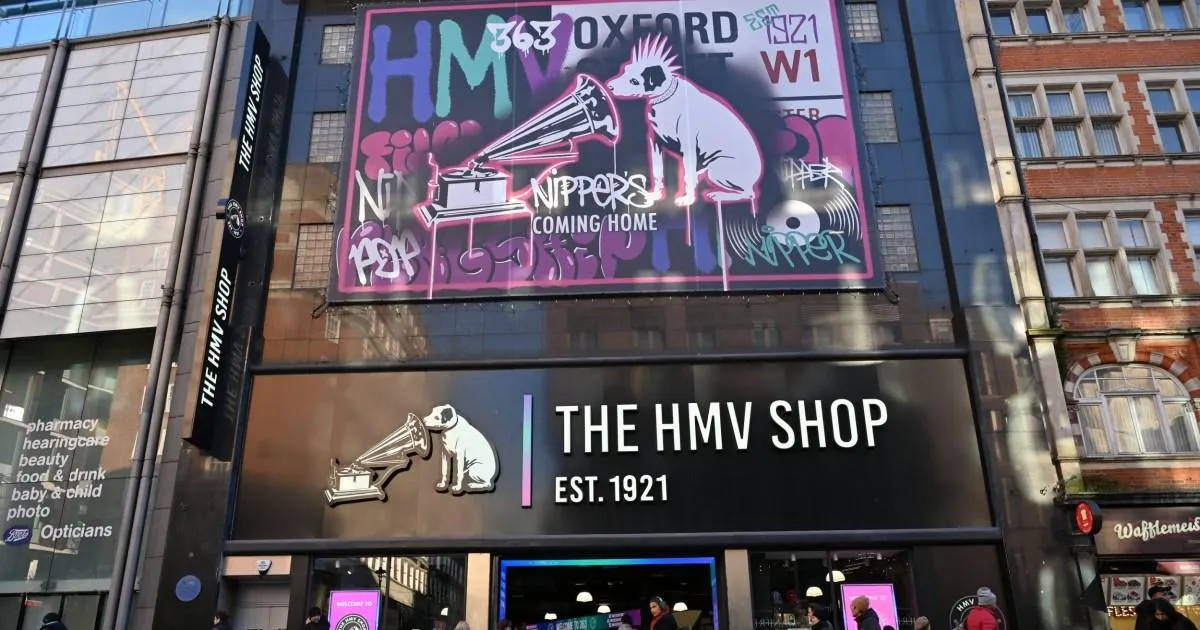
There is something profoundly disheartening about the news that HMV’s iconic Oxford Street store is closing its doors once again. For generations of music lovers, 363 Oxford Street was never just a shop; it was a pilgrimage site, a treasure trove of vinyl, CDs, posters, and endless hours of joyful browsing. It was the place where you went to discover a band you had never heard of, to hold a record in your hands before deciding it was worth your pocket money, and to feel the pulse of popular culture in a way that no algorithm could ever replicate. The store first opened in 1921, and for over a century it stood as a symbol of entertainment retail in Britain, surviving wars, economic crashes, the rise of digital downloads, and the seismic shift towards streaming. It seemed almost miraculous when, in November 2023, after a four-year absence, HMV made a triumphant return to this historic address, with members of the band Madness opening the shutters and fans celebrating what felt like a victory for the high street. Now, just three years later, the shutters are set to close again, and the news has landed with a heavy thud for the roughly fifty workers whose jobs are affected and for the countless customers who had dared to believe that the flagship had found its footing once more.
The immediate reason for this latest closure is depressingly familiar in the world of physical retail: money. HMV’s bosses have blamed a doubling in the rent demanded for the site at 363 Oxford Street, alongside a bill for what they describe as “substantial” renovation works that the building now requires. Together, these costs have made the store “commercially unsustainable,” a phrase that feels cold and clinical when applied to a place with so much history and emotional weight. Phil Halliday, HMV’s managing director, did not hide his frustration. He called the store “special,” noting that it was where the company began a hundred years ago and that bringing it back to life in 2023 was a big moment in HMV’s recent history. But he also made it clear that the company is not dwelling on the loss. Instead, the focus is on the future, with Halliday speaking of “exciting steps for HMV in 2027.” The company is actively searching for a new location in London’s West End, determined to maintain a “significant presence” in the capital. The Oxford Street store is one of only three HMVs in London, and the hope is that affected team members will be redeployed to other London stores or into head office roles. It is a plan that offers some comfort, but it cannot erase the sting of losing such a landmark.
To understand why this closure feels so personal to so many, it helps to remember the full arc of HMV’s story. The Oxford Street store first opened its doors in 1921, the original flagship of a company that would grow into a beloved British institution. For decades, it was the place where music fans gathered for midnight releases, where artists performed intimate in-store sets, and where the simple act of buying an album felt like a ritual. But the rise of online retail and streaming took a brutal toll. In 2019, HMV tumbled into administration, and the Oxford Street store was forced to close, joining a wave of high street casualties. The company was salvaged from insolvency by Canadian entrepreneur Doug Putman, whose Sunrise Records business stepped in to rescue around 100 stores and roughly 1,600 jobs for an undisclosed sum, though 455 people were made redundant in the process. Putman declared himself “delighted to acquire the most iconic music and entertainment business in the UK,” and his confidence seemed justified when HMV reopened the Oxford Street site in November 2023 after a four-year absence. The reopening created 70 new jobs and was hailed as the creation of “a hub for entertainment in the capital,” a sign of a “dramatic turnaround” for the business. Madness, fittingly, were on hand to mark the occasion, and for a brief, hopeful moment, it felt as though the high street might just be able to hold its own against the digital giants.
What makes this latest announcement so strange is that it comes at a time when HMV, as a business, is reportedly doing rather well. The company currently operates 113 stores across the UK, including six sites under the Fopp brand, as well as another eight in Europe. Like-for-like sales were up 15% across the group in the first nine months of 2026, and revenues for both shops and online trading are set to reach over £240 million this year, up from £212 million in 2025. These are not the numbers of a dying retailer. They suggest that there is still a real appetite for physical music, for vinyl records, CDs, merchandise, books, and all the other treasures that HMV sells. The group has said it remains committed to high street stores, and Halliday has insisted that the closure plans are not a retreat but a repositioning. Yet the paradox is hard to ignore: a successful company, with growing sales and a loyal customer base, is being forced out of its own flagship because the cost of occupying that space has become too great. It is a stark illustration of the pressures facing physical retail in prime locations, where rent hikes and maintenance bills can outweigh even the most robust trading figures. The store may be full of customers, but if the landlord doubles the rent and the building needs expensive repairs, the numbers simply stop adding up.
For the fifty or so workers at the Oxford Street store, this news brings a familiar knot of anxiety. Even with promises of redeployment, the uncertainty of not knowing where you will be working, or whether you will have a job at all, is a heavy burden. HMV has said it hopes to redeploy affected team members through other London stores and head office roles, and that it is exploring ways to minimise the impact on jobs while it seeks a new flagship site. But for the wider community, the loss is more than just a matter of employment. HMV Oxford Street was a cultural landmark, a place where music fans could feel a sense of belonging. It was a space for browsing, for discovering, for talking to staff who genuinely cared about music, and for stumbling upon something you never knew you needed. In an age of algorithms and instant gratification, that kind of physical experience is increasingly rare. Halliday’s promise that the company is “actively looking for a new location in the West End” and is “determined to give London a store that music fans can be proud of” offers a glimmer of hope. But there is no guarantee that a new site will capture the same magic, the same sense of history, or the same place in the city’s heart. The search for a new home is a reminder that even the most beloved institutions are not immune to the cold realities of commercial property.
As HMV looks ahead to 2027, there is a sense that this could be a moment of reinvention rather than an ending. The company has weathered storms before, and its continued growth suggests that there is life in the physical music retail model yet. Perhaps the next flagship will be smaller, more curated, more experiential, with space for live performances, listening stations, and community events. Perhaps it will be a store that embraces the nostalgia of its heritage while finding new ways to attract younger fans who have grown up in a world of streaming. The closure of 363 Oxford Street is undoubtedly a blow, but it is not necessarily the final note in HMV’s song. The company’s history is one of resilience, from its beginnings a century ago to its rescue from administration and its triumphant reopening. The challenge now is to take the lessons of the past and build something that can survive the pressures of the future. For the workers, the customers, and the music lovers who have made HMV a part of their lives, the hope is that the next chapter will be worthy of the legacy. The shutters will close on Oxford Street, but the music does not have to stop. HMV’s story began a hundred years ago in the heart of London, and with a little luck and a lot of determination, it will find a new home in the West End, ready to play on for another generation.