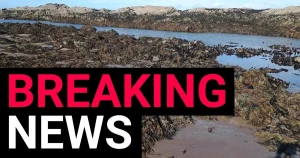



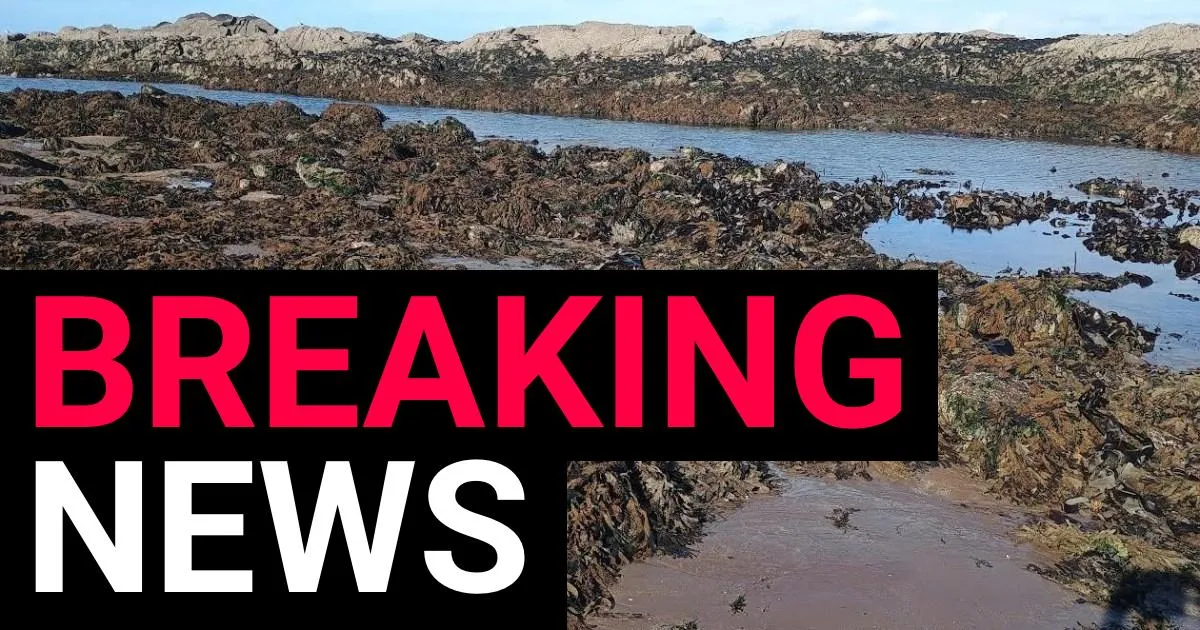
There is a special kind of quiet that settles over a beach at low tide, when the water retreats far out and leaves behind a landscape of wet sand, rock pools and stranded things. It was in that hush, on a late September morning, that Rob, a 61-year-old North Berwick resident, found himself walking his labradoodle along the sweeping stretch of coast between Muirfield Beach and Eyebroughy Beach in East Lothian, near Edinburgh. He and his wife had made the walk countless times;;the dog knew the rhythms of the shore as well as they did. But on September 28, something new was waiting among the rocks. At first glance it could have passed for a length of abandoned pipe, one of those odd industrial relics that occasionally surface after a storm. It was roughly three metres long, thick as a drainpipe, sheathed in rust and stubborn patches of seaweed that gave it the look of something that had been underwater for a very long time. It lay right down on the foreshore, exposed by an unusually low tide, wedged between rocks. Rob stopped. He knew this beach intimately; he walked there at low tide frequently, and he was certain this object had not been there before. It had arrived recently, carried in by the sea, left behind like a message inbox bottle. And the more he looked at it, the more he felt that familiar prickle at the back of his neck: this was not driftwood, not a piece of fishing gear, not a gas canister. It was something else, something heavier, something with a purpose. He did not know yet that it was suspected of being a Second World War torpedo. He only knew that the beach had given up something that did not belong to the present, and that he should not get too close. His wife stood beside him, the labradoodle tugging gently at the lead, oblivious to the rusted cylinder lying a few paces away. The tide was still out, but it would not stay out forever. Rob took out his phone, photographed the object from a safe distance, noted its coordinates, and decided he would contact the Coastguard once they got home. It was, he later told Metro, a moment of surprise and caution. The surprise was easy to explain;;the caution was a feeling, but a useful one. He had heard stories of ordnance being washed up on this coast before, and now he wondered if he had just found the next chapter in that strange history.
Back home, still thinking about the dark shape on the foreshore, Rob did what most of us would do: he started searching online. He typed descriptions of what he had seen—large rusty metal tube on beach—and scrolled through photographs of discarded pipes, old boilers, mysterious debris. Then he came across a poster from the Coastguard, and his breath caught. The photograph in the poster showed an object that looked identical to the one he had photographed that morning. The caption was blunt: “This isn’t a gas canister, it’s a torpedo.” In that moment, Rob realized what they had stumbled upon. It wasn’t just an old piece of metal—it was possibly a live piece of military history, something that could still be dangerous after decades underwater. He began to find more reports of unexploded ordnance being found around the UK coastline, including cases in his own region, East Lothian. There was something sobering about seeing the pattern: these things were not as rare as people might think. The sea, which gives pleasure to swimmers, surfers and walkers, also keeps silent custody of relics from old wars. Sometimes, during a very low tide, it hands them back. Rob and his wife did not hesitate. They had already taken the sensible step of photographing the object and recording its coordinates;;now they followed through, contacting HM Coastguard. It was not a panicked call, but a careful one. He explained what they had seen, where exactly, and how big it was. The Coastguard asked him to email his photographs. They studied them, then gave a response that was both reassuring and strangely matter-of-fact::theitem was a “fair size,” they said, and they would “send the boys in green” to assess and identify it at the next low tide in daylight. That phrase—“boys in green”—stuck with Rob. It made the whole thing feel less like an emergency and more like a carefully planned operation, the kind of thing that happens more often than holidaymakers realize along Britain’s military-scarred shores. The wait must have been strange::knowing that just below the tideline, a potential torpedo was lying in the open, waiting for the experts to arrive. But he had done exactly what he should have done: kept his distance, reported it, let the people who knew what they were doing take over.
HM Coastguard later confirmed to Metro that a report of a possible piece of ordnance on Gullane Beach had come in at around 3pm on Friday, September 28. The North Berwick Coastguard Rescue Team was sent to the scene, and Police Scotland was informed. An Explosive Ordnance Disposal team—the EOD—attended and established that the item was safe. Those last three words—“established the item was safe”—were what everyone needed to hear. But notice what the Coastguard did not say::they did not confirm whether it was actually ordnance. It might have been a torpedo, or a practice round, or something else entirely. It might have been harmless, or it might have been a reminder of just how close the past can swim. What mattered was the outcome::no one was hurt, no dramatic controlled explosion was needed this time, and the beach was left to return to its usual quiet. For Rob, there was probably a strange mix of relief and anticlimax. On one hand, you do not want a live torpedo lying on your beach. On the other, there is something undeniably dramatic about the idea of waking up a wartime relic, watching the experts descend, and hearing them pronounce it safe. This is a beach that has seen similar before. The Coastguard’s response was routine in the best possible sense::they had protocols, they had seen this before, they knew what to do. Their statement was calm, almost clinical, but behind it was a system designed to keep the public safe. And Rob, who had done his part by reporting the find rather than poking it, had helped that system work. It is worth remembering that a torpedo, even a suspected one, is not something to roll aside with your foot or take home as a souvenir. The advice from safety authorities is simple and blunt::iffind something on the beach that is an unusual size or shape, especially if it is rusty, it could be unexploded ordnance. Do not touch it. Do not move it. Call 999 and ask for the Coastguard. It may feel like an overreaction, but it is the reaction that keeps people alive. For Rob and his wife, that morning walk along the stunning East Lothian coastline became one of those stories they would not soon forget, a reminder that peace and danger can lie side by side, separated only by a strip of wet sand and a very low tide
This stretch of coastline, roughly 23 miles east of Edinburgh, is celebrated for its beauty. It is also, increasingly, known for its surprises. The beach where Rob made his find sits just a stone’s throw from the exclusive Renaissance and Muirfield Golf Clubs, the former of which hosts the Genesis Scottish Open each year. This year, golfing legends including Rory McIlroy, Scottie Scheffler and Bob MacIntyre walked those immaculate fairways, a world away from the rusted cylinder lying on the foreshore. But the same sea that frames those picture-perfect views has a long memory. Only a week before Rob’s discovery, on September 21, the North Berwick Coastguard Rescue Team and EOD experts were called to the nearby Broad Sands Beach following reports of a possible unexploded item. That time, the object was examined and found to be a 20lb artillery shell, which was taken away for safe disposal. The coincidence was striking::two beaches, a week apart, both giving up remnants of military training or conflict. And in July, even closer to home, a World War II bomb containing “highly explosive material” was found on Belhaven Bay Beach in Dunbar, only about 15 miles from where Rob would later find his torpedo. EOD teams carried out a series of controlled explosions to ensure the bomb was safely disposed of, turning a quiet stretch of coastline into a temporary exclusion zone. Thenews of these discoveries tends to arrive in short, cautious statements, but the stories behind them are long. These ordnance pieces date back decades, to times when the coast was a training ground, a frontline, or a dumping ground for military equipment. Storms, currents and shifting sands gradually uncover them, and each one is a small historical echo, a physical reminder of wars that ended long ago but have not completely released their grip on the landscape. Rob himself has had a similar encounter in the same area before. A previous year, he said, he and his wife were approaching this same beach when they were turned back by a friendly policewoman who was part of a cordon. Something had been found, something that needed to be dealt with before the public could pass. They never saw what it was, but they understood::this was not the first time, and it would not be the last. The coastline, he noted, was“stunning,” but stunning places are not always empty places. They carry their history beneath the surface, literally, waiting for the right tide.
What should a beachgoer do if they encounter something like this? The Coastguard’s guidance is worth repeating, because it could one day save a life. They recommend that people“always be mindful” of anything they find on the beach. “If you find something on the beach that’s an unusual size or shape, especially if it’s rusty, it could be unexploded ordnance.” That sentence is perhaps the most important piece of beach safety you will ever read. It does not matter whether you are in East Lothian, Cornwall, Norfolk, or the Scottish islands::unexploded ordnance can turn up anywhere, because Britain’s coasts were heavily militarized during the wars, and even after, and the sea does not discriminate. The Coastguard goes on to say that while“it is very rare to find unexploded ordnance on a visit to the beach, it’s important to be cautious, as ordnance can come in all shapes as sizes.” That last phrase is crucial. Not everything that looks like a torpedo is a torpedo, and not everything dangerous looks like a weapon. It can be encrusted in rust, covered in barnacles, half-buriedin sand, disguised as junk. It can be large or small, obvious or subtle. The safest approach is to assume nothing and treat anything suspicious as potentially hazardous. If you do come across something on the beach that you are unsure of or suspect could be unexploded ordnance, the instructions are clear::please do not touch it or move it. Call 999 and ask for the Coastguard. That may sound dramatic, but it is far better to make an embarrassing call than to risk an explosion. The experts would rather come out and find a harmless piece of pipe than hear that someone had picked up a live shell and carried it to their car. For Rob, the decision to keep his distance was instinctive, but it was also informed::he knew these finds happen, he had been turned back from a beach before, and he understood that the“boys in green” were trained for exactly this. There is no shame in not knowing what an object is. There is only danger in assuming it must be safe because it is old, or rusty, or half-buried. Thesea is a patient and powerful force. It has been known to take things from people and to give things back. Sometimes what it gives back is a piece of driftwood, a message in a bottle, a child’s lost toy. And sometimes, on a low tide in a beautiful bay, it gives back a piece of history that demands to be treated with respect.
In the end, Rob’s discovery turned out to be safe, at least according to the Coastguard. But the story does not really end there. It lingers, like the tide inching back over the rocks, because it is a reminder of something deeper. We like to think of our coastlines as places of leisure, relaxation, clean air and beautiful views. They are all of those things, of course. But they are also places of memory, where the past can resurface without warning. A man walking his labradoodle ona stunning beach in East Lothian expected to see seabirds, rock pools, maybe the distant figures of golfers on immaculate greens. Instead, he saw a three-metre-long tube of rusted metal, and for a moment, the whole weight of history settled onto the shore. It must have been a strange feeling, standing there in the wind, looking down at something that might once have been designed to destroy, now harmless baked in seaweed and salt. The dog did not care. The gulls did not care. But Rob and his wife will probably never look at that stretch of coast in quite the same way again. They did the right thing, and the Coastguard did its job,,and the beach remains as beautiful as ever. That is often how these stories go::quietly, safely, with nobody hurt and no headlines beyond a few paragraphs. But every so often, the outcome is different, which is why the advice is so important. If you find something unexpected on the shore, stop. Take a photograph, note the location, and call the Coastguard. Do not treat it as a curiosity. Do not attempt to move it. Let the experts decide. It might be a gas canister, a piece of agricultural machinery, or an old boiler. Or it might be a torpedo. And if it is, you want to be standing well back when the experts arrive, not crouching over it with a stick. The sea keeps many secrets, but occasionally it reveals one. When it does, the best thing any of us can do is respect it, admire it from a distance, and hand it over to those who know how to handle it. For Rob, that late-September walk became one more story in a lifetime of walking the same beaches, one more reminder that the British coastline, for all its beauty, is never entirely tame. And that is perhaps the most human truth of all::we share these shores with a history we can never fully see, and we must learn to live alongside it, carefully, wisely, and with a little wonder.