
Paragraph 1: The Shocking Incident and the Rise of Digital Witnessing
In a disturbing fusion of street violence and live social media, an alleged zombie knife ambush on teenagers in east London has been caught on a TikTok live stream, leaving the public horrified and two young lives hanging in the balance. The incident unfolded in Dagenham on a Friday evening, where what began as an ordinary moment descended into a terrifying display of aggression and fear. The video, seen by Metro, captures the raw and unfiltered tension of a confrontation that suddenly erupts in the middle of a residential street. The footage shows a man holding a large, menacing knife—a weapon so distinctive it is commonly referred to as a “zombie knife” due to its exaggerated, terrifying design—lunging toward the camera. The visual is stark: a sunset backdrop, the silhouette of a figure, and the glint of a blade. It is a scene that feels less like reality and more like a scene from a crime thriller, yet it is happening in real time, before the eyes of hundreds, perhaps thousands, of online viewers. The fact that such a violent episode is being broadcast on a platform frequented by teenagers underscores a troubling new dimension of modern crime: the blurring line between lived experience and digital performance, where even an attempted attack can become content for a global audience. The alarming normality of recording violence rather than immediately fleeing raises profound questions about our times, and the comments left by viewers during the live stream only compound the discomfort. From frantic pleas for the cameraman to run to darker, more aggressive suggestions, the digital audience acted less as bystanders to an emergency and more as participants in a macabre drama. As police later confirmed that two teenagers were fighting for their lives in hospital, the video transformed from a sensational clip into critical evidence of a brutal reality that has shaken the local community and reignited the ongoing debate over knife crime in London.
Paragraph 2: The Terrifying Video Unfolds in Real Time
The content of the video itself is chaotic, disorienting, and deeply unsettling. As the camera captures the scene, the sound of clashing blades cuts through the air, piercing the ambient noise of traffic and the city. Screams accompany the metallic clashes, while cars in the background sound their horns, their drivers either oblivious to the danger or desperately trying to signal for help. The viewer sees two figures seemingly dueling in the middle of the street, their movements erratic and fueled by adrenaline. The weaponry is not subtle; these are not small pocket knives but large, intimidating blades designed to cause maximum harm. At one point, a young man wearing a balaclava appears on screen, holding a knife high in the air, making aggressive lunges toward the person filming. The balaclava anonymizes his face, rendering him into an ominous, terrifying figure against the dying light of the sun. The setting sun, which might otherwise provide a beautiful backdrop to an ordinary evening, here casts a dark, cinematic shadow over the violence. The person operating the camera remains off-screen, but their presence is felt through the shaky footage, their heavy breathing, and the obvious panic that seems to grip them. It is impossible not to feel the danger radiating from the clip; the threat is visceral and immediate. The fact that this is live adds an extra layer of horrid intimacy, as viewers are watching events unfold with no edited cuts, no commentary, just raw and unfiltered peril. For several agonizing moments, the standoff continues, with the clanging of metal and the shouting of aggressive language serving as the soundtrack. The city around them does not stop; life goes on, cars pass by, and the ordinary world continues, juxtaposed against this pocket of extreme violence. This jarring contrast between the mundane and the horrific is what makes the footage so haunting, serving as a stark reminder that knife crime can erupt anywhere, at any time, in the most unassuming of places.
Paragraph 3: The Bystander Reaction and the Darker Side of Live Streaming
As the live stream continued, the comment section became a hive of conflicting and, at times, disturbing responses. Some followers, clearly terrified for the person filming, shouted out instructions to put the phone away and run to safety. Their messages reflect a common-sense reaction to a life-threatening situation, a desperate attempt to reach the person behind the screen and tell them to escape. However, other comments took on a far more sinister and troubling tone. One individual shouted out the phrase “wet him,” a slang term that incited the cameraman to stab the attacker. This shocking comment highlights the desensitization and the dangerous bravado that can emerge in anonymous online spaces, where the real-world consequences of violence are forgotten or overlooked. The tension in the comment section was a microcosm of a broader societal issue: how we respond to violence when viewed through the lens of entertainment. The stream becomes a twisted sort of reality show, with viewers offering a play-by-play, some urging caution, others urging bloodshed. At one point, the person filming, perhaps feeling the pressure from both the attacker and the audience, seemingly brings out his own knife in an attempt to see off the assailant. This escalation is terrifying to witness, as the line between victim and perpetrator blurs. The cameraman, who was perhaps initially just an innocent observer, is now drawn into the fray, forced to engage in the very violence he was documenting. The live stream eventually pauses, with a message reading: “Live paused – The creator will be back soon.” This message feels deeply ironic and unsettling, as if the person were a content creator taking a scheduled break, rather than someone fleeing for their life. One viewer, capturing the surreal nature of the situation, commented: “Am I watching a true crime documentary?” This question encapsulates the entire phenomenon: a horrifying event unfolding in real time on a social media platform, making the viewer feel both present and powerless. The digital world has made us all potential witnesses, but it has also, in some cases, distorted our moral compass during moments of crisis.
Paragraph 4: The Aftermath and the Struggle for Young Lives
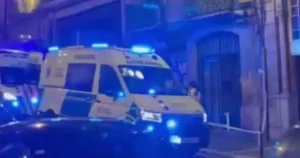
Away from the screen, the aftermath of the incident is a grim reality that now unfolds in a hospital setting. The Metropolitan Police reported that at 6:30pm on Friday, a 19-year-old man was found with critical stab injuries. Just minutes later, at a nearby location in Fanshawe Crescent, a 17-year-old boy was also discovered with serious knife wounds. Both were rushed to the hospital, where they are now fighting for their lives. The severe injuries inflicted by these weapons, with their long, sharp blades, underscore the devastating physical toll that zombie knives can take on the human body. These are not weapons designed for self-defense or utility; they are engineered for inflicting maximum damage, and the fact that they are in the hands of young people in a residential area is a profound cause for alarm. The two teenagers, whose names have not been released, now face a precarious battle, surrounded by anxious families and medical staff. While their attackers remain unnamed and at large in the immediate aftermath, police have made swift progress in the investigation. Two other individuals have been arrested on suspicion of affray and possession of an offensive weapon. These arrests, while a step toward justice, do little to alleviate the immediate suffering of the victims and their loved ones, who are now living through every parent’s worst nightmare. The community in Dagenham has been left in a state of shock and grief. A Friday evening, which should have been filled with the ordinary rhythms of life, has instead become a watershed moment of trauma. Local residents will now look at their streets with a new sense of vulnerability, aware that such a brazen attack can occur in their midst. The presence of the TikTok live stream only amplifies the public awareness of this tragedy, turning a local incident into a viral spectacle and forcing the entire city, and indeed the country, to confront the pervasive and insidious nature of knife crime among young people.
Paragraph 5: The Scourge of ‘Zombie Knives’ and London’s Knife Crime Crisis
This incident shines an uncomfortable spotlight on the specific weapon involved: the zombie knife. These weapons, characterized by their intimidating appearance, serrated edges, and menacing designs, were originally created for the aesthetic appeal of horror films and video games. However, they have tragically found their way into the hands of criminals and young people on the streets of London. Despite legislative efforts to ban such weapons, they continue to circulate, and their very design can escalate a confrontation into a fatal one. The term “zombie knife” seems almost absurdly theatrical, a name borrowed from a fictional apocalypse, but the wounds they inflict are devastatingly real. The ease with which such weapons can be obtained, coupled with an underlying culture of carrying knives for protection or status, has created a toxic environment where disputes are settled with deadly force. The Dagenham attack is not an isolated event but rather a symptom of a deeply rooted crisis. Statistics have repeatedly shown a worrying trend of knife crime involving young people, with many victims and perpetrators being teenagers. The reasons are complex and multifaceted, involving social deprivation, lack of opportunity, gang culture, and a pervasive fear that forces individuals to arm themselves. The fact that this particular attack was streamed live on TikTok adds another layer of complexity. It suggests that for some, the act of violence and the act of broadcasting it are intertwined, an attempt to gain notoriety, to exert dominance, or to create a shocking spectacle for online approval. This modern twist on an age-old problem complicates the response needed from law enforcement and social services. Policing alone cannot solve this issue; it requires a comprehensive approach involving education, youth programs, community engagement, and addressing the root causes of social alienation that lead young people down this destructive path. The image of a young man in a balaclava lunging at a camera with a zombie knife should serve as a wake-up call to the entire nation, a stark visual representation of a crisis that is spiraling out of control and claiming the futures of too many young people.
Paragraph 6: A Community on Edge and the Need for Reflection
As the video circulates and the news spreads, the broader implications of this event weigh heavily on the community and the public consciousness. The initial shock will eventually subside, but the scars will remain, both for the victims and for all those who witnessed the footage. The fact that this was caught on a TikTok live stream means that the trauma has been broadcast far and wide, indelibly etched into the digital record. It forces us to question our own role as consumers of such content. When we watch a video of a real-life attack, are we simply horrified witnesses, or are we complicit in a culture that glorifies and exploits violence? The comments on the stream, ranging from pleas for safety to incitements to violence, show that we are not passive observers; our engagement shapes the narrative. This incident should prompt a much-needed national conversation about knife crime, about the easy availability of dangerous weapons, and about the desensitization that occurs when violence is routinely consumed as entertainment. For the residents of Dagenham, the priority now is supporting the two young victims and their families and cooperating with the police to ensure justice is served. But beyond that, there is a deep-seated need for reassurance that their streets are safe, that their children can walk home without fear of an ambush. The police response, with its swift arrests, provides a small measure of comfort, but the underlying problem remains. The battle for life taking place in the hospital is a battle that reflects a wider struggle occurring across London and other major cities—a struggle against a tide of violence that threatens to engulf a generation. The TikTok video, with its jarring imagery of blades clashing against a sunset sky, is not just a piece of crime footage; it is a tragic symbol of our times. It represents the convergence of social media, youth violence, and the urgent, desperate need for societal change. In the days and weeks ahead, as the two teenagers fight to survive, their story will serve as a painful reminder that behind every statistic, behind every viral video, there are human lives, families, and communities shattered by a moment of brutal violence. The hope is that this shocking event will not be in vain, but will galvanize a collective effort to end the scourge of knife crime and provide young people with a path away from violence and toward a future filled with hope rather than fear.