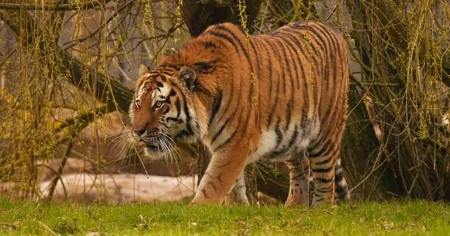



It was meant to be an ordinary October afternoon at Yorkshire Wildlife Park in Doncaster, the kind of bright, crisp day when families wander along raised walkways, children point excitedly at animals they have only ever seen in books, and the world feels safely separated from the wildness on display. The park, which opened in 2009 and has become a beloved attraction, was bustling with visitors who had come to see endangered species, including the magnificent Amur tigers in their purpose-built two-acre reserve. Among those visitors was a young man in his twenties, whose name has not yet been released, and who by the end of that afternoon would be the centre of a tragedy no one could have foreseen. A video captured by a family at the park shows him approaching another visitor and asking, with what sounds like perfect politeness, “Excuse me, can you grab a shot of myself with the tiger?” The woman agreed. The recording goes quiet as she presumably frames the photograph, and then the man thanks her. He asks for “one more” picture, three times, before saying, “Thank you, lady.” These are the last ordinary words he appears to have spoken before the day collapsed into horror. At around 1.30pm, the same man was inside the tiger enclosure, pinned to the ground by one of the most powerful predators on earth. Zookeepers fired warning shots in a desperate attempt to separate the animal from him, but the injuries were already fatal. He was pronounced dead at the scene. The tiger, officials later confirmed, was unharmed and would not be put down, a detail that would become part of a much larger and more uncomfortable conversation about wild animals, human responsibility, and the fragile line between awe and catastrophe.
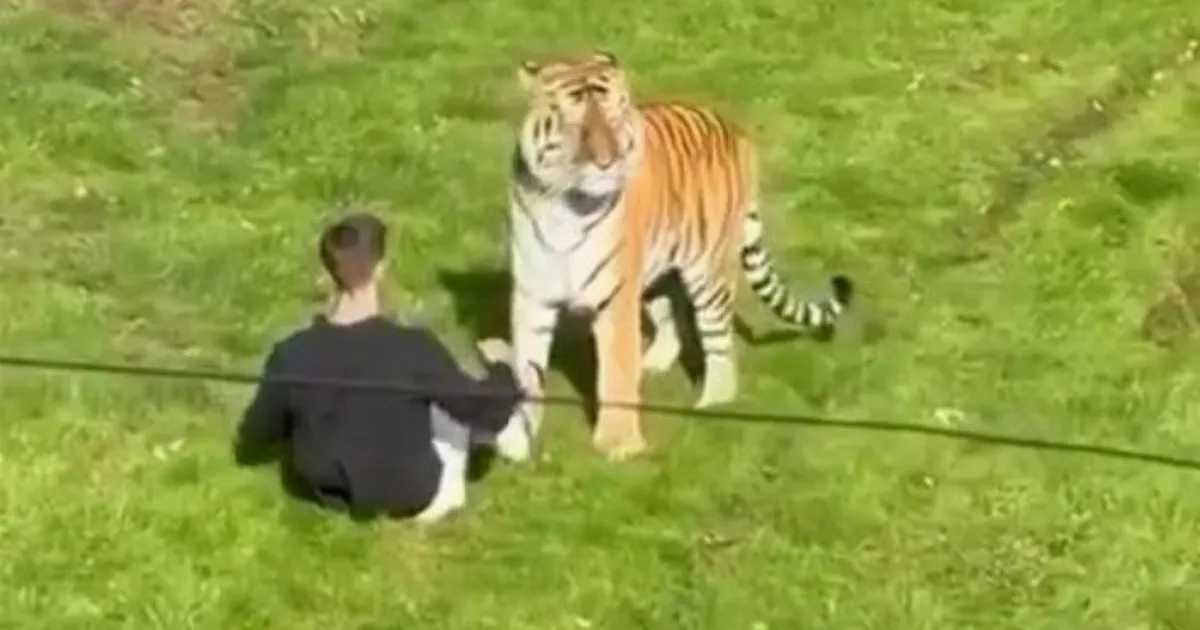
The sequence of events that led to the man’s death has emerged piece by piece, through eyewitness accounts, amateur footage, and the painful recollections of people who were standing only feet away. After the photograph was taken, the man did not leave the viewing area. Instead, according to witnesses, he appeared to become increasingly agitated. One visitor described him dancing, apparently to “psych himself up,” while holding a mobile phone and wearing earpods—small, mundane details that make the story feel unbearably human and all the more confusing. A woman nearby seems to have realised what he was about to do and tried to stop him, but as witnesses later said, she “wasn’t strong enough.” He pulled away from her, climbed down from the viewing bridge, and jumped about twelve feet into the enclosure below. The tiger, which had been circling, reacted instantly. The man knelt in front of the animal and began shouting at it, waving his finger in a gesture that looked like a command, yelling “no, no” as if trying to assert control over a creature that could never be controlled. The tiger grabbed him by the neck within seconds. What followed was brutal and swift. Witnesses described the man being ragdolled by the enormous cat, his body no match for the animal’s raw strength. In the chaos, a small and haunting detail emerged: the man appeared to hold up his little finger, a gesture that some have interpreted as the Makaton sign for “bad.” Makaton is a language system combining hand signs, pictures, and speech, often used by people with learning disabilities or communication difficulties. Whether the man was using Makaton is unconfirmed, but the possibility has opened a door to a deeper and more painful question—was he trying to communicate something he could not say aloud, even as his life hung in the balance?
The suggestion that the victim may have been communicating through Makaton has added a layer of profound sorrow to an already devastating story. It forces us to consider that the young man may not have been simply reckless, but vulnerable in ways that were not visible to the people around him. He may have been experiencing a mental health crisis, a moment of profound confusion, or a breakdown in his ability to express fear, distress, or intention. The fact that he made a fist and wagged his little finger toward the tiger suggests a childlike attempt at discipline, as though he believed the animal would understand him, or as though he was acting out a scene that existed only in his own mind. Witnesses also reported that he seemed agitated before the incident, and that he was seen dancing and wearing earpods, seemingly disconnected from the reality of where he was and what he was doing. These details do not make the tragedy easier to understand; they make it more heartbreaking. They point to a young man who may have been struggling, isolated in his own world, unable or unwilling to ask for help in a way that others could recognise. The woman who tried to stop him, who reportedly was not strong enough to hold him back, now carries the unbearable weight of those moments. In one piece of footage, a woman’s voice can be heard saying, “I tried to stop him.” Those words are a cry of helplessness that echoes far beyond the park. They remind us that so often, tragedy happens not because no one cared, but because caring was not enough, because the signs were missed, because the person in crisis slipped through the cracks of everyday life and into a place where no amount of concern could reach him.
The emergency response was swift, but it was never going to be enough. South Yorkshire Police received reports at 1.35pm, only minutes after the initial disturbance, and officers arrived to find the man already dead. Two ambulances, the Yorkshire Air Ambulance, and a doctor were dispatched to the scene, but despite their best efforts, the man could not be saved. His next of kin were informed and are now being supported by specialist officers, a clinical phrase that cannot possibly capture the shock, grief, and disbelief a family must feel when they learn that a son, brother, or partner has died in such a sudden and violent way. The park was evacuated and closed, and it will remain closed until at least Monday, with tickets still on sale for the days after that—a strange and unsettling detail that suggests life will eventually return to normal, even though nothing about this tragedy feels normal. In the immediate aftermath, police also asked people not to share footage of the attack online, urging the public to respect the dead man and his family. Yet despite that request, clips have circulated on social media, each view reopening the wound and turning a human tragedy into a spectacle. The tiger, meanwhile, remains in its enclosure, uninjured and unpunished. This decision has been met with mixed reactions. Some people argue that the animal was only acting on instinct and should not be blamed for the actions of a human who entered its space. Others find it difficult to accept that a creature capable of such violence continues to live while its victim is gone. But the tiger is not a villain. It did not ask to be confined in a park, nor did it understand the meaning of the intruder who jumped into its home. It behaved exactly as a tiger should, and the tragedy lies not in its nature, but in the sequence of human decisions—and the invisible suffering behind them—that led a young man to his death.
Yorkshire Wildlife Park is not a zoo in the traditional sense; it is a walk-through wildlife attraction designed to give animals space and visitors a sense of connection with the natural world. The Land of the Tigers exhibit, which opened in 2011, was specifically built as a two-acre reserve for Amur tigers, an endangered subspecies with only around five hundred individuals left in the wild. Visitors normally view the animals from a high walkway, with fencing and barriers above the area where the tigers roam freely. The design is intended to protect both humans and animals, to create a safe distance while still allowing for the wonder of seeing such magnificent creatures up close. But no barrier can account for a person who deliberately chooses to climb over it, and no design can predict every possible act of human desperation. The park’s statement, which emphasised that “the safety and wellbeing of our visitors, staff and animals remain our highest priority,” was no doubt sincere, but it now reads like an epitaph for a day that went horribly wrong. The incident has reignited broader debates about the ethics of keeping large predators in captivity. Supporters of wildlife parks point to conservation efforts and public education, arguing that facilities like this play a vital role in protecting endangered species from extinction. Critics ask whether it is ever truly ethical to confine an animal capable of killing a human in a space designed for entertainment, no matter how spacious or well-intentioned. Both sides have valid points, but in the shadow of this tragedy, the arguments feel abstract. What remains is a simple and painful truth: a human being is dead, and an animal that was only doing what nature intended has become a symbol of something far larger than itself.
In the days ahead, as investigations continue and the park remains closed, the focus must eventually shift from the horror of the event to the humanity of the person at its centre. A young man in his twenties is gone. He had a name, a family, a history, and a story that no one yet fully understands. He may have been struggling with mental health issues, he may have had communication difficulties, or he may have simply made a catastrophic decision in a moment of impulsive distress. We may never know what was going through his mind in those final minutes, and perhaps it is not for us to know. What we do know is that many people are now living with the aftermath: the family who lost a son, the woman who tried to hold him back, the visitors who watched in helpless terror, the park staff who fired warning shots and will forever wonder if they could have done more, and the emergency workers who arrived too late. Their trauma is real and deserves compassion, not morbid curiosity. As difficult as it may be, we should resist the urge to reduce this tragedy to a shocking headline or a viral video. The dead man’s dignity matters, and so does the dignity of everyone touched by his death. Instead of sharing footage, we can honour him by reflecting on the ways we treat the vulnerable among us—those who communicate differently, those who seem agitated, those who may be crying out for help in ways we do not recognise. If there is any lesson to be drawn from this terrible afternoon, it is that human beings are fragile, and that the barriers we build are not always physical. A word of concern, a moment of attention, or a willingness to ask “are you okay?” might make all the difference. For the young man at Yorkshire Wildlife Park, that intervention came too late. But for someone else, it may not have to be.