


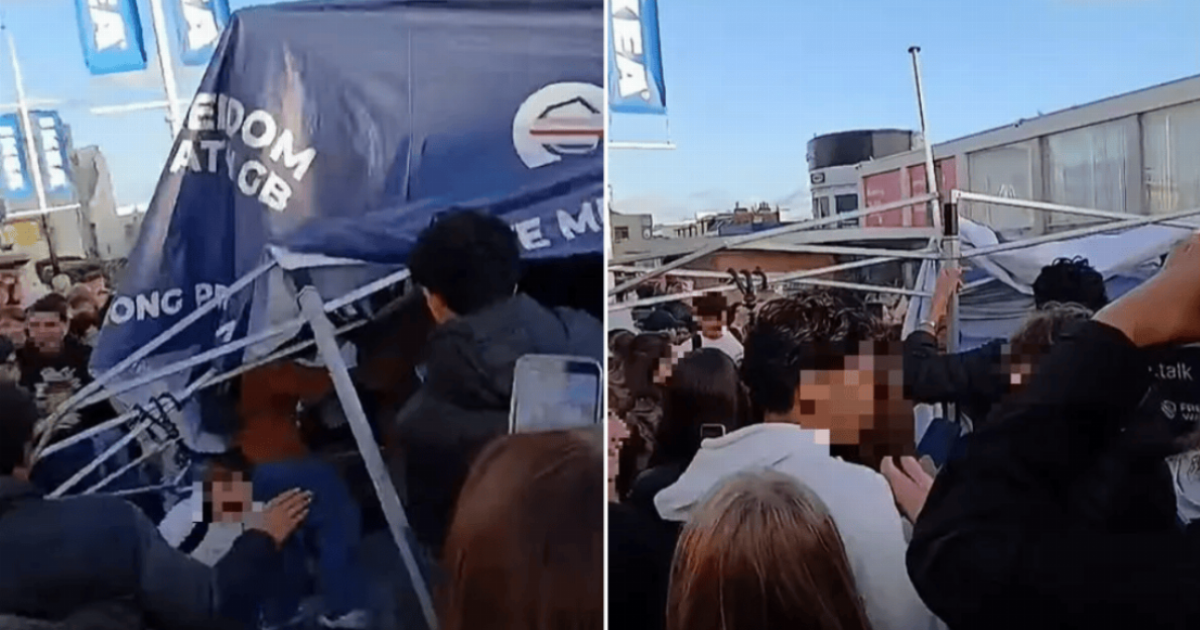
On an ordinary Saturday afternoon, the seaside streets of Brighton became the backdrop for a confrontation that had been brewing for weeks. Montgomery Toms, a right-wing activist sometimes described as the British answer to Charlie Kirk, had set up his Freedom Watch GB gazebo along Western Road, near Churchill Square, with a banner inviting passersby to “prove me wrong.” It was a familiar spectacle: a folding table, a provocative slogan, a camera rolling, and a small team of self-styled truth-tellers waiting for a debate. But what followed was not a debate. According to Toms and his organisers, hundreds of people—including schoolchildren—swarmed the stall. Video footage shared on social media shows the gazebo pitching and writhing under the pressure of hands and feet, before the canopy collapses on top of the crowd. Shouts of “racist,” “Nazi,” and “fascist” ring out, along with mock cries of “Charlie Kirk.” Toms says he had to be escorted by police. He claims his team was assaulted, spat on, had equipment stolen, and were utterly overwhelmed: one security guard, two fellow debaters and a cameraman against a crowd he described as being in the hundreds. By the time the dust settled, only the canopy was left, a twisted piece of fabric lying in the street, and the man who had come to spark a conversation about immigration and free speech was being led away from the very square he had chosen for his street-corner performance.
Yet Toms, who represents the far-right Restore Britain party, insists he kept his composure. In a statement posted on X, he wrote that he made a conscious decision not to fight during the scuffle, and instead to practice Stoicism—the ancient philosophy that focuses on inner virtues rather than outward reaction. “There is nothing you can do in this situation with the manpower we had,” he said, rattling off the numbers like a captain recalling a battle he never stood a chance of winning. “A masculine man is one who has a sword but knows when to use it,” he added, a line that manages to be both martial and oddly passive. But Toms also made clear that he was not simply walking away. “I am, however, capturing each face and handing the footage to the police, along with looking into prosecution for criminal damage.” His next message was far less philosophical: “Retaliation is getting another gazebo, more security, returning and pushing on.” The combination of wounded defiance and strategic retreat is the language of a social-media activist who understands that the footage of a destroyed gazebo is itself a kind of victory. For him, it proves his claim that free speech is under attack. For his critics, it proves that the public is willing to physically shut down messages they find intolerable. Either way, the camera was rolling, the video was uploaded, and the argument was no longer about mass deportation or hate speech, but about who gets to claim the streets of a city like Brighton.
Anti-fascist and anti-racist observers saw the day in very different terms. The independent outlet UK 161 News, which often documents right-wing activism, shared footage of the tent falling on Facebook. Brighton & Hove Stands Up To Racism reshared the video with a blunt message: “Freedom Watch – right-wing grifters turned up today in Brighton and were shown the door! Goodbye! Don’t come back.” In a separate post on X, the group congratulated “the school kids of Brighton” for using “mass direct action” to shut down the far-right figure and his group in Churchill Square. “You did us all proud!” The approval of direct action—rather than simply counter-speech or ignoring the provocation—is central to understanding what happened. For Toms, the crowd was a mob that had destroyed property and silenced a political opponent. For his critics, it was a community refusing to pretend that a banner demanding mass deportation is simply one side of an intellectual argument. They framed the confrontation not as an attack on free expression but as a defensive shutdown of a hateful spectacle. The language on both sides was emotional, absolutist, and carefully constructed for the audiences watching online. One side saw a martyr; the other saw a mess. The truth probably lies somewhere in the messy middle, in the gap between the live event and the digital afterlife it immediately acquired.
The group at the centre of the confrontation describes itself, on its website, as the “youth voice of Britain” and claims to be “on the front line of Britain’s fight for freedom.” In practice, Freedom Watch GB stages pop-up debates that borrow heavily from the playbook of Charlie Kirk, the controversial American right-wing commentator whose “Prove Me Wrong” tour became a social-media phenomenon. Kirk would sit on a folding chair, often with a camera operator nearby, and challenge students to prove him wrong on hot-button issues like immigration, trans rights, abortion, and free speech. Toms has transplanted that format to British streets and campuses, sitting behind a desk covered with a banner printed with deliberately provocative statements—“Britain needs mass deportation” or “hate speech is free speech, prove me wrong.” The set-up is designed to generate precisely the kind of angry reaction it received in Brighton. A quiet conversation with a cordial passerby does not go viral; a collapsed gazebo, shouted slogans, and a police escort do. The line between a genuine invitation to debate and a performance designed for outrage is difficult to draw, and perhaps that is the point. Freedom Watch GB often asks people to debate its members, but the framing of the invitation is confrontational from the start. It is not “let us talk” but “prove me wrong.” The challenge is not an open hand but a raised fist, and the response from the public is often equally combative.
Saturday’s confrontation was not an isolated incident. The same Freedom Watch GB tents have already met organised protests at the University of Bristol and Cardiff University, where anti-racist groups mobilised students and locals to stand against them. The pattern repeats itself almost ritualistically: the activist arrives, the crowd gathers, the cameras roll, the tension rises, and eventually the tent falls. What is harder to measure is the human cost. For Toms, that cost is fear, humiliation, and the indignity of being chased from a public square by a crowd that included teenagers. For the young people who mobilised against him, the cost is the exhaustion of having to repeatedly defend their communities and their humanity against a movement they see as demonising them. The footage from Brighton is chaotic and unflattering to everyone involved: adults kicking at a tent, children shouting insults, a security guard trying to hold back a tide of bodies, and a man in a polo shirt standing nearby, watching his equipment being destroyed. Sussex Police, which covers Brighton, has been approached for comment, but the legal aftermath remains unclear. Toms has promised to pass footage to the police and pursue charges for criminal damage, which suggests the conflict is not over. But the more important battle is taking place online, where each side is curating its own version of what happened, editing the footage, and feeding it to followers who already know what they believe.
Underneath the spectacle lies a genuinely uncomfortable set of questions. What does it mean to take freedom of speech seriously when the speech in question is designed to wound? When is direct action justified, and when does it simply hand the provocateurs the footage they want? The right to hold a demonstration and the right to counter-protest are both supposed to be protected, but when they collide in a narrow street, the law is less useful than the language of blame. Toms says he will return with a new gazebo and more security, which means the cycle is likely to continue in Brighton and beyond. The anti-racist groups say they will keep showing up, and the schoolchildren who helped pull down the tent may well do it again. In the middle, ordinary passersby are left to decide whether they witnessed an assault on free expression or a community defending itself from a familiar act of political theater. Perhaps both are true. The collapse of the gazebo was messy, angry, and very human. It showed how quickly a debate can stop being about ideas and become about bodies, space, and power. And it reminded everyone involved—Toms, his supporters, his critics, and the people who just happened to be walking down Western Road that day—that in a democracy, the streets belong to whoever shows up.