

It was supposed to be a routine morning at one of the world’s busiest airports. Travelers were shuffling through Heathrow’s Terminal 3, some exhausted after overnight flights, others eagerly meeting loved ones, and many just trying to grab a coffee before the next leg of their journey. The air was filled with the low hum of announcements, rolling suitcases, and the clatter of Caffè Nero’s espresso machine. But at around 8am on December 7, that ordinary rhythm was violently shattered. According to Isleworth Crown Court, a group of men in dark clothing and face coverings approached a lift in an airport car park. Inside were two women who had just arrived on a flight from Johannesburg, South Africa, along with two men who had come to meet them. When the group tried to enter the lift, the occupants blocked them, and the would-be intruders responded by spraying a substance into the confined space. Innocent parties fled in distress, but the damage was only beginning. When the lift reached the ground floor, gas poured out, spreading through the area and causing chaos. Within minutes, dozens of passengers were coughing, struggling to breathe, and some were vomiting blood. The terminal was locked down, flights disrupted, and emergency services rushed to help the sick and terrified.
The full human toll of the incident only became clear through the emotional testimony of those who were caught in the middle. One of the most harrowing accounts came from a barista at the Caffè Nero, a young woman who had started her shift expecting nothing more than a busy day serving lattes. Instead, she found herself suddenly unable to breathe, coughing so violently that she vomited blood. She told the court she was “scared” because she “felt fine one minute and then almost instantly unwell.” Her words capture the terrifying unpredictability of the attack: no one in that terminal had any warning, and no one had any way to protect themselves. The two women from Johannesburg, who had just endured a long flight from South Africa, became more than collateral damage. They were followed by the attackers and had their suitcases stolen. One of them was sprayed with CS gas directly in the face at close range at 8:03am, causing her to cough and choke helplessly. CS gas is a chemical weapon used by police forces worldwide to temporarily incapacitate people, but here it was deployed not by authorities, but by individuals in a crowded civilian space, turning a place of transit into a scene of fear and pain.
The ripple effects extended far beyond the immediate victims. A customer service agent working in Terminal 3 described the incident as “terrifying,” saying she felt dizzy and as though she was going to pass out. She was assisting a woman in a wheelchair at the time, and that woman began struggling to breathe and reached for her inhaler. A mother who had just arrived from South Africa with her 14-month-old son told the court that her child started coughing, and she was “immediately afraid for my baby’s safety and my own safety.” There is perhaps no more primal fear than a parent watching their infant struggle to breathe, and that fear was inflicted not by an accident or a natural disaster, but by the reckless actions of a few individuals. Another man, who had been ordering a taxi from the airport’s car park, looked on as 20 to 30 people around him were all coughing, and he himself was “struggling to breathe.” These testimonies paint a picture of chaos and vulnerability, where ordinary people going about their daily lives suddenly found themselves gasping for air, surrounded by strangers in the same state of panic, with no idea what was happening or when it would stop.
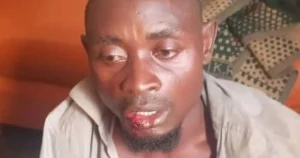
The four men responsible for this terrifying ordeal have since been identified and brought to justice. Tyrone Richards, 31; Anton Clarke-Butcher, 25; Omoneke Whyte, 31; and Denzel Eduardo, 29, all pleaded guilty to affray at Isleworth Crown Court in June. Richards was arrested while still at the airport, while the other three were identified and arrested separately in the days that followed. Prosecutor Gary Rutter told the court that he “could not say exactly what led to this incident,” but added, with a note of understated suspicion, that “one may suspect what was going on.” The phrase hints at a darker context, perhaps a dispute or retaliation between groups, but regardless of the motive, the consequences were devastating for innocent members of the public. The use of CS gas, a substance designed to incapacitate, in an environment filled with families, elderly passengers, and young children, was not just reckless; it was an act of violence that endangered lives. Terminal 3 was locked down for hours, shuttle buses and trains were delayed, and travelers heading to and from the airport were left stranded and confused. The airport eventually reopened, but the emotional scars left on those who were present will not disappear so easily.
In the courtroom, the defense lawyers offered details about their clients’ backgrounds, adding layers of complexity to the story. Denzel Eduardo’s lawyer, Genevieve Moss, said the CS gas “was discharged by the rival group,” and noted that Eduardo himself suffers from asthma, meaning the gas would have had a “dangerous impact on him.” She described him as someone with 12 previous convictions for 18 offences, but insisted he would have “not agreed to take part in any activity involving such a substance” and expressed “deep remorse.” Rushnay Sikander, representing Omoneke Whyte, said his client was “very remorseful” and spoke of a “traumatic childhood,” including the murder of his father when Whyte was just five years old, and the fact that he had been the victim of three separate stabbings. Shanda McAteer, representing Anton Clarke-Butcher, who has 14 convictions for 31 offences, said he denied releasing the gas but “genuinely expresses remorse.” Patrick Harte, representing Tyrone Richards, who has three previous convictions, said Richards was “not present when the first spray was released” and was “sorry to innocent bystanders suffering anguish.” These mitigation pleas remind us that the defendants are not one-dimensional monsters, but human beings shaped by their own pain and trauma. Yet they also raise difficult questions about accountability, choices, and the line between understanding a person’s past and excusing their actions.
As the sentencing hearing continues, the court faces the delicate task of balancing justice with compassion. For the victims, the memory of that morning will linger long after the courtroom doors close. The barista who vomited blood, the mother who clutched her baby, the woman in the wheelchair gasping for breath, the travelers who ran coughing through the terminal: they are the true center of this story. They did nothing wrong, and yet their lives were upended by a few moments of senseless violence. The incident at Heathrow is a stark reminder of how fragile our sense of safety can be, and how quickly the ordinary can turn into the terrifying. It also serves as a warning about the consequences of reckless behavior, especially when weapons designed for law enforcement are used by civilians in crowded spaces. As justice moves forward, one can only hope that the defendants truly understand the harm they caused, and that the victims find some measure of peace. The airport may be back to normal, the flights running on time, and the coffee machine at Caffè Nero brewing again, but for those who were there, the air will never feel quite the same.