


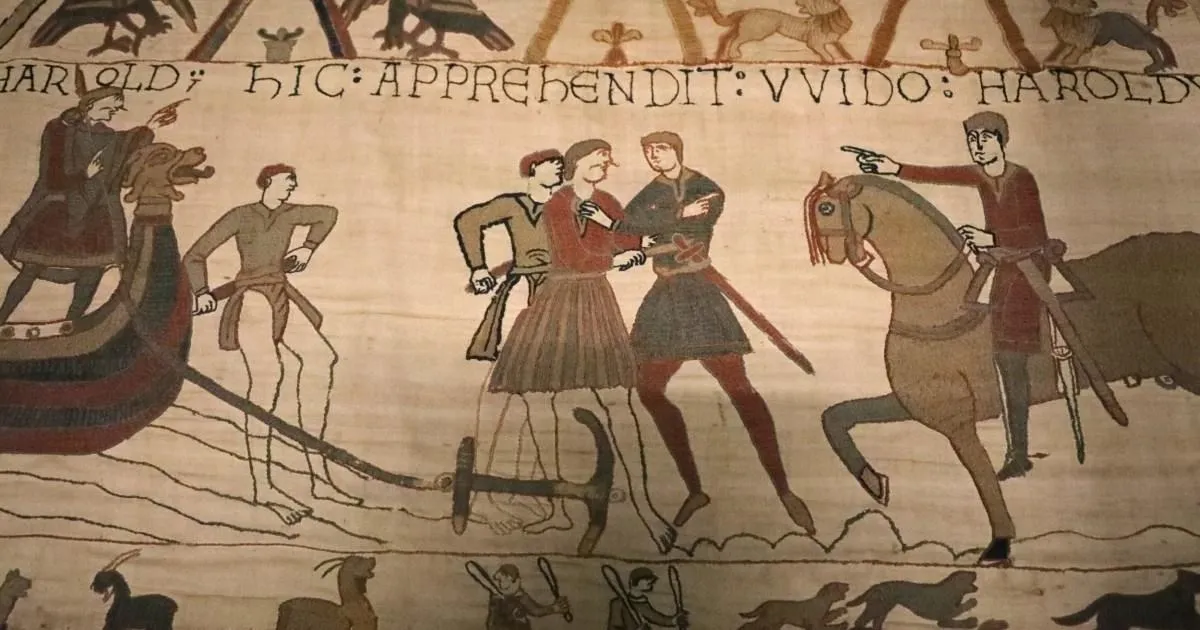
For a thousand years, the Bayeux Tapestry has survived wars, revolutions, the passage of dynasties, and the slow erosion of time itself. Yet no amount of history could have prepared its custodians for the sheer emotional force of its arrival in Britain. The magnificent 70-metre-long embroidery, which narrates the story of the Norman Conquest and the Battle of Hastings in vivid, painstakingly stitched scenes, is now on display in the United Kingdom for the very first time. It has been loaned to the British Museum in central London while the Bayeux Museum in Normandy, France, where it normally resides, undergoes extensive renovation. For centuries, this fragile masterpiece has been a pilgrimage destination for historians, artists, and dreamers; but for the British public, it has always existed at a distance—a half-remembered image from textbooks, a name whispered in documentaries, an artwork so iconic that it felt untouchable. Now, for a brief and finite window, it is here, in the same country, in the same city, within arm’s reach of ordinary people. The exhibition opened to ticketed visitors on September 10, and the response was nothing short of frenzied. More than 65,000 people joined the online queue for the very first batch of tickets, each costing £33 for adults, with an optional £3.50 donation. The demand spoke to something deep and collective: a desire not merely to look at an artefact, but to stand in the presence of a story that shaped a nation. For many, this was a once-in-a-lifetime opportunity, and the air around the exhibition was charged with anticipation, reverence, and the quiet thrill of touching something ancient.
But for one devoted visitor, that dream collapsed into confusion, frustration, and a profound sense of loss. Dr Ellen Walker, a 29-year-old artist and illustrator, had wanted to see the Bayeux Tapestry since she was seven years old. As a comic artist by practice, she understood the tapestry on an intimate level—it is, as she puts it, “essentially an embroidered comic,” a sequential narrative stitched in wool, depicting knights, ships, horses, and the death of a king with an energy that feels startlingly modern. Her childhood fascination had never faded; it had only grown deeper with age and artistic training. She had arranged her visit to coincide with being in London for her graduation, and her mother had joined her for the occasion. It was meant to be a celebration, a shared experience between mother and daughter, and a fulfilment of a promise made to her younger self. They had booked tickets for 3pm on September 30, and arrived at the British Museum at 2.15pm, early enough to be thoughtful, prepared, and hopeful. Seeing the long queue already forming, Dr Walker asked a member of staff whether it would be wise to join the line right away. The advice was reassuring: it would be better to start queuing at 3pm sharp, and they would definitely get in. Trusting this guidance, they wandered through the rest of the museum, waiting for the clock to move, letting their excitement build. When they returned at 3pm, as instructed, they joined the queue with patient anticipation. Twenty minutes later, the news came: the gallery was closing. No warning, no explanation, no chance to rush forward. The line was shut down, and they were turned away.
The disappointment was not just about logistics or wasted time; it was about the crushing of a long-held dream. Dr Walker described being handed a printed note from the museum apologising for the disruption, but she was not told why the afternoon had gone so wrong. The staff themselves seemed baffled; one ticket worker admitted they did not know why it was happening, and appeared just as surprised as the waiting visitors. Dr Walker was careful to say that she did not blame the staff at all—they were clearly caught in the middle of a situation beyond their control. But that did little to soothe the sting. She thought of the other people in the queue, many of whom had travelled far longer distances. There were visitors who had come from elsewhere in the UK specifically for the tapestry, and others who had flown in from abroad. To have come so far, to have planned so carefully, and then to be turned away at the threshold—it felt almost cruel. “I’ve been wanting to see the Bayeux Tapestry since I was seven,” she said, and the weight of that confession is impossible to ignore. She had spent more than two decades imagining the moment she would stand before those ancient embroidered scenes, tracing the stories with her eyes, feeling the texture of history. Instead, she stood in a queue, holding a piece of paper that told her, in polite bureaucratic language, that her time had run out. She is an artist, a storyteller, a person who understands the value of narrative. And yet the narrative of her own visit had been rewritten without her consent.
She was not alone. Another visitor took to X, the platform formerly known as Twitter, to describe being turned away after queuing for forty minutes—an even longer wait, an even deeper investment of hope. The museum had been scheduled to close for a private event from 4pm, but earlier delays in the day meant that the queue to enter the exhibition had to be closed before many ticket holders could be admitted. In total, around 200 people were affected—a relatively small number in the grand scheme of an exhibition that has drawn tens of thousands, but a devastating cohort of individuals, each with their own story, their own journey, their own reasons for being there. For some, it was a birthday present; for others, a long-awaited return to the world after a period of doubt; for still others, a once-in-a-lifetime trip from another continent. The museum’s notice, handed out by staff as the queue was turned away, read: “We apologise for the disruption to your visit to The Bayeux Tapestry today. If we are able to re-open the gallery today, we unfortunately will not be able to admit you at a time later than listed on your ticket. This is due to time and space restrictions in the gallery. We sincerely apologise for any inconvenience and disappointment caused.” The language was careful, courteous, and entirely inadequate to the moment. It did not explain why the delays had happened, nor why the affected visitors could not simply wait a little longer. It simply told them, in the most gently official voice possible, that they could not enter. For Dr Walker, the note became a symbol of the experience—something flat, impersonal, and utterly unable to capture the human cost of a day that had once shimmered with possibility.
The British Museum, for its part, responded with a statement that acknowledged the scale of the demand and the difficulty of managing it. “We have seen unprecedented demand for the Bayeux Tapestry exhibition and our priority is to enable as many people to see it as possible, while maintaining our commitment to the best possible visitor experience,” a spokesperson said. “Unfortunately, delays earlier in the day meant that some visitors were unable to enter at their allotted time. We have apologised to those affected and are giving a refund as well as rescheduling their ticket for free. This was an isolated situation, and we appreciate visitors’ patience and understanding.” The offer was generous, in its way: a full refund, plus a new ticket for another day, at no extra cost. But for many, the gesture could not undo the damage. The tapestry’s time in the UK is limited; the exhibition, after all, is anchored to the renovation schedule of the Bayeux Museum. For some visitors, rebooking was not simply a matter of choosing another date from a calendar. It required new travel arrangements, new accommodation, new time off work, new childcare, new hope. And even for those who could rebook, the magic of the original plan—the convergence of a graduation, a mother’s visit, a childhood dream—could not be reconstructed. The museum’s statement ended with a plea for patience and understanding, and indeed, most visitors tried to be understanding. They understood that the museum was not intentionally cruel, that the staff were doing their best, that an exhibition of this magnitude is an enormous logistical challenge. But understanding and disappointment can exist side by side, and in the moments after being turned away, it was the disappointment that spoke loudest.
Perhaps what makes this story so human, so resonant, is that it reflects a fundamental tension in our relationship with great art. We treat masterpieces like the Bayeux Tapestry as timeless, eternal, existing beyond the ordinary rules of the world. But when we try to encounter them, we are reminded that they are physical objects, held in physical spaces, governed by physical limitations—queues, capacity, time, and the closing of doors at 4pm for a private event. The tapestry itself has survived for a thousand years because it was made to last, but no exhibition can promise perfection to every visitor. Still, the disappointment felt by Dr Ellen Walker and the others is not pointless. It speaks to the enduring power of art to move us, to draw us across continents, to make us queue for hours in the rain and the cold, to make us believe that a moment in front of an ancient piece of cloth can change our lives. In that sense, the visitors who were turned away are not failed spectators; they are proof of art’s extraordinary pull. Dr Walker, the comic artist who dreamed of this moment since childhood, will likely find another way to see the tapestry. She may rebook, she may try again, she may one day travel to Normandy and stand before the embroidery in its permanent home. But even if she does, the memory of that September afternoon at the British Museum will remain—not as the moment she saw the tapestry, but as the moment she realised how much it meant to her. And in the end, that too, is part of the story. The Bayeux Tapestry is a narrative about ambition, power, loss, and the struggle to tell a story across time. It is fitting, perhaps, that its first visit to these shores should be marked not only by triumph, but by the very human mess of yes, no, wait, sorry, and try again. History is not a tidy museum display. It is alive, awkward, and occasionally heartbreaking—just like the people who come to see it.