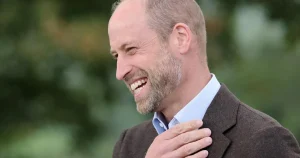


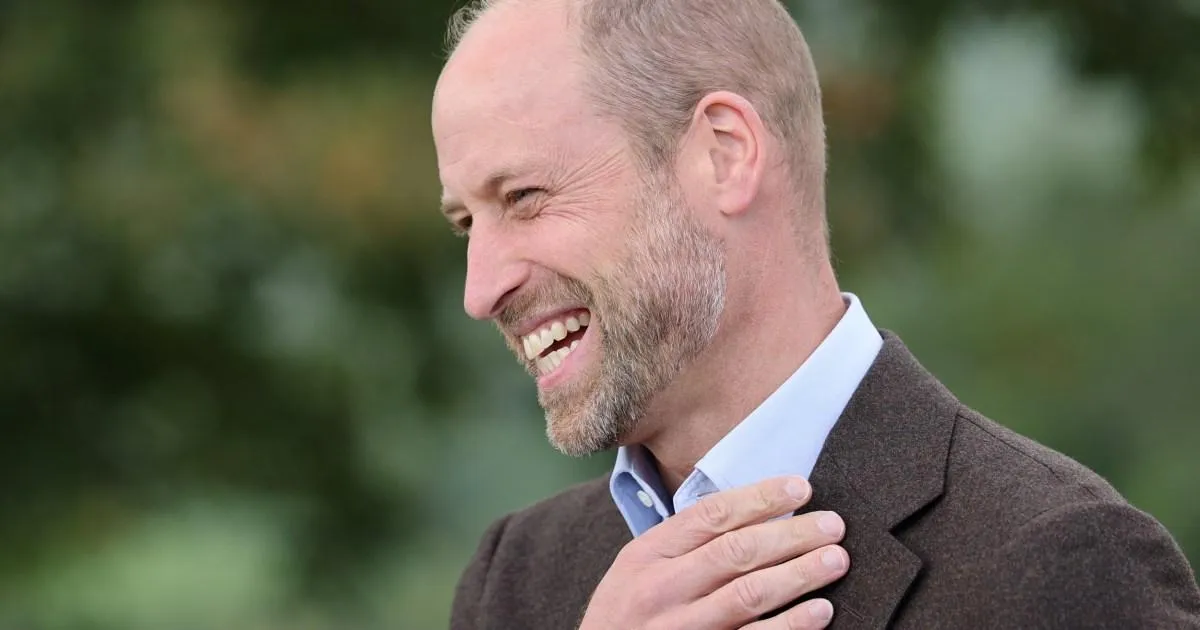
Prince William found himself laughing in the Welsh countryside as a chance encounter pulled him back to the carefree days of his youth. The occasion was a visit to Skenfrith, a picturesque Monmouthshire village, where he had come to hear about the flood defences that have become a matter of survival for local residents. But before the serious conversations about swollen rivers and climate change, there was a moment of pure, unexpected nostalgia. Rod Wyatt, a local resident, met the Prince with a grin and held his hand waist-high. “First time I met you, you were this high,” he said. “In Glanusk Estate – you sold me a CD from a bric-a-brac stall.” William’s face lit up. “Dodgy car boot sale, yes I remember that,” he laughed. Rod, enjoying the exchange, joked, “Still doing that?” The future king played along: “No, I don’t sell… it’s dried up a bit that one, perhaps I should reopen it.” Rod’s wife Helen couldn’t recall the title of the CD, and William, still smiling, confessed, “I got up to a lot… we had some fun round there.” It was a fleeting glimpse of the man behind the crown—a teenager with a stall, a stack of second-hand CDs, and no idea that one day he would be back in Wales, not to sell music, but to listen to the concerns of people whose lives have been turned upside down by the weather. The contrast between that memory and the purpose of his visit was not lost on anyone. Here was a future king, standing in a village that had been repeatedly battered by floods, laughing about a dodgy car boot sale. It was a reminder that even the most formal of royal duties can be softened by human connection. For William, the memory seemed to ground him, reminding him of a simpler time before the weight of expectation. And for the Wyatts, it was a chance to share a piece of history with a man who, despite his title, was once just a boy selling CDs in the Welsh countryside.
Behind the laughter, though, lay a sobering reality. Skenfrith has endured four major floods in six years, and the most recent—last winter—was the worst. After Storm Claudia dumped a month’s rain in just 24 hours across parts of England and Wales, the River Monnow burst its banks and swept through the village, leaving homes and businesses underwater. Rod Wyatt, who has lived in his home for a decade, has learned to cope with a darkly humorous resilience. He told William that when the water rose again, “we had to give up really, we got two bottles of Prosecco and went to watch Strictly upstairs.” The image is both funny and heartbreaking: a couple retreating upstairs with sparkling wine while their ground floor disappears beneath brown water. William’s face softened into sympathy. “It must be so demoralising for you now,” he said. “The worry each year you’ve got to go through that again, potentially, is becoming more frequent.” He questioned the official language of rare events, noting that “they keep talking about a one in 50-year event, it doesn’t make sense anymore. It might be in the researching and scientific point of view—it’s happening every year now, it’s mad.” His words were not those of a distant royal; they were the observations of someone who had listened, absorbed, and understood the creeping dread that comes with living beside a river that no longer respects its banks. The Wyatts nodded, grateful that someone in power was finally speaking their language. For them, the statistics were not abstract. Each autumn brings the same question: will this be the year the water comes again? And each flood leaves behind not just mud and damaged furniture, but a deeper weariness that is hard to shake.
William did not stop at empathy. He wanted solutions, and he had been thinking hard about them. “It’s trying to understand how we can do a better holistic view of the whole catchment area, so we’re dealing with the whole problem,” he said, listing practical ideas: slowing the water down through farming landscaping remedies, planting trees, and improving monitoring “so we know when things might be getting worse.” These were not abstract talking points. Later that day, he put his boots on at Great Tre-Rhew Farm in Monmouthshire, where he met the environmental charity Stump Up for Trees. Founded in 2020, the organisation has set itself the ambitious goal of planting one million native trees across south Wales and the Bannau Brycheiniog—the national park formerly known as the Brecon Beacons. William joined volunteers as they harvested seeds from a field maple tree and then planted a sessile oak, the national tree of Wales. It was a small but symbolic gesture, the kind of hands-on action that speaks louder than any speech. He spoke with farm owners Kate and Jim Beavan and the charity’s director, Jenny Knight, trading ideas about how to make the landscape more resilient. The Prince seemed genuinely in his element, asking detailed questions about seed collection, tree species, and how the new woodlands would help absorb rainfall and prevent runoff. For William, this was the real work of climate action: not grand declarations, but the patient, unglamorous task of restoring nature’s own defences. Tree by tree, hedge by hedge, the land could be made to hold water longer, slow the flow, and give downstream villages like Skenfrith a fighting chance.
Jenny Knight was clearly struck by the Prince’s approach. After the visit, she paid tribute to him for “looking at not just the problems but the solutions as well.” That was no small compliment. Alongside the local farmers, representatives from the Duchy of Cornwall—the vast estate that funds William’s public life—had joined the visit to share learning about nature recovery and climate-resilient forestry, and to begin what they hope will be a long-term partnership. Dr Knight described the “knowledge exchange” as “so valuable”, noting that working together across different areas would have a far greater impact than any single project. The Duchy’s involvement is significant; as Duke of Cornwall, William oversees an estate that includes farms, forests, and coastal properties, and he has been increasingly vocal about using that influence to promote sustainable practices. The conversation eventually turned to something more personal: cider. The farm makes its own, and William happily admitted his enjoyment of it. “He said ‘one pint a day keeps the doctor away,’” Dr Knight revealed, laughing. It was a light-hearted end to a serious afternoon, and it showed a man who can move seamlessly from discussing the intricacies of flood defence to sharing a joke over a glass of locally produced cider. That ability to connect—to be both a concerned leader and an ordinary person who enjoys the simple pleasures of rural life—is perhaps what makes him so effective in these settings. He does not lecture; he listens. He does not impose; he collaborates. And in doing so, he earns the trust of the very people whose lives he is trying to improve.
William’s final stop took him across the border into Herefordshire, to Monkhall Farm, where he met 25-year-old Harry Davies, the incoming tenant of the Duchy of Cornwall’s first regenerative farm business tenancy. It was a meeting that felt like a glimpse into the future of British agriculture. Regenerative farming is about restoring soil health, increasing biodiversity, and improving the water cycle—rather than depleting the land for short-term gain. For a young farmer like Davies, it represents a chance to build a livelihood in harmony with nature, and to prove that sustainability and productivity are not enemies. William, as Duke of Cornwall, has made rural resilience a cornerstone of his work, and this tenancy is a bold experiment in putting those principles into practice. The Prince listened intently, asking questions and offering encouragement. In Davies, he saw the next generation of stewards who will have to deal with the very same flooding, extreme weather, and environmental pressures he had been discussing all day. It was a reminder that the fight against climate change is not just about grand global summits; it is about individual farmers, families, and communities making changes on the ground. The Duchy’s decision to offer a regenerative tenancy is a signal that the old ways of farming—intensive, extractive, short-sighted—are no longer the only option. For Davies, it is an opportunity to build something lasting, to leave the soil better than he found it, and to show that a small farm in Herefordshire can be a model for the rest of the country. William seemed to understand that, and his presence at Monkhall Farm was a quiet endorsement of a quieter revolution.
Taken together, the Prince’s day in Wales and the borderlands offered a portrait of a royal who is deeply, personally invested in the challenges facing rural Britain. He laughed about his misspent youth, listened to stories of flooded homes and Prosecco-soaked escapes, planted an oak tree, praised the value of a pint of cider, and championed a young farmer’s vision for the future. It was a masterclass in human connection. The floodwaters of Skenfrith may have receded, but the anxiety they left behind remains, and William’s willingness to engage with that anxiety—to call it “mad” that so-called once-in-a-generation floods now arrive every year—shows a man who refuses to hide behind royal platitudes. He is not offering false hope; he is rolling up his sleeves and looking for answers. And in doing so, he is redefining what modern royalty can mean: not distant and ceremonial, but present, curious, and genuinely useful. From a dodgy car boot sale to the planting of a sessile oak, it was a day that captured the full arc of a life in service—one that began with youthful mischief and has grown into a quiet, determined campaign to protect the land, the people, and the communities that make Britain what it is. The challenges are immense, and no single visit can solve them. But by showing up, by listening, and by laughing with the people he serves, William offers something that cannot be measured in policy terms: hope. And in a village like Skenfrith, where the river rises and falls with terrifying unpredictability, hope is perhaps the most precious thing of all.