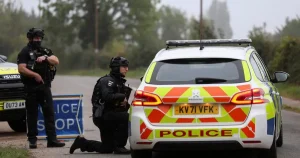

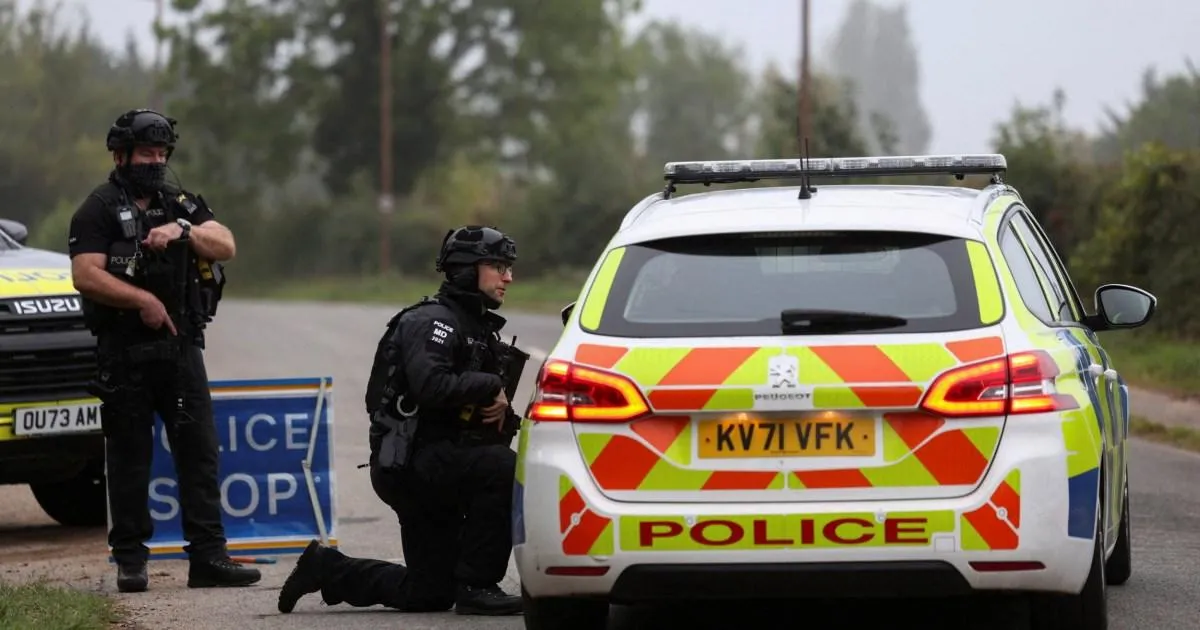
In the early hours of a recent Sunday, the quiet roads around RAF Fairford, a sprawling Royal Air Force base in the Gloucestershire countryside, were the last place anyone expected to find the focus of a national security emergency. Yet that is exactly what happened. A white van, captured by a home doorbell camera less than a mile from the base, became the first visible thread in a tangled and deeply unsettling investigation. The van was not alone. Two others were discovered nearby, parked outside the perimeter of the base, which is a key hub for American military operations and a familiar presence in the lives of locals. When news of the discovery spread, the initial confusion gave way to fear. Armed police appeared at checkpoints, roads were closed, and residents were told to stay indoors. The phrase “suspected terror plot” echoed through the village and beyond, carried by news alerts and social media posts that seemed to move faster than the police themselves. What made it all the more chilling was that the vans reportedly contained a quantity of petrol, a substance so ordinary and yet so menacing when placed in the wrong hands. For a few hours, the possibility of an imminent attack hung in the air. The world watched as counter-terrorism officers descended on the scene, forensic tents and evidence bags appearing in the morning light, while the everyday life of the Cotswolds came to a halt. The threat had not been a distant headline or a warning from a foreign country; it was here, in the lanes and driveways of an English rural community, caught on a doorbell camera that no one had ever imagined would one day play a part in a major terror investigation.
Days later, the investigation moved decisively from the countryside to the capital. The police announced that five men, all from London, had been arrested in connection with the incident and subsequently released under investigation or bailed. That news was sobering enough, but it was only the beginning. In a dramatic development, counter-terrorism officers in Westminster, central London, arrested a 27-year-old man described as a dual British and Iranian national. He was held on suspicion of the preparation of terrorist acts under Section 5 of the Terrorism Act 2006, a charge that speaks to planning and intent rather than an impulsive act taken in the heat of the moment. The weight of that charge was immense. It suggested that the vans found near RAF Fairford were not an accident or a misunderstanding, but part of a carefully considered operation. At the same time, a second man, aged 26 and described as a UK national, was questioned under caution, a step that sits just short of arrest but still carries real legal significance. One can only imagine what that moment felt like for the families involved: a knock at the door in the early hours, the sight of armed officers on the street, the sudden realisation that a son, husband, or friend was at the centre of a national security investigation. The homes raided in London were ordinary-looking places, the kind found on any street, and that is precisely what made it so unsettling. The investigation had pulled the veil back on a network that moved between the capital’s busy neighbourhoods and the quiet perimeter of a military base, leaving a trail of questions for police to follow.
What the police actually found in those vans was crucial, and it revealed that the plot was not what it first appeared to be. Counter-terrorism officials confirmed that a quantity of petrol was recovered, but no explosive devices were discovered. That distinction matters. Petrol, while dangerous, is not a bomb. Without detonators, timers, or some kind of explosive charge, it remains what it is: a flammable liquid. The absence of devices led investigators to describe the incident as a suspected “dry run” for an attack, a phrase that felt both technical and alarming. A dry run is a rehearsal, a way of testing the waters, observing security, measuring response times, and identifying weaknesses before committing to a deadly airstrip or attack. It is a tactic used by hostile reconnaissance teams, and its implication is that the vans were placed intentionally, as a kind of probing exercise. The fact that no actual explosives were found did not reduce the seriousness of the threat; it simply placed it at a different stage. Vicki Evans, the Senior National Coordinator for Counter Terrorism Policing, spoke publicly about the investigation, describing it as “hugely complex” and saying that specialist teams were interrogating multiple lines of enquiry. She did not hide the fact that the authorities were looking at “all possible angles,” including possible foreign state involvement. Those words were chosen with care. They told the public that the investigation was far from straightforward, that the threat had international dimensions, and that the apparent simplicity of a few vans and some petrol concealed a much deeper and more dangerous puzzle.
The political dimension of the case added another layer of tension. Andy Burnham, the Mayor of Greater Manchester, made the significant statement that there were “strong indications” Iran had played a part in what happened at RAF Fairford. It was a bold assertion, especially coming from a political figure, and it immediately raised the stakes. Iran, after all, is no ordinary actor in the world of international security; it has been accused of supporting militant activity across the Middle East and beyond, and any suggestion of an operation on British soil was always going to ignite diplomatic storms. But Burnham’s comments were not made in isolation. They were part of a broader conversation that included Donald Trump, whose anger over the release of suspects on bail became another story in itself. Trump, as ever, was blunt. He seemed to view the decision to release suspects as a sign of weakness, an invitation for further boldness. Burnham responded with firm reassurance, saying that the authorities had the situation “under the strongest grip and the closest control.” That response was designed to calm nerves, both in London and in Washington, but it also served as a reminder of the delicate balance between political pressure and legal procedure. In Britain, suspects can be held only for a limited time before being charged or released, and the police must weigh the need to gather evidence against the rights of the individual. Releasing five men on bail may have enraged politicians abroad, but it was a legally necessary step in an investigation that was still unfolding. The tension between the law’s slow, careful process and the political demand for immediate action is one of the defining challenges of modern counter-terrorism.
One of the strangest and most human details of the case was the mystery surrounding how the plot was discovered in the first place. Early reports suggested that a farmer driving home in the early hours of Sunday morning had spotted suspicious activity and tipped off police. It was a comforting image: an ordinary, observant citizen noticing something wrong and doing something about it. But later reporting complicated that picture. It emerged that police may already have been on the scene before the farmer arrived, and that the suspect’s own warning to police was itself a subject of investigation. Why would someone involved in a suspected terror plot alert the authorities? There are two broad possibilities, and both are deeply revealing. The first is cold feet: the sudden, overwhelming realisation of the consequences of one’s actions, the moment when ideology collides with the reality of mass casualties, and the courage to pull back. It happens more often than people might think, and it has saved countless lives. The second possibility is more calculating: the warning was part of the plan, a deliberate move designed to mislead, distract, or draw security forces into a trap. In the shadowy world of intelligence, every piece of information is suspect. A tip-off that seems helpful could also be a feint, a way of making the authorities look in one direction while the real operation proceeds in another. The police were said to be probing the suspect’s motive in warning them, trying to understand whether the call came from a place of remorse or from a pre-arranged script. For local residents, the uncertainty was chilling. It meant that even the act of calling the police could not be taken at face value. It also meant that the prevention of the plot—if that is indeed what happened—owed as much to luck and psychology as to surveillance and intelligence.
As the dust begins to settle, the full weight of what happened at RAF Fairford is still being felt. The arrests, the discovery of petrol, the suspected dry run, and the possible involvement of a foreign state all point to a threat environment that is more complex than ever. Traditional terrorism, once associated with radicalised individuals acting alone or in small groups, now overlaps with state-sponsored and state-inspired operations that use simple materials and careful planning. The vans found outside the base were not loaded with rockets or explosive belts; they were unassuming vehicles carrying petrol, the kind of thing anyone could buy. That ordinariness is what makes this story so unsettling. It is a reminder that security is not guaranteed by walls and checkpoints alone. It depends on the vigilance of ordinary people, on the quiet effectiveness of doorbell cameras, on farmers and neighbours willing to look twice at something strange, and on police officers who are able to connect the dots before it is too late. Vicki Evans’s appeal for public support and patience was not just bureaucratic politeness; it was an honest acknowledgment that the investigation would take time, and that the public’s trust is an essential resource. For the people of Gloucestershire, the immediate danger has passed. The roads around RAF Fairford are quiet again, the checkpoints have been dismantled, and life has returned to something like normal. But the questions remain. Who was behind the plot? What was the intended target? And could another attempt come from a different direction? Those questions hang in the air, along with a more human one: how easily could any of us, under the right pressure, be drawn into something we never thought we would do? The investigation is ongoing, and the answers may take months to emerge. Until then, the memory of that white van, frozen in a doorbell camera’s grainy frame, serves as a reminder that the dangers of the world can arrive in the most unremarkable of places, and that safety is never something to be taken for granted.