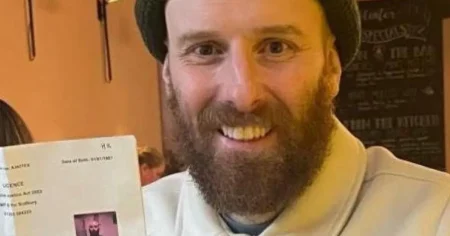


There is a particular kind of anger that only football can create—a slow, simmering frustration that builds with every misplaced pass, every missed chance, every defensive lapse, until you can no longer sit still. Alastair Cass knew that feeling all too well. A 40-year-old Arsenal supporter living in the quiet Devon countryside, he had spent the afternoon watching his team collapse against Brighton, losing 3-0 in a performance that felt less like a football match and more like a public exercise in disappointment. When the final whistle blew, he did what many fans have done in moments of sporting despair: he got up, walked out of the house, and tried to let the anger dissolve in the open air. He had no grand plan, no idea that he was about to become part of a story far bigger than any Premier League result. His property in Chulmleigh spans 150 acres, a vast and peaceful stretch of land where the sounds of the outside world rarely intrude. But on that afternoon, as he wandered toward one of his barns, he heard something unusual—a noise that did not quite belong. At first he dismissed it, but when he heard it again, something told him to listen more carefully. It was a voice, faint but persistent, and it seemed to be coming from the valley below. He later explained that living on such a large property, you do hear things now and then, but this was different. “Something’s up,” he thought. He jumped onto his quad bike and followed the sound, heading down toward the river, and only when he got closer could he finally make out the word that had been carried on the wind: “Help.” It was a cry for help, and it was coming from somewhere below. In that moment, the football match no longer mattered. Something far more important was happening.
The valley behind Alastair’s home was not the kind of place you would expect to find a person in trouble. It was overgrown, wild, and in places genuinely dangerous—the sort of terrain that most people avoid, especially if they are not familiar with the land. But as Alastair guided his quad bike down toward the river, the cries became louder, and he knew he was getting closer. Eventually, he found the source. A woman, later identified as Sallie, was trapped in a ditch, sunk in thick mud up to her chest. She had been there for hours. In fact, she had been stuck since 1:30 that afternoon, and it was now around 5pm. Four hours of struggling, shouting, shivering, and waiting. Four hours of wondering whether anyone would ever hear her. When Alastair first saw her, he swore out loud. He had lived in the area for 28 years and had never seen anything like it. “It’s such an unkempt and dangerous area to go in,” he later said, “but I eventually came across her down a ditch, stuck in mud up to her chest line. She was shivering. I swore when I saw her cause I just couldn’t believe what I was seeing after living here for 28 years!” The woman was pale, exhausted, and shaking uncontrollably. The mud had held her fast, and every attempt to move had only made things worse. She was cold, frightened, and running out of hope. Alastair knew he could not pull her out alone, and he knew that every minute mattered. He turned his quad bike around and raced back to the house, his mind already working through the options. He gathered rope and wooden boards—the kind of equipment that might allow him to spread his weight across the mud and get close enough to help. When he returned, he laid the boards down carefully and tied the rope around Sallie. He pulled, but the mud would not let go. It was thick, heavy, and suction-like, clinging to her body as if it had no intention of releasing her. He tried again, but it was no use. This was going to require more than one man and a few pieces of equipment. It was going to require a full rescue operation.
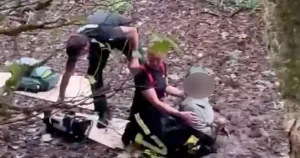
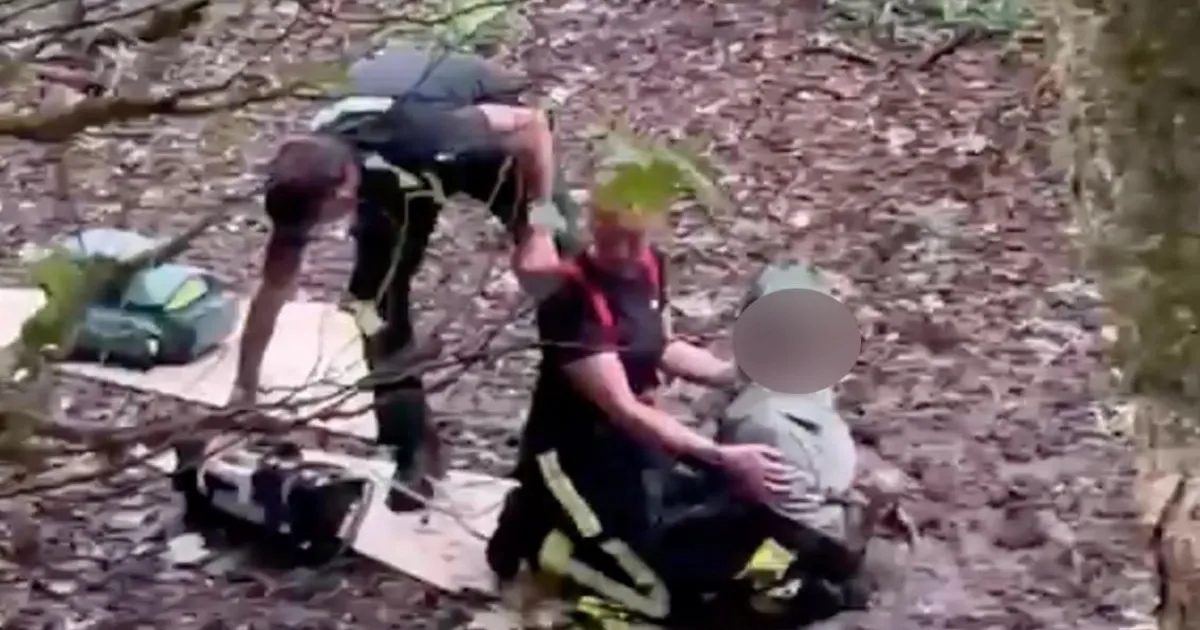
Alastair made the call that would bring an army of rescuers to the quiet Devon valley. The Chulmleigh fire brigade arrived first, followed by specialist rescue teams, police officers from South Molton, the boat rescue service, four ambulance crews, and even multiple helicopters. It was an extraordinary response for an extraordinary situation. The rescue operation was long and painstaking. The mud around Sallie was deep and unstable, and the risk of making things worse was constant. Rescuers worked carefully, using ladders, ropes, boards, and their own training to create a way to lift her free. Every movement had to be measured. Every attempt had to be coordinated. Alastair, who had started the afternoon in front of the television, now found himself in the middle of a live emergency, standing alongside firefighters and paramedics in the fading light of the Devon countryside. For Sallie, the rescue must have felt like an eternity. She had already spent four hours alone in the mud, and now, even with help around her, the minutes stretched on as the team worked to free her. The operation took two hours in total. Two hours of pulling, digging, stabilizing, and reassuring. Two hours of trying to keep her calm while the cold and exhaustion threatened to overwhelm her. Finally, with a collective effort that involved every person on the scene, Sallie was pulled free. She was alive. She was covered in mud, cold, and deeply shaken, but she was alive. She was taken to hospital, where she remained until 4am the following morning, receiving treatment for the effects of her ordeal. It was a close thing. If Alastair had not heard her cries, if he had not followed the sound, if he had decided to stay inside and watch the post-match interviews instead of walking out in frustration, the outcome could have been very different.
In the days that followed, Sallie had time to think about what had happened, and about the man who had found her. She wanted to thank him properly, but a simple message did not seem enough. So she wrote him a card. In it, she expressed her gratitude in a way that perfectly captured the strange circumstances of their meeting. “Thanks to Arsenal for being rubbish at football!” she wrote. It was a joke, but it was also true. If Arsenal had played better, if they had won or even drawn, Alastair would likely have stayed on his sofa, watching the analysis and feeling satisfied with the result. He would not have stormed out of the house. He would not have heard her cries. He would not have jumped on his quad bike and followed the sound into the valley. The football team he loved had let him down, and because of that, he had been in exactly the right place at exactly the right time. Alastair himself found the irony impossible to ignore. “If it went differently, I would have stayed and watched the post-match interviews and so on—but luckily that wasn’t the case on this day!” he said. His frustration had been redirected into something meaningful. The anger he felt at the final whistle had become the energy that saved a life. Sallie’s card also included a line that cut through the humor and got to the heart of the matter: “I have never been so happy to see another human being as I was to see you that day!” It was a simple sentence, but it carried the weight of four hours of fear, isolation, and desperation. She had been alone in the mud, unable to move, unsure if anyone would ever come. And then, out of nowhere, a man on a quad bike had appeared—a man who had been driven there by a football defeat. It was the kind of coincidence that makes you believe in fate, or luck, or at least in the strange ways that life works.
There is something deeply human about this story, and it is not just the rescue. It is the way that a moment of personal disappointment turned into an act of selflessness. Alastair had every reason to stay inside and sulk. He had every reason to focus on his own frustration, to vent about the match, to let the anger burn itself out in private. Instead, he walked outside, and when he heard something that did not sound right, he listened. That is the kind of instinct that cannot be taught. It is the instinct that makes someone stop what they are doing and pay attention to the world around them. In a rural area like Chulmleigh, that instinct is especially important. The countryside is beautiful, but it can also be isolating and unforgiving. A fall, a sudden illness, or a stuck vehicle can quickly become a serious emergency if no one is around to help. The fact that Sallie was stuck in mud for four hours before anyone heard her is a reminder of how easily accidents can happen in remote places. But it is also a reminder of how communities come together in a crisis. The rescue involved not just Alastair, but firefighters, police officers, ambulance crews, and helicopter teams—people who dropped what they were doing and rushed to help a stranger. They worked together in difficult conditions, and they did not stop until Sallie was safe. That is the best of humanity. It is also a reminder that we never know what a bad day might be leading us toward. Alastair’s bad day at the football was the beginning of something good. His disappointment was the spark that set off a chain of events ending in a life saved. It is a strange thought, but perhaps sometimes we are meant to be in certain places at certain times, even if the reason we are there is frustration, anger, or a terrible result on a Saturday afternoon.
In the end, the story of Alastair Cass and Sallie is not really about football at all. It is about the unexpected ways in which our lives are connected. It is about a man who let go of his anger long enough to hear someone else’s cry for help. It is about a woman who spent four hours in the mud, cold and afraid, and who found hope in the sound of a quad bike approaching. It is about the emergency services who worked for two hours to free her, and about the small, darkly funny card that turned a terrifying experience into a memory with a punchline. “Thanks to Arsenal for being rubbish at football!” Sallie wrote, and it is hard to imagine a more perfect thank-you note. It acknowledges the absurdity of the situation while also expressing genuine gratitude. It is a line that will probably make Alastair smile every time he reads it, and it is a line that perfectly captures the strange twist of fate that brought them together. Alastair will likely never watch an Arsenal match the same way again. When the team loses, he might think of Sallie. When they win, he might wonder what he would have missed if he had stayed on the sofa. The truth is that we do not always understand why things happen, but sometimes the worst moments turn out to be the beginning of something extraordinary. Arsenal’s defeat was a disappointment. Sallie’s rescue was a miracle. And all because a man walked out of his house in frustration, listened to the wind, and followed a voice that needed him. It is a story worth remembering, not just because it is heartwarming, but because it reminds us that we are never too angry, too tired, or too wrapped up in our own lives to hear someone else calling for help. Sometimes, the thing that ruins your day is the thing that saves someone else’s. And sometimes, being rubbish at football is exactly what the world needs.