

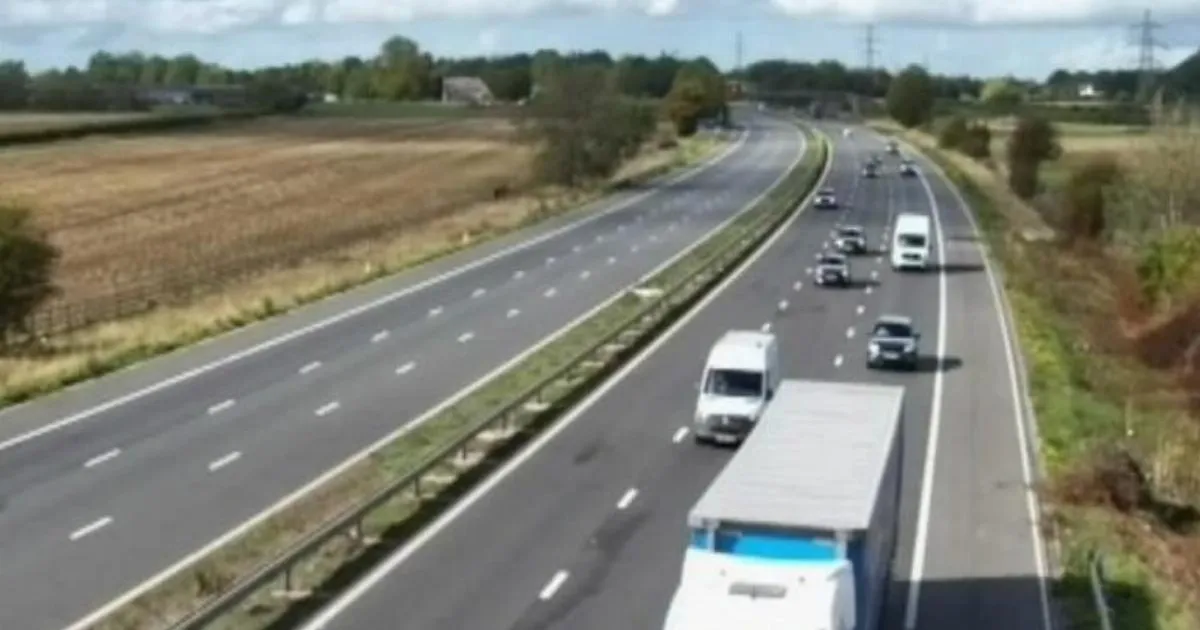
The M4 is not the kind of road that makes people sentimental. It is a working motorway, a workhorse of tarmac and bridges, carrying thousands of vehicles every day through a familiar landscape of service stations, slip roads and county towns. But on this particular morning, from a stretch between Swindon and Chippenham, it looked less like an efficient expressway and more like a strange sunrise gathering. Drivers who had set out expecting a routine journey found themselves stopped, not for a few minutes but for hours, their engines idling, their windscreens filling with the pale light of a new day. Some got out of their cars and walked to the central reservation, not because they were reckless but because the road had stopped being a road and become a waiting room. The usual urgency of the commute had been replaced by something else: the quiet, anxious solidarity of people who are all heading somewhere and cannot get there. Whether they were going to work, school, hospital, or home after a long night shift, the delay was more than an inconvenience. It was a disruption of the day’s careful architecture. And for the hundreds caught in the traffic that stretched along the westbound carriageway, the absence of information only sharpened the edge of their frustration. National Highways had closed the section in the early hours of the morning, warning that the M4 would remain shut westbound between junction 16, Swindon, and junction 17, Chippenham. The reason, a collision involving a lorry, had left a serious environmental and engineering problem behind. Diesel had pooled across the road, making the surface dangerously slippery, and the central reservation had been damaged so badly that the carriageway could not simply be reopened after a quick sweep. As the hours passed, the queue behind the closure only grew, and those who had chosen, or been forced, to wait in place began to understand that their journey would not be the one they had planned. By the time the sun had fully cleared the horizon, the motorway, normally a place of endless movement, had become a space where people stood, stretched, exchanged words across lanes, and wondered whether they would ever get out.
The crash itself happened shortly after 2am, when the motorway was much quieter and most drivers were still asleep. At that hour, a lorry came to a stop in the worst possible way, colliding with the central reservation and blocking the westbound carriageway. The impact was powerful enough to tear into the barrier and to spill litres of diesel fuel across the asphalt. The fuel spread quickly, seeping into the surface and turning the road into a slick, hazardous environment. Even after the lorry had been removed, the residue would remain a real danger. National Highways later explained that the recovery of the HGV had been completed at 06:40, but that the process had been protracted because the vehicle had come to rest on the central reservation barrier. That detail mattered, because retrieving a lorry from such an awkward position is not simply a matter of attaching a tow rope. It requires lifting, stabilising, checking, and carefully moving a huge vehicle without causing further damage to the road or risking the safety of the workers involved. Once the lorry was gone, the next challenge emerged: the road itself was no longer fit for use. An inspector arrived on scene and confirmed that around 146 metres of carriageway would need to be resurfaced before traffic could safely pass. The central reservation also needed emergency repairs, which could be carried out in lane closures later, but the underlying damage to the road surface was more significant. A clean over the top would not be enough. The affected stretch would have to be dug out, relaid, compacted and marked, a process that takes time, manpower and machinery. The carriageway, in other words, had been not just blocked but wounded. The decision to keep the M4 closed was not made lightly. National Highways is not in the business of shutting one of the country’s busiest motorways for fun. The closure was a safety measure, designed to prevent a much worse series of crashes on a surface coated in diesel and littered with broken barrier debris. In the dark, before the sun came up, any vehicle trying to negotiate that stretch could have skidded or hit the damaged reservation. Keeping the road shut allowed the emergency services, recovery crews and highways teams to do their work without the added risk of moving traffic passing inches away. It also meant that the incident would take longer to resolve, because a closed road is a safe workspace, but an open road, even with restrictions, demands constant vigilance. As the morning progressed, that difficult balance between safety and public convenience played out in real time on the M4, with the closure lingering far longer than anyone had hoped.
Meanwhile, on the far side of the cones and barriers, real people were living through the consequences. Hundreds of motorists woke up early, filled up with petrol, perhaps bought coffee, and set off into what they thought would be an ordinary morning on the M4. Instead, many were caught in queueing traffic that stretched for miles. Some reported waiting for four hours, their journeys unravelling in a long, crawling haze of brake lights and not knowing. The frustration was understandable. Morning routines are built around small margins: school drop-offs, shift starts, meetings, medical appointments. A four-hour delay is not a minor irritation; it is a missing half a day, an appointment cancelled, a child collected late, a good reason to be written up, or simply the loss of a morning that will never come back. Footage shared online showed people getting out of their vehicles and standing along the central reservation as the sun was rising. Some were clearly in phone calls, some just stood with their arms folded looking at the horizon. The sight of drivers out on the motorway, a landscape normally reserved for moving metal, was a strange and powerful image. It captured the odd reality of the moment: the road had stopped working, so the people could not move either. They were not being difficult; they were simply coping in their own ways. Some walked over to talk to other drivers. Some let their children out to stretch their legs. A few, perhaps, were simply lost in the realisation that no amount of planning could have prepared them for this. Eventually, National Highways confirmed that all traffic caught within the closure had been turned and released. Relief, for many, must have come with exhaustion. To be released is not the same as to arrive; it means finding a new route, re-routing through unfamiliar villages and congested local roads, and figuring out how to salvage the day.
At the heart of the response was National Highways, whose officials worked through the morning to assess the damage and keep the public informed. In a statement, they described the scene in precise, technical language. “Recovery of the HGV was completed at 06:40,” they said. “The process was protracted due to the vehicle coming to rest on the central reservation barrier. National Highways area team crews are now treating the road surface following a substantial oil spillage from the collision.” That statement, for all its coolness, was a small window into a much larger operation. A team of inspectors, engineers, contractors, incident support staff and, earlier, police and ambulance crews had all been brought together by a single crash. The substantial oil spillage left behind by the lorry was not just a stain. It was a hazard that had to be neutralised before the road could be resurfaced. The inspector who attended the scene confirmed that 146 metres of carriageway required resurfacing, which meant shutting the westbound route through the entire repair process. The road, they said, was unable to re-open until the resurfacing was completed. Emergency barrier repairs were also needed, though those could be completed within back-to-back lane 3 closures, reducing the additional disruption once the main work was done. But perhaps the most disappointing news for drivers was the timeline. Although no definitive re-opening time was available, early estimates suggested that the M4 westbound heading towards Bristol would remain closed throughout the evening peak travel period and until at least 18:00. In a brief update posted to social media, National Highways repeated the message and added practical advice: plan ahead, you may wish to re-route or even delay your journey. It was a short sentence, but it carried a heavy implication. For many drivers, the chase for the day had already been lost.
The M4 is not simply a convenient shortcut. It is one of the most important roads in the United Kingdom, a vital corridor that links London and the South East to Heathrow, Reading, Swindon, Bristol and South Wales. It carries commuters, holiday traffic, freight lorries, emergency vehicles, deliveries and all the rest of the daily national choreography. When a section of it is closed for an entire day, the effects ripple outward far beyond the immediate queue. Drivers trying to reach Bristol, for instance, found themselves forced off at Swindon, heading through Chippenham and onto local roads, which are simply not designed to carry that scale of traffic. Villages that normally see a few dozen cars an hour suddenly became de facto alternatives to a motorway, with all the dangers and frustrations that implies. Businesses reliant on just-in-time deliveries saw their timetables slip. Car deliveries, food distribution, parcels, fuel tankers, building materials and a hundred other essential loads all had to find alternative routes or wait. For long-distance drivers and freight operators, the cost of delay can be measured in money and missed deadlines. For individuals, it can be measured in missed flights, anxious passengers, or the quiet guilt of not arriving when promised. Even people who did not come anywhere near the closure were touched by it, because the traffic that should have been travelling along the M4 was now being distributed across the surrounding network. National Highways urged drivers to plan ahead, and perhaps to re-route or delay their journeys. It was good advice. When a motorway is closed, there is no such thing as a local workaround that can absorb the load without queues. There is only a series of less bad options. On a day like this, the most human response is to make time for the fact that the journey will not be smooth and not to take it out on the people around you, because no one in the queue is the cause of the problem.
By the time the afternoon passed, the M4 between junctions 16 and 17 remained a roadside construction site, its future still uncertain except for the promise that it would not reopen before the evening rush hour. There was no fanfare, no easy alternative, no fast fix. Just a long, dirty, necessary process of recovery and renewal. It is easy to be angry at such disruption, and hundreds of people were no doubt frustrated beyond belief. But it is worth pausing to think about what happens behind those metal barriers. While stranded drivers were being turned around, while some were sitting in cafes in Chippenham trying to decide what to do next, road workers and recovery teams were dealing with a lorry, a damaged barrier and 146 metres of contaminated asphalt. They did not block the road out of spite. They were there to make it safe, to clean up a spill that could have caused a far more serious accident had the road remained open. The diesel that had gushed from the lorry was not just a mess; it was a hidden danger, waiting for the wrong combination of wet tyres, speed and gravity. The resurfacing that would eventually repair the road was not bureaucracy; it was the difference between a stretch of motorway that could safely carry traffic for years and one that might fail at the worst possible moment. In the end, all roads are fragile. They are just strips of engineered ground resting on the landscape, and they depend on constant care. A crash like this is a brutal reminder that the normal flow of life can be interrupted at any moment. The best any driver can do is leave earlier, check the news, be patient, and treat other road users as fellow humans rather than obstacles. The M4 will reopen, the fresh tarmac will roll out in a smooth grey ribbon, and people will forget the morning they stood on a motorway watching the sunrise. But for those who were caught there, the memory will linger: a strange, shared moment when the great road was silent, and one small piece of the country had to wait.