
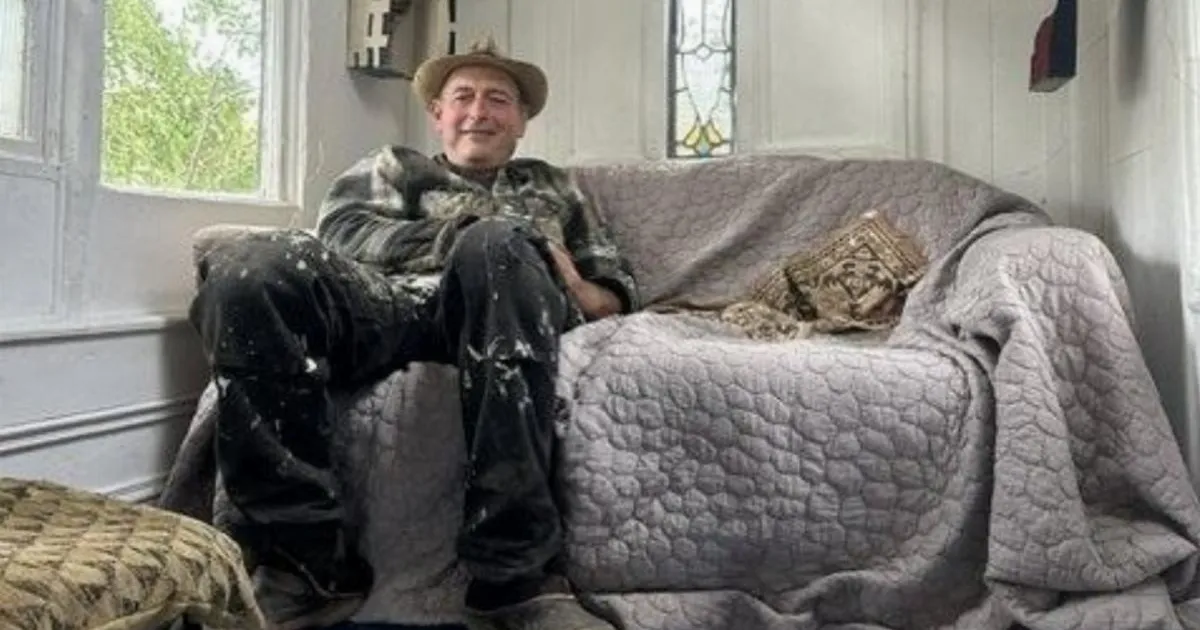
In a city that never quite stops moving, where millions of hurried feet pound the pavement every single day, there is a man who has spent more than two decades asking people to slow down and look down. You might not know Ben Wilson by name, but if you have ever wandered through the streets of London, you have almost certainly seen his work without realizing it. For the past 22 years, Wilson—better known to many as the “Chewing Gum Man”—has been transforming the discarded, the spat-out, and the overlooked into something unexpectedly beautiful. He paints tiny, intricate pictures on the flattened wads of chewing gum that have been trodden into the pavement, turning a symbol of our throwaway consumerist culture into a tiny canvas for art. Where most of us see nothing but grey, sticky blobs on the street, Wilson sees potential. His philosophy is simple but profound: you take something that has been rejected and you transform it into something positive. In a world that creates cheap, artificial things at lightning speed, his work is a gentle rebellion—a reminder that beauty can be found in the most unlikely of places, and that even the smallest, most mundane object can carry meaning if we are willing to look closely enough.
But Wilson’s art has not come without its battles. Painting on public property, even something as small as a piece of discarded gum, has landed him in trouble with the law more than once. He has faced court cases where authorities claimed his paintings were on public property, and in one notable case, he managed to win on a technicality. His argument was elegant in its simplicity: the gum itself is on public property, but the gum is not public property—it has been abandoned, thrown away, and is therefore, in a sense, fair game. That legal victory, however, did not end his struggles. He has also had to fight to save hundreds of his pieces on the Millennium Bridge, which have been under threat of removal due to renovation works. The thought of losing years of painstaking work to a cleaning crew or a construction project might be enough to make most artists give up, but not Wilson. For him, the challenges are simply part of the process. He believes deeply in the value of what he does, and he knows that the real worth of his art lies not in its permanence, but in the moments of connection it creates. It is art made for the people, not for the galleries, and that makes it powerful in a way that a framed canvas on a white wall could never be.
At the heart of Wilson’s work is something much deeper than aesthetics: human connection. He has created hundreds of dedications on those tiny gum canvases, each one a personal gift to someone he will likely never see again. He has painted miniature portraits to mark births, deaths, and marriages, and he has honoured requests for things as simple and wonderfully ordinary as a piece of cheese and crackers. The joy he gets from this is evident in his voice. He talks about the beauty of making a picture for someone in a truly giving way, with no expectation of payment or recognition, purely for the sake of acknowledging another person’s existence. In a world that often leaves people feeling alienated and disconnected, Wilson sees his art as a bridge. It is a way of saying, “I see you.” He also sees it as an act of freedom of expression. In a society where so much is controlled, monitored, and regulated, his spontaneous, unpermissioned art is a small act of defiance. It is art that exists in the margins, literally underfoot, and that is exactly what makes it so precious. He creates in the cracks of the city, and in doing so, he opens up a space for surprise, for joy, and for genuine human encounter.
Wilson’s work has taken him far beyond the streets of London. Over the years, he has travelled to some of the most remote and challenging places on Earth, from the frozen landscapes of the Arctic Circle to the vibrant, complex communities of South Africa. One of his most difficult and moving projects involved creating a painting for a doctor living outside Gaza City. The image was of an olive tree growing around the ruins, with the word “steadfastness” painted beside it. It is a powerful symbol of resilience and hope in the face of destruction, and it reflects Wilson’s belief that art can speak to the deepest parts of our humanity, even in the midst of conflict and suffering. But for all his travels, it is London that holds his heart. He loves the city’s diversity—the diversity of action, thought, and people that makes it unlike anywhere else on Earth. In a time when the world can feel increasingly divided, Wilson finds hope in the way Londoners live side by side, different in so many ways but sharing the same streets, the same pavements, and sometimes, the same tiny piece of gum. For him, the city is not just a backdrop for his art; it is the reason his art exists.
Recently, Wilson opened the doors of his north London home and studio to the public, offering a rare glimpse into the mind and work of a man who has spent decades creating art for the streets. The open house was an eclectic showcase of his talents, featuring his renowned chewing gum art alongside wooden sculptures and a fascinating daily “diary” made up of small, intuitive paintings on tiny tiles. Each tile represents a single day of thought, a small moment captured in colour and form. Selling his work at events like this is not just about making a living, though that is certainly part of it. It is about giving Wilson the means to continue making street art, to keep connecting with people in that spontaneous, unmediated way. He has completed hundreds of requests over the years, but he still has countless notebooks filled with commissions he has not yet been able to get to. These unfinished requests, he admits, are always on his mind. His girlfriend, Freya Cummings, herself an artist, says these unmet demands “haunt him.” It is a touching insight into the kind of person Wilson is—someone who feels a deep sense of responsibility to the people who have placed their trust in him, who have asked him to create something personal and lasting for them.
In the end, Ben Wilson’s story is about so much more than chewing gum. It is about the power of art to transform the everyday, to find beauty in the discarded, and to bring people together in a world that often feels fragmented. His work is a quiet reminder that creativity does not need permission, that it can flourish in the most unexpected places, and that sometimes the smallest gestures matter the most. Every time Wilson kneels down on a city pavement, paintbrush in hand, to add a splash of colour to a forgotten piece of gum, he is making a statement. He is saying that nothing is worthless, that everyone deserves to be seen, and that even in a world dominated by consumption and disposal, there is still room for wonder, for spontaneity, and for human connection. The chewing gum paintings are ephemeral—they will be walked on, scrubbed away, and lost to time—but the moments of joy they create are real, and they echo long after the images themselves have faded. Ben Wilson may never be a household name, but in the hearts and memories of those who have encountered his work, he has left a mark far more lasting than any painting on a wall. He is the man who made the pavement a little more beautiful, one tiny piece of gum at a time.