


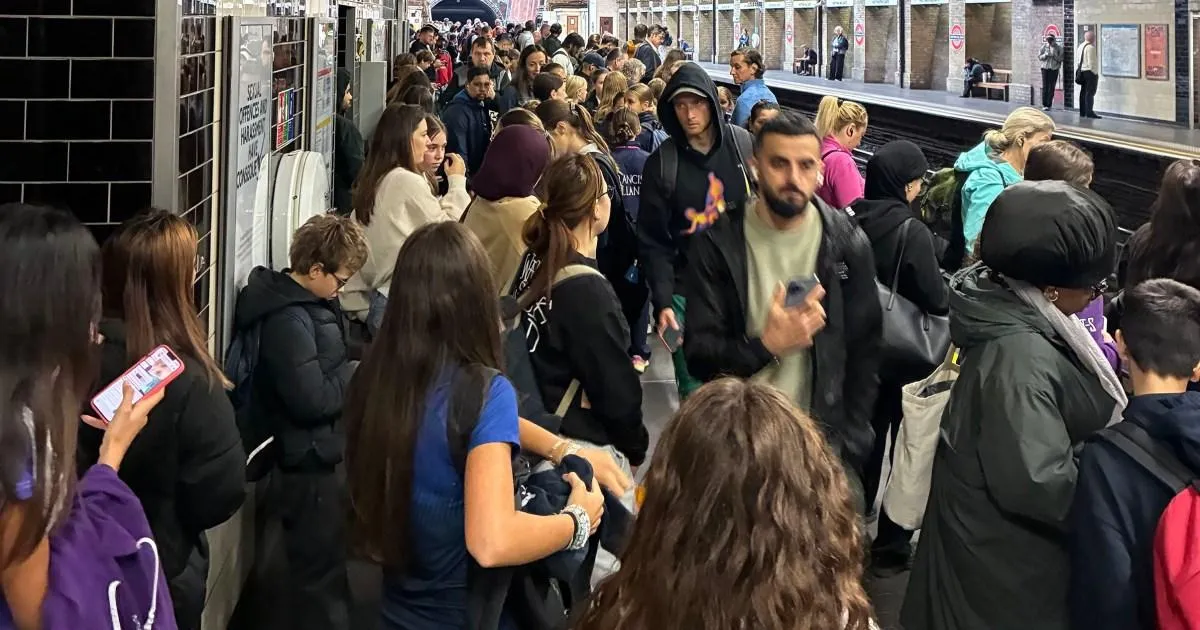
Few things test the patience of a Londoner quite like the morning commute, and today the city’s famously resilient travellers found themselves facing one of those days that makes even the calmest person want to turn around and go back to bed. A collapsed drain at Baker Street sent shockwaves through the Tube network, forcing the complete suspension of the Circle line and leaving thousands of passengers stranded, confused and increasingly frustrated. The trouble unfolded early in the morning, when engineers discovered that a broken pipe on the track had simply caved in, creating a hazard that stopped trains in their tracks across central London. The knock-on effect was immediate and severe: platforms began to fill within minutes, the familiar electronic boards switched from arrival times to apologetic delay notices, and the air buzzed with the collective groan of people realising that their carefully planned journeys were falling apart. The latest Transport for London travel status update confirmed the worst: the entire Circle line remained suspended while engineers worked to fix the broken drain, and the Metropolitan line was partially closed between Baker Street and Aldgate for the same reason. It was, in every sense, the kind of infrastructure failure that turns an ordinary weekday into an endurance test, and more than one commuter was heard muttering that the whole ordeal was enough to give you grey hairs.
The misery was by no means confined to one line. The Hammersmith and City line, which shares track in some of the most congested parts of central London, was suspended in both directions between Euston Square and Edgware Road, while severe delays were reported across the entire route. The Metropolitan line, a vital artery for commuters travelling into the capital from the north-west suburbs, was also hit hard, with a partial closure between Baker Street and Aldgate causing severe delays on every branch. Even the Central line, which usually chugs along with only the occasional hiccup, saw minor delays on several stretches, including between Epping and Leytonstone, Hainault and Leytonstone, North Acton and West Ruislip, and North Acton and Ealing Broadway. For passengers, the disruption meant a day of improvisation: checking phone apps for alternatives, squeezing onto already packed buses, and waiting in long, shuffling queues for replacement services that seemed to take forever to arrive. The phrase “severe delays” became a grim refrain, repeated on loudspeakers and status boards across the network. What made it worse was the sense that this was not a single, isolated problem but a cascading series of failures. A collapsed drain might sound like a small, almost mundane thing, but beneath the streets of London it can bring the entire system to its knees. By midday, many travellers had accepted that meetings would be missed, appointments would need to be rescheduled, and the morning’s plans were effectively a write-off.
Across town, passengers on the Elizabeth line were having their own transport nightmare, and this one came with an added layer of confusion. Severe delays were reported between Abbey Wood and Heathrow Airport, as well as on the stretch towards Reading, after engineering works overran and finished late. The timing could not have been worse, coming just days after the route was hit by a combination of vandalism and a fire over the weekend. That earlier incident had already damaged the rail route between London and Heathrow, affecting not just the Elizabeth line but also Great Western Railway and Heathrow Express services. The result was a reduced timetable that was still in place long after the weekend had ended, with train times and frequencies varying unpredictably. Transport for London sent an email to customers the previous day, warning that the reduced timetable would continue until further notice and urging people to check before they travel. But for many, the warning arrived too late or was simply buried under the flood of daily emails. Passengers stood on platforms staring at departure boards, watching trains disappear from the schedule at the last minute, and trying to work out whether it was faster to wait or to abandon the railway altogether and take a taxi. For anyone trying to catch a flight, the stress was especially acute. A delayed train to Heathrow is more than an inconvenience; it is a direct threat to holiday plans, business meetings and long-awaited reunions.
The weekend’s events only made today’s situation harder to swallow. Over Saturday and Sunday, the rail route between London and Heathrow had already been damaged by a fire, with Network Rail reporting that the infrastructure had suffered significant harm. The fire disrupted services on the Elizabeth line, Great Western Railway and Heathrow Express, three of the most important routes for travellers heading to and from one of the busiest airports in the world. Then came the vandalism, which added insult to injury and forced Transport for London to implement an emergency reduced timetable. The combination of fire, vandalism and a late finish to engineering works meant that Monday’s commute was never going to be smooth, but the collapse of a drain at Baker Street turned a bad situation into a full-blown travel crisis. For regular commuters, it was another reminder of just how delicate the capital’s transport network can be. A single broken pipe, a malicious act, a fire in the wrong place at the wrong time—any one of these can ripple across the system, affecting tens of thousands of people who are simply trying to get to work, to school, to an appointment, or back home to their families. The frustration was palpable on social media, where Londoners shared photos of packed platforms, empty ticket halls turned into waiting areas, and the ubiquitous apologetic signs that have become a symbol of the modern commute.
Beneath the practical chaos, though, there was a deeper human story. Commuters are not just numbers on a spreadsheet; they are people with lives, deadlines and emotions. There was the mother trying to get her children to school before rushing to a meeting, the nurse heading in for an early shift after a sleepless night, the student clutching a laptop and hoping not to miss an important lecture, the elderly couple trying to navigate the Underground for the first time in years. For all of them, a collapsed drain at Baker Street was not just an engineering problem; it was a personal disruption, a jolt to their carefully organised routines. The phrase “grey hairs” that appeared in coverage of the incident was more than just a joke. It captured the genuine weariness of a city that has endured so much over the past few years and has learned to expect disruption as part of daily life. Yet Londoners are also remarkably adaptable. Within minutes of the delays being announced, people were already rerouting, sharing tips on social media, and making the best of a bad situation. Some walked, some cycled, some squeezed onto river buses or overground trains. The resilience of the capital’s travellers is never more visible than on days like this, when the entire network seems to conspire against them and they somehow find a way through. Still, there is no denying that the strain is taking its toll. Every cancellation, every stranded train, every long wait on a drafty platform chips away at the goodwill that keeps the city moving.
As the day wore on, engineers continued to work on the collapsed drain at Baker Street, and Transport for London said it was doing everything possible to restore services as quickly as safety would allow. The Metropolitan line remained partially closed, the Circle line stayed suspended, and the Hammersmith and City line continued to suffer severe disruption. On the Elizabeth line, the reduced timetable was expected to remain in place until further notice, with passengers advised to check live departure information before setting out and to allow extra time for their journeys. For anyone planning to travel later in the day, the advice was simple: expect delays, have a backup plan, and try to keep a sense of humour. The truth is that London’s transport network is ageing, overstretched and constantly under pressure, and incidents like this one are unlikely to be the last. But the city has a long history of getting through difficult days, and today will be no exception. The grey hairs may be multiplying, the coffee may have gone cold, and the patience may be wearing thin, but Londoners will get where they need to go, eventually. They always do. And when the next collapse, fire, or act of vandalism comes along, they will grumble, complain, roll their eyes and carry on—because that is what living in a great city demands. For now, the best anyone can do is take a deep breath, check the status boards, and remember that even the worst commute is temporary. The engineers are working, the repairs are underway, and somewhere beneath the streets of Baker Street, a team of people is doing its best to put the tube back together again.