
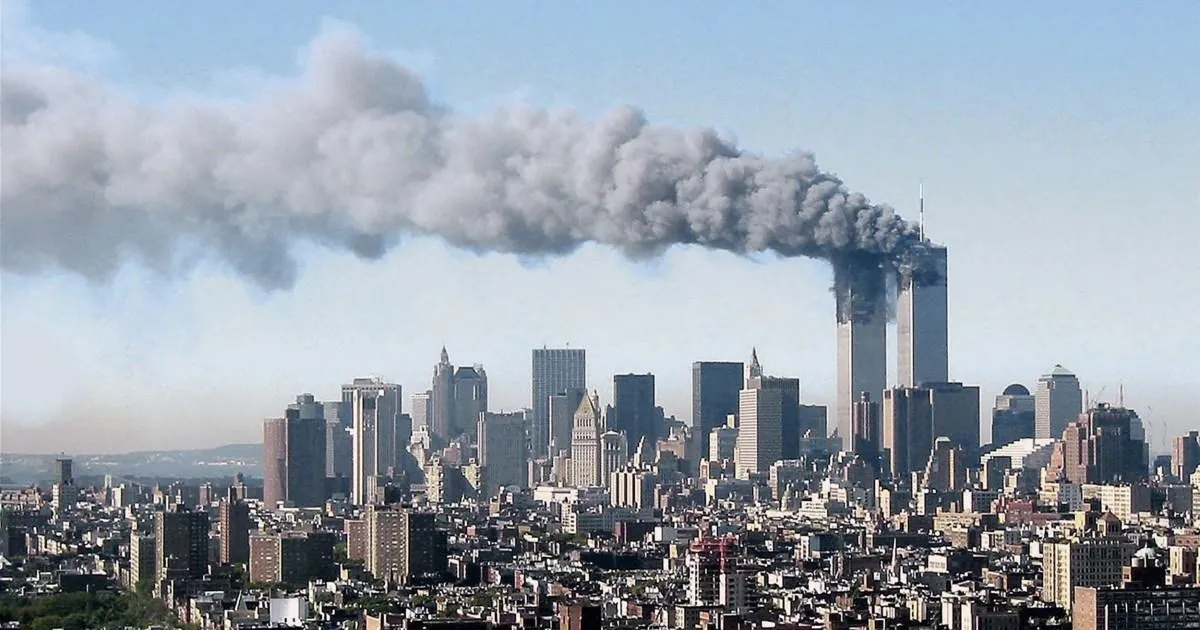
The invitation is deliberately uncomfortable. On a Friday evening in September, as the world marks the 25th anniversary of the 11 September 2001 attacks, a small seaside café in Bournemouth will ask its guests to hand over their phones, take their seats, and watch the day unfold again — not through Hollywood reconstructions or solemn documentaries, but through the raw, unedited television footage that was broadcast live while the Twin Towers burned. Wild Boscombe Café, an independent venue on the Dorset coast, is hosting what has been described as a “9/11 watch party”, organised by Verdurin, a political arts group, as part of an event called the Adam Curtis Party Conference. For many, the phrase “watch party” sounds like a social gathering, an evening with drinks and discussion, maybe even a kind of dark entertainment. And that is exactly why the announcement has provoked anger, unease, and a fierce debate about memory, art, and respect. The event is not being promoted as a memorial service or a history lecture. It is being framed as an evening of immersion, a chance to “refresh your memories” if you lived through that day, or to “get a feel” for it if you were too young. Guests will be asked to leave their phones at the door, removing the distractions of the present, so that they can sit with the past and absorb it in real time — the news anchors stumbling over their words, the smoke rising from Lower Manhattan, the second plane hitting, the collapse, the dust, the silence. It is a concept that could be called powerful, provocative, or profoundly insensitive, depending on who you ask.
Among those voicing alarm is Simon McCormack, a local councillor in Bournemouth, whose words have cut through the artistic framing and landed on something simpler and more painful. He said he was “deeply concerned” by the event, and he did not soften his language. Nearly three thousand people were murdered on 9/11, he said. Survivors were left with lifelong injuries, trauma, and memories they cannot escape. Emergency workers who ran into the buildings when everyone else was running out have spent the last twenty-five years dying of illnesses caused by the toxic air they breathed. Families have lived with empty chairs at dinner tables, with birthdays and anniversaries that became impossible dates, with children who never got to meet their parents. For them, 9/11 is not a piece of history or a media phenomenon. It is a real human tragedy, and the idea of turning it into an evening event in a café, however thoughtful the intentions, feels like a violation. McCormack said the event “crosses a line” and risks turning tragedy into spectacle. He urged the organisers and the venue to reconsider, out of respect for the victims, survivors, and their families. His words were not abstract. They were the words of a community representative who recognised that a watch party, even one dressed in high-minded artistic language, can look and feel like entertainment. And when you call something a party, people will wonder what exactly is being celebrated.
The curator behind the event, Pierre d’Alancaisez, has responded to the criticism with a carefully worded defence, insisting that the evening is not a celebration or a trivialisation, but an attempt to understand how 9/11 transformed the way we see the world. He said that there will be “no spectacle here” — which is itself a play on the accusation. His argument is that the spectacle already happened, live, on television, in 2001, and that the event is simply an opportunity to examine it. The installation, he explained, rebroadcasts the responses of the mainstream media and twines them with conspiratorial commentators, creating what he called “an installation of overwhelming scale”. The point, he said, is to show how people were taken in by the seductive power of conspiracy theories, and how the events of that day were engineered, in a sense, for the camera. Al-Qaeda chose targets that would produce the most devastating images imaginable: the Twin Towers, symbols of American financial power, framed by a clear blue sky, with television cameras already present because of the political atmosphere of the time. The attacks were not just an act of war; they were a media event that would play on repeat for years and would spawn an entire ecosystem of doubt, suspicion, and alternative narratives. By asking guests to leave their phones at the door and watch the footage as it originally unfolded, d’Alancaisez wants to recreate the moment before interpretation hardened into orthodoxy, before the phrases “9/11 truth” and “inside job” became cultural shorthand. He says the event is about “reviewing our hyperreality’s fundamental building block” — the moment when live television and terrorism fused, and when the boundary between fact and belief began to blur.
To understand why an arts group would choose a title like the Adam Curtis Party Conference, it helps to know who Adam Curtis is. Curtis is a British documentary filmmaker known for dense, essayistic films such as The Century of the Self, The Power of Nightmares, and HyperNormalisation. His work often argues that the modern world is built on illusions, that political leaders and media institutions have constructed a simplified, managed reality, and that the rise of conspiracy theories is a symptom of a deeper crisis of trust. He is fascinated by how power uses images, how narratives are manufactured, and how people try to make sense of chaotic events. His films are not conventional documentaries; they are sprawling, hypnotic collages of archival footage and ominous music, designed to make audiences feel like they are stepping outside the official story. Verdurin, the group behind the Bournemouth event, appears to be inspired by this tradition. The Adam Curtis Party Conference is presumably not an actual political conference but a cultural gathering, a space for screenings, discussions, and installations that explore Curtis’s themes. Holding it in a café rather than a gallery or theatre is itself a statement: this is not academic, not distant, not safely framed. It is meant to be uncomfortable, immersive, close. But that closeness is exactly what worries critics. There is a difference between examining images and re-presenting them as an experience. There is a difference between critiquing media manipulation and asking an audience to sit through two hours of real death and destruction as a form of intellectual exercise. Even if the organisers have the best intentions, and even if they genuinely believe they are offering a critical perspective on conspiracy theories, the format can still be experienced as a kind of dark tourism.
The deeper issue is one that has haunted every artistic attempt to engage with 9/11, from films to paintings to theatre. Who owns the story? Who has the right to use the images of that day for reflection, provocation, or education? On one hand, there is a strong argument that the events should not be sealed off from art and questioning. 9/11 changed the world in profound ways: it led to wars in Afghanistan and Iraq, to the erosion of civil liberties, to the creation of the Department of Homeland Security, to a permanent climate of surveillance and fear. It also gave birth to a vast conspiracy culture that still influences politics today, from QAnon to election denialism. Ignoring that, or treating 9/11 only as a sacred, untouchable subject, would be an abdication of the artistic and intellectual duty to understand the present. Artists have always grappled with war, violence, and tragedy; some of the most important works of the twentieth century were responses to the Holocaust, the bomb, and other catastrophes. But the key word is “grappled”. There is a world of difference between a work that asks difficult questions and an event that invites people to watch raw footage of people jumping from burning buildings as a way to “feel” history. The organisers say they will not show the most graphic images, and they insist that the focus is on media coverage and conspiracy narratives rather than on the suffering of victims. Yet once you turn real footage into an installation, once you describe it as overwhelming and seductive, you are aestheticising a tragedy. The families of the victims do not get to choose how their loved ones are remembered. They did not ask to become part of a cultural experience. And a café in Bournemouth is a long way from a museum or a memorial, no matter how thoughtfully curated.
Perhaps the only honest response to this controversy is to acknowledge that it contains no easy answers. It is possible to understand the curator’s intellectual aims and still feel that this particular event is in poor taste. It is possible to believe that 9/11 should be publicly discussed, challenged, and revisited, and still to flinch at the phrase “watch party”. It is possible to condemn conspiracy theories while also recognising that they emerged from a real crisis of trust in authority, a crisis that the media’s own relentless loop of images helped to fuel. The people of Bournemouth are not being forced to attend; the event is voluntary, and those who find it offensive can stay away. But the fact that it is authorised by the venue and promoted by an arts group sends a message, whether intended or not, that this is an acceptable way to engage with a national tragedy. Maybe the organisers have thought deeply about the ethics of what they are doing. Maybe they believe that by forcing people to sit with the uncomfortable reality of 9/11, they are doing something more honest than the sanitised memorials and patriotic tributes that dominate the anniversary. But the burden of proof is on the artist, especially when the raw material of the work is the worst day of so many people’s lives. In the end, it comes down to empathy. The dead deserve memory, not recreation. The survivors deserve support, not an evening of immersive entertainment. And if we have learned anything in the twenty-five years since the towers fell, it is that the line between understanding and spectacle is fragile, and once crossed, it cannot easily be uncrossed. On Friday, in a small café by the sea, that line will be tested again — and the debate will continue long after the footage stops playing.