

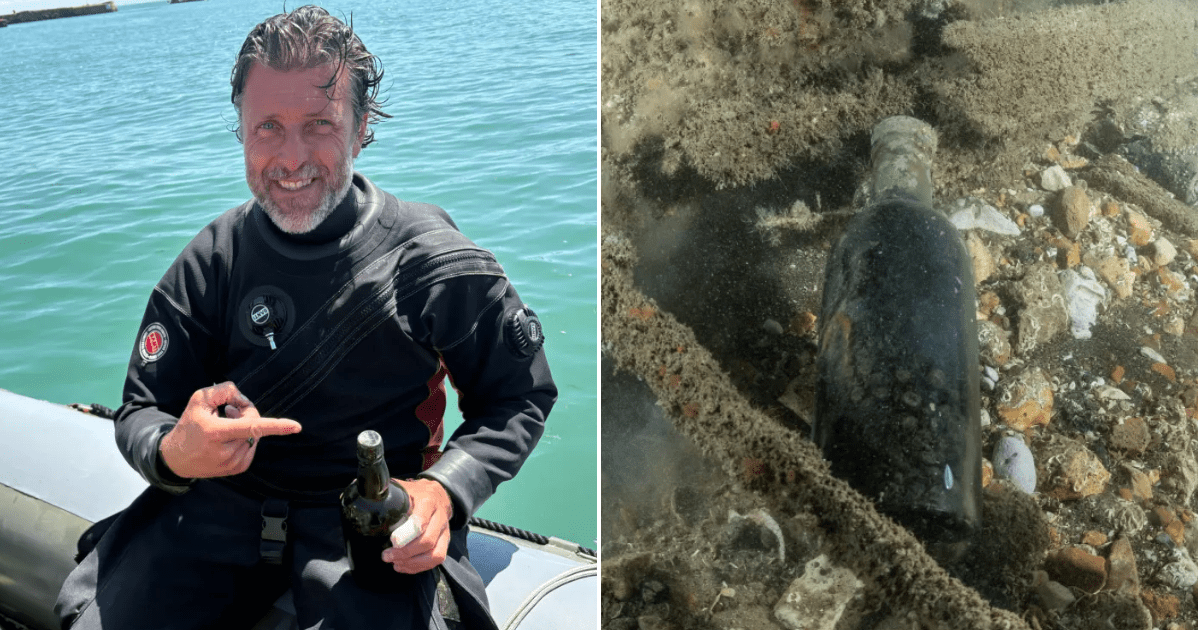
Imagine diving into the murky, silent depths of the English Channel, expecting nothing more than the typical remnants of a seafloor exploration, only to come face-to-face with a literal time capsule of brewing history. This is exactly what happened to Stefan Panis, a Belgian underwater photographer with over four decades of experience, when he stumbled upon the wreckage of the Mindora. Resting five kilometers off the coast of Dover, this vessel has been sitting in a watery grave since it collided with another ship in December 1864, just a week after embarking on a journey from London to Vancouver. Amidst the dark, silt-covered cargo, Panis made a discovery that would soon capture the imagination of beer enthusiasts and scientists alike: a cache of original, 162-year-old Guinness stout bottles, perfectly preserved by the crushing pressure of the deep sea.
The story of the Mindora is as much about serendipity as it is about history. For over a century, the wreck lay largely untouched, protected from looters by the harsh, unpredictable storms of the English Channel that previously thwarted attempts to blast open the decks. Because the bottles were resting upside down, they formed a natural, pressurized barrier against the seawater, keeping their contents remarkably intact. When Panis finally brought one of these artifacts to the surface and washed away the grit, the embossed name “Guinness” revealed itself, confirming he had unearthed something extraordinary. He believes there are at least two dozen bottles in the case he found, with the distinct possibility that many more remain buried in the wreckage, waiting for a future expedition to bring them into the light.
This discovery has evolved from a diver’s curiosity into a serious scientific venture. Panis, who is already planning a return trip to the site, has been in constant contact with Diageo, the parent company of Guinness. Samples from the recovered bottle have been sent to microbiologists at KU Leuven University in Belgium to be analyzed. The experts are hoping to isolate the original DNA of the yeast strains used by the brewery back in the 1860s. If successful, this could allow scientists to perform a “re-brew,” effectively traveling back in time to taste exactly what a Victorian-era pint of the world’s most famous stout was supposed to be like, offering a sensory link to the mid-19th century that has been lost for generations.
Beyond the scientific potential for a re-creation, there is a fascinating debate regarding whether the original contents themselves are actually drinkable. Panis, a pragmatist despite his role in this historic find, notes that if the seawater never breached the corks—which seems to be the case—the beer might still be physically consumable. While he isn’t a massive fan of stout himself, he has expressed a willingness to take a sip of history if the researchers declare it safe. It is a surreal thought: the idea that a beverage brewed during the American Civil War era could still retain its character, guarded by the very environment that claimed the ship carrying it.
The significance of this find isn’t just about the novelty of drinking old beer; it’s about understanding the evolution of a global icon. Guinness has been a household name since 1759, and this 1864 batch represents a direct descendant of the “Superior Porter” recipes perfected by Arthur Guinness II in 1821. As a spokesperson for the brand noted, the discovery provides a “fascinating window” into their heritage. By comparing this Victorian-era cargo to the modern-day recipe—which still relies on the same core quartet of roasted barley, malted barley, hops, yeast, and water—historians can gain a deeper understanding of how the industrial revolution and changing trade routes influenced the beverages that shaped our culture.
As the scientific world waits for the results from Belgium, the story of the Mindora remains a captivating reminder that history is often hidden just beneath the surface. What started as a standard dive by an experienced photographer has turned into a global news event, sparking dreams of a limited-edition, 19th-century stout hitting modern shelves. Whether or not we ever see this “ghost beer” become a commercial reality, the Mindora wreck has already achieved something remarkable: it has revived an old story and invited us all to look at our history through the bottom of a bottle. Until then, we are left to wonder what secrets, besides the perfect recipe for a classic stout, still lie buried in the darkness of the Dover seabed.