

The high-speed pursuit of Mudassir Sandhu, a 24-year-old from Morden, South London, serves as a harrowing reminder of how quickly emotional volatility can escalate into life-threatening danger. What began as a personal crisis spiraled into a reckless, high-stakes spectacle on the M25, where Sandhu pushed a BMW X1 to speeds of 130mph. As he wove through traffic, occasionally killing his headlights and reportedly inhaling nitrous oxide, he turned a public highway into a lethal playground. The scene captured by police body cams depicts a chaotic, adrenaline-fueled standoff, illustrating the perilous intersection of heartbreak and criminal negligence that authorities are increasingly forced to manage on major transit arteries.
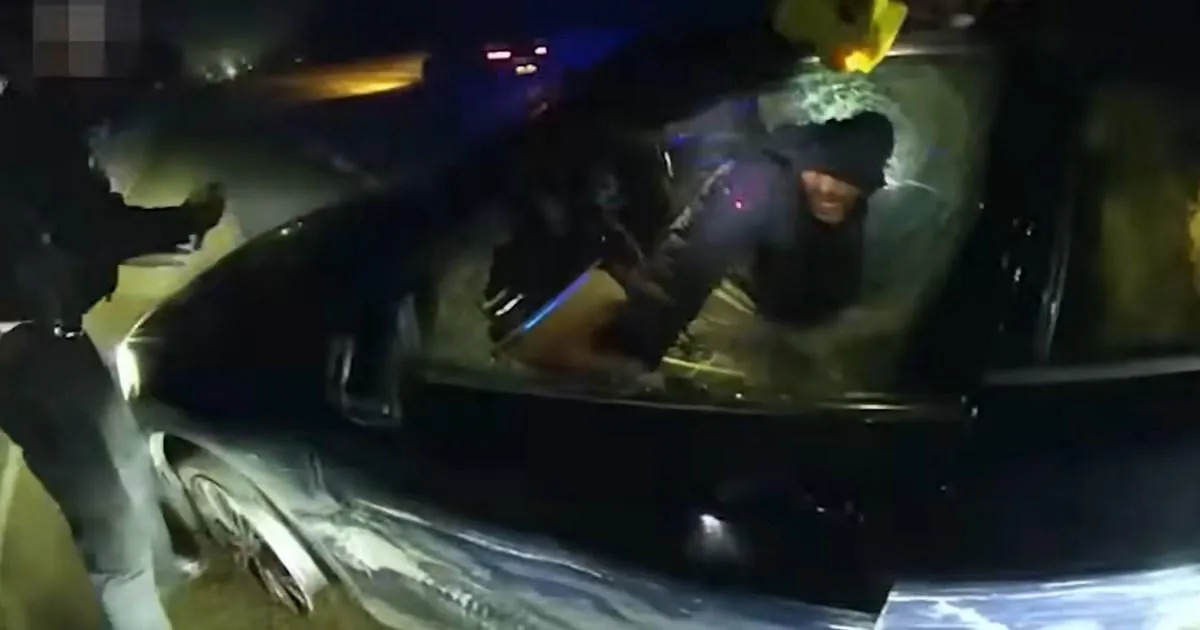
The eventual conclusion of the chase near junction 10 in Surrey was as jarring as the pursuit itself. Metropolitan Police officers, having successfully deployed a “stinger” device to disable the vehicle, swarmed the BMW with tactical precision. As the footage shows, officers were forced to break the glass to extract a defiant and agitated Sandhu from the wreckage. In the immediate aftermath, as the adrenaline of the chase gave way to the reality of his apprehension, the gravity of his choices began to set in. Yet, even in his vulnerable state, his attempts to justify his actions were met with little sympathy from the officers on the scene, who were clearly appalled by the utter disregard for human life exhibited during the high-speed ordeal.
What makes this incident particularly humanizing—and perhaps more frustrating—is the bizarre, almost pathetic nature of the excuse offered by the driver. When confronted by officers about his dangerous behavior, Sandhu’s immediate defense was a visceral admission of emotional trauma: he claimed he had just discovered his girlfriend was cheating on him. By his own admission, the high-speed evasion and the consumption of illicit substances were a maladaptive response to his heartbreak. When he questioned why he was being handled forcefully, the responding officer offered a sharp, blunt rebuke, labeling him an “imbecile.” This exchange highlights the chasm between a driver’s internal justification and the objective, dangerous reality of their actions on the road.
Beyond the immediate crisis of his relationship, the consequences for Sandhu were swift and life-altering. During the arrest, the realization that he was driving a “work car” led to a fleeting moment of self-pity, where he mused, “I’ve lost my job, innit?” To this, the officer replied with a cold, matter-of-fact, “Yeah, damn right.” This interaction marks the collapse of Sandhu’s professional and personal life in a single evening, a direct result of his decision to trade rational judgment for a reckless, drug-fueled outburst. It is a stark example of how, in an instant, a person can dismantle their future and jeopardize the lives of countless innocent motorists simply because they lacked the emotional regulation to process a difficult personal setback.
Legal consequences followed swiftly in the wake of the incident. Sandhu appeared at Guildford Crown Court this past June, where he faced the music for his charges of dangerous driving and failing to stop. The court sentenced him to 12 months in prison, a period of incarceration that stands as a sobering reflection on the severity of the threat he posed. Furthermore, the judge imposed a four-month driving disqualification and a £187 fine. These penalties, while standard for such offenses, underscore the judiciary’s stance on road safety: regardless of the emotional turmoil a defendant claims to be experiencing, the responsibility to operate a vehicle safely remains absolute and non-negotiable.
Ultimately, the story of Mudassir Sandhu serves as a cautionary tale about the dangers of impulsive behavior during times of extreme stress. While heartbreak is a universal human experience, the decision to weaponize a vehicle and endanger the public represents a profound failure of character and responsibility. The intersection of mental health, personal tragedy, and criminal law is complex, but the law remains clear: personal suffering does not grant a license to endanger others. As Sandhu serves his time, the memory of that 130mph chase on the M25 remains a testament to the fact that while we cannot always control the tragedies that happen to us, we are fully and entirely responsible for how we respond to them.