

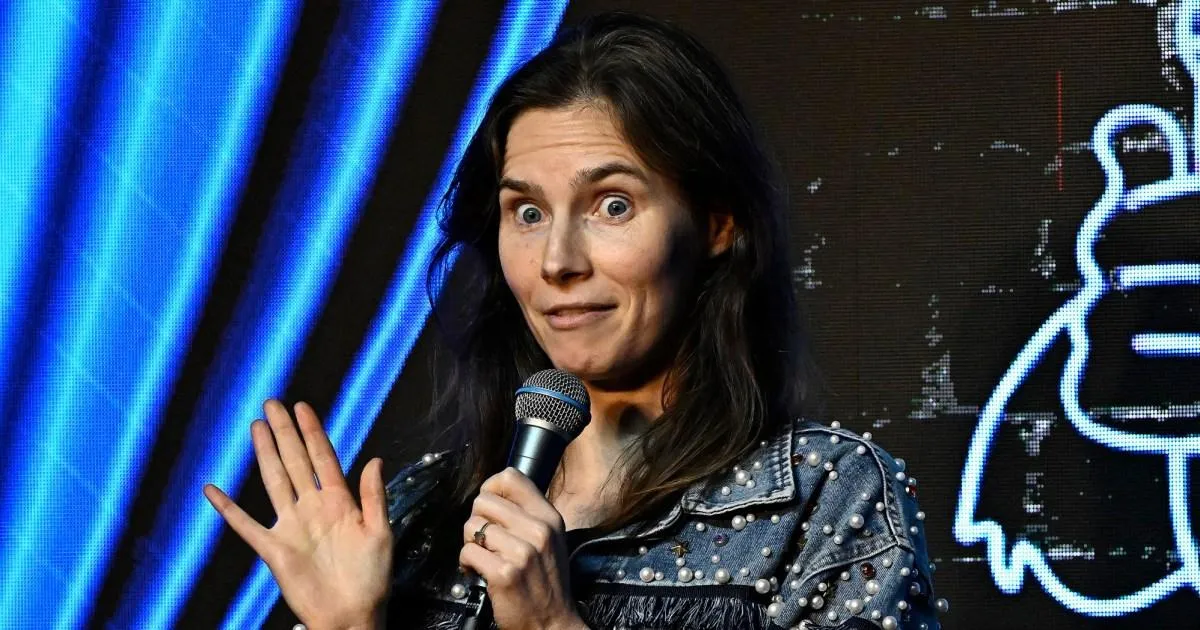
The recent debut of Amanda Knox’s one-woman show, Cartwheel, at the Edinburgh Fringe Festival has ignited a fierce public firestorm, highlighting the painful friction between personal catharsis and the trauma of others. Knox, who famously spent years at the center of a global media frenzy following the 2009 murder of her roommate, Meredith Kercher, eventually saw her conviction overturned. Now, more than a decade later, she has returned to the public eye in a format that few expected: stand-up comedy. While the venue, the Gilded Balloon, has stood by its commitment to free expression, the performance has reopened old wounds, particularly for the Kercher family, who view the choice to use such a tragedy as a stage prop as both insensitive and deeply offensive.
During her performance, Knox leaned heavily into the surreal, often controversial nature of her own past, using dark humor to dissect the media’s portrayal of her. Surrounded by children’s toys, she addressed the absurdity of the accusations leveled against her, suggesting that the public and legal systems were quick to condemn her simply because she didn’t fit the expected mold of a grieving person—or, as she put it, because she was a “little too theatre kid.” By adopting a provocative, biting tone when discussing the sensationalized details of her case, such as her public displays of affection with her then-boyfriend, Knox attempted to reclaim the narrative, arguing that her behavior was a human response to trauma rather than evidence of a cold-blooded crime.
However, the tone of her act has been met with intense backlash from those who believe the death of a young woman is not an appropriate subject for comedy. Stephanie Kercher, Meredith’s sister, has been at the forefront of the criticism, launching a petition to shut the show down. The campaign argues that by turning her ordeal into a performance, Knox is effectively commodifying a tragedy that ended a life and shattered a family. For the Kerchers, the mere existence of the show feels like a final, stinging insult, turning the memory of a victim into a backdrop for the protagonist’s own search for closure or public redemption.
In response to the mounting pressure, Knox’s team has remained steadfast, labeling the petition a form of censorship based on misconceptions. They argue that the critics are attacking a show they have never seen, insisting that Cartwheel is not a cynical re-enactment of the murder, but a nuanced reflection on motherhood and the challenges of raising a daughter in a world that is often hostile toward women. Knox herself has suggested that if Meredith were here today, she might have found the irony of the situation worthy of a laugh, a sentiment that the Kercher family understandably rejects. Her team maintains that the show actually honors Meredith’s memory by challenging the very systems of judgment that condemned them both.
The Gilded Balloon venue has navigated this controversy by invoking the spirit of the Fringe itself—a platform designed for artistic liberty and a diverse array of human experiences. By distancing themselves from the content while providing the space, they have underscored the reality that the Fringe is meant to be a laboratory for difficult, sometimes uncomfortable ideas. This highlights the inherent tension of the festival: it is a space where the boundaries of what is “too soon” or “too taboo” are constantly pushed, often forcing audiences to navigate the thin, blurry line between artistic expression and genuine ethical transgression.
Ultimately, this standoff reflects our modern struggle with how to process trauma in an age of constant documentation. Is there a statute of limitations on public scrutiny, or a moral boundary to how we interpret our own history? Knox’s performance asks the audience to look past the tabloid headlines and see the human being who survived a nightmare, yet in doing so, she risks alienating those for whom that nightmare is still an open, bleeding wound. As the debate continues, the case remains a sobering reminder that for every story told, there is a complex web of perspectives, and that one person’s path to healing can, quite unintentionally, become another person’s source of renewed agony.