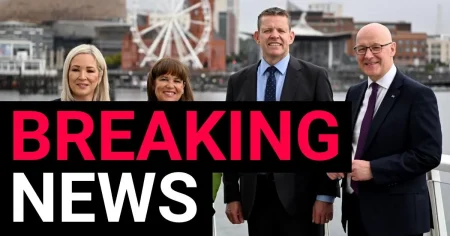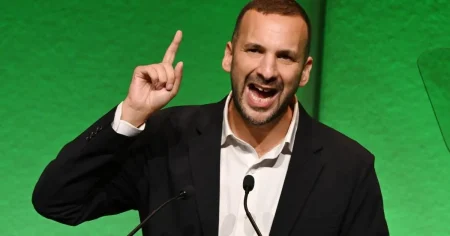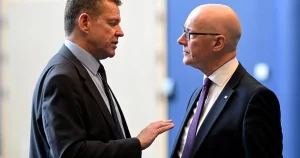


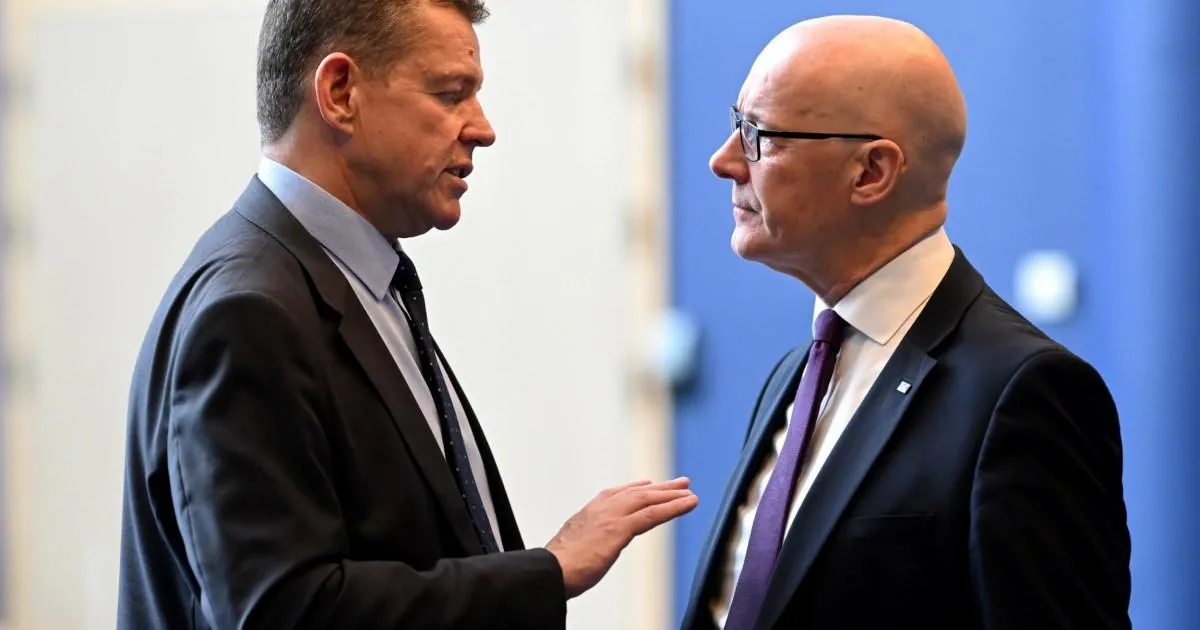
There was a moment on Monday in Cardiff when Welsh First Minister Rhun ap Iorwerth said something that, on the surface, sounded almost contradictory coming from the leader of Wales’s main pro-independence party. Standing alongside fellow nationalists from Scotland and Northern Ireland, he declared, “I’ve never been interested in the break-up of the UK.” If you weren’t paying close attention, you might have thought he was walking back years of Plaid Cymru ambition, or trying to soften the edges of a movement that has often been caricatured as separatist. But then he kept talking, and the meaning became clearer. “We’re talking about having the tools to build a future for our people through the right of self-determination,” he said. “It is a wholly positive outlook and vision that we have.” In other words, the break-up of the United Kingdom was never really the point for these leaders; it’s simply what would happen if their positive vision ever became reality. The gathering itself was unprecedented: Scottish First Minister John Swinney, Northern Ireland’s First Minister Michelle O’Neill, Sinn Fein president Mary Lou McDonald, and ap Iorwerth all in the same room, representing parties that have spent decades pushing against the British state from different angles. Their politics are far from identical, but on this day they shared a platform and a common language about self-determination and the future. And the mathematics of their ambitions is stark. If all four of them got what they wanted, an independent Scotland, an independent Wales, and a reunified Ireland would leave only England inside what remains of the United Kingdom. At that point, the name “United Kingdom” would become something of a historical joke, unless someone decided England should keep the title all to itself. The flag, too, would need a serious rethink, but the changes would go far deeper than symbols. Borders, economies, passports, armies, oil, whisky, and the very idea of what it means to belong somewhere would all be thrown into the air.
The practical consequences of such a dramatic reshuffle are immense, and they are not always the ones you hear about first. Alistair Jones, a former associate professor at De Montfort University who studies politics, talked through some of the less obvious impacts with Metro. Ireland, for example, has suddenly become a live conversation again, partly because of an unexpected intervention from President Donald Trump. Last week, Trump said he would “love to see” the island of Ireland unified and proclaimed that “it’s going to happen eventually.” Mary Lou McDonald, who has been one of Trump’s fiercest critics on issues like Gaza, was quick to seize on the moment, saying his comments showed that “the unity debate is very much alive.” But Jones pointed out that reunification would not just be a warm story about ancient history being settled. Northern Ireland currently occupies a strange and privileged position within the post-Brexit UK, because it effectively remains inside the European Union’s single market for goods. If Ireland were reunified, that arrangement would disappear, and the border between the new united Ireland and Great Britain would suddenly become a hard external EU border. For businesses that have been operating on both sides of the Irish Sea and using Northern Ireland as a bridge into the European market, that would mean losing automatic access and having to navigate tariffs and customs checks again. It would be a monumental realignment for companies that have spent the last few years adapting to the Windsor Framework. On the other side of the ledger, Jones noted, a reunified Ireland would remove the British military presence in Northern Ireland. That might sound like a simple, even symbolic change, but it would have real consequences for thousands of soldiers and their families who would suddenly be relocated to barracks in Great Britain, or potentially discharged from the army altogether as surplus to requirements. The emotional weight of that cannot be underestimated either, because for many in the Irish nationalist community, the sight of British soldiers on their streets has always been one of the most visceral reminders of partition.
Scotland, by most measures, is the part of the UK most likely to make the leap next. Polls have shown, for years, a consistent level of support for independence that hovers around the mid-to-high forties, and the Scottish Parliament has had a pro-independence majority since 2011. Recent aggregator polls have even suggested that the “yes” vote has opened up a small but persistent lead over “no.” But if Scotland were to leave, the immediate headaches would be enormous, and some of them are hiding in places most people never think about. Jones pointed to the North Sea, where huge oil and gas reserves have long been a point of contention between Edinburgh and London. An independent Scotland would need to work out exactly where its maritime border lies in international waters, a negotiation that would be legally complex and politically explosive. Then there is the currency question, which was one of the great sticking points in the 2014 independence referendum. In the short term, Scotland could probably keep using the pound, but if the goal is to rejoin the European Union as an independent state, it would eventually be required to adopt the euro. That is a tough pill for many Scots to swallow, especially given that the UK as a whole has never been particularly enthusiastic about the single currency. Yet Jones also offered a more reassuring perspective: Scotland, he argued, is already in a weird position compared to other parts of the world. It has more devolved powers than many federal states in countries like the United States, Germany, or Australia. In a number of areas, it already acts almost like an independent country, just one that doesn’t have full control over its own foreign policy or defence. So while the final constitutional transition would still be a massive upheaval, Jones suggested it might actually be less problematic for Scots, and less visible for people living in England, than the drama of Westminster politics might imply. The daily texture of life in Scotland would not change overnight. The bins would still be collected, the NHS would still run, children would still go to school. What would change is the framework around all of it, and that framework matters more than some people on the pro-Union side like to admit.
Wales is a different story altogether. In comparison to Scotland, Wales appears to be a long way from any serious tilt at independence. Polling consistently suggests that a strong majority of Welsh voters would reject leaving the UK, and while Plaid Cymru is the largest party in the Senedd, it does not command a majority there. At the most recent Welsh elections, the party notably did not call for a referendum at all. Instead, it asked for greater devolution, a kind of step-by-step approach that would gradually bring Wales closer to the level of autonomy Scotland enjoys. This is partly an admission of political reality, but it is also a recognition of how deeply Wales is bound up with England. Jones was blunt about the problem: “The Welsh economy is hugely intertwined with that of England, so any separation is going to be very, very difficult indeed.” He explained that a huge number of UK businesses operating in Wales are based in England and treat Wales largely as a source of resources. The economic relationship is not a partnership of equals; it is more like a dependency, and that makes the idea of a sudden break profoundly risky. For many Welsh voters, the prospect of independence is not a romantic dream but a terrifying economic unknown. They look at Scotland and see a country with its own oil, its own financial sector, and a stronger sense of a separate national identity, and they wonder whether Wales would even be able to stand on its own feet. There is also a cultural dimension that is harder to quantify. English is the dominant language across most of Wales, and while Welsh identity is real and fierce, it is often expressed through the Welsh language, rugby, and a sense of place rather than through a coherent demand for statehood. The emotional pull of independence just does not seem to be there in the same way it is in Scotland. That could change, of course, especially if the UK continues to lurch from one crisis to another, but for now Wales feels like the least likely candidate to actually leave the Union.
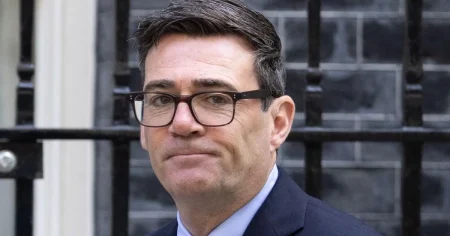
England, meanwhile, is in the strangest position of all. It is the one constituent part of the UK that does not have its own devolved parliament, which means it is, in a sense, governed directly by Westminster in a way that Scotland, Wales, and Northern Ireland are not. That has led to a curious irony: England could end up becoming independent by default, not through any conscious decision, but simply because everyone else left. Jones, however, believes that would not be as disruptive as people might expect. “People in England would not notice much difference,” he said, which is both a reassurance and a telling comment on how English politics have long treated the Union as simply the natural order of things. The most visible changes, he suggested, would be for ordinary people wanting to go on holiday to Scotland or Wales. They would suddenly need passports, just as they do when travelling to France or Spain. And there would be economic ripples, too. Jones speculated that the price of whisky would almost certainly go up, because Scotch and malt whiskies transported across the border would be subject to customs duties, especially if Scotland were inside the EU while England remained outside. That thought might make some whisky lovers wince, but it is a reminder that the consequences of independence are not just constitutional abstractions. They show up in everyday life, in the cost of groceries, the ease of travel, and the shape of family holidays. The public, at least, seems to have a sense that change is coming. A recent Ipsos poll found that only 24% of British adults believe the UK will still exist in its current form in twenty years’ time. That figure rises to 34% on a ten-year timescale and 55% for five years, but even that means nearly half the population does not take the Union’s survival over the next half-decade for granted. However, not everyone in power agrees that the conversation should even be happening. In a recent letter to John Swinney, Prime Minister Andy Burnham insisted that a Scottish independence referendum is “off limits,” saying there is “no consensus” for one and adding that there is “no clear basis to suggest” most people in Northern Ireland want to leave the UK. Swinney, unsurprisingly, did not back down, making the bold prediction that Burnham would prove to be “the last prime minister of the United Kingdom.”
That line has a certain rhetorical flourish to it, the kind of thing that makes headlines and gets quoted for years, but it also captures something deeper about the moment. The United Kingdom is not obviously falling apart in the way that, say, Yugoslavia did in the 1990s. There is no civil war, no mass movement with millions of people in the streets demanding independence, no sense of imminent collapse. And yet the foundations have shifted. The Irish border question has never been fully settled by Brexit, Scotland has spent the last decade in a state of constitutional agitation, and Wales is quietly accumulating powers while keeping its options open. What happened in Cardiff on Monday was not a declaration of war on the British state. It was an attempt, by four political leaders from four very different traditions, to give voice to a different way of imagining the future. They were careful with their language, talking about self-determination rather than separation, about tools and futures rather than enemies and victories. That does not mean the Union is safe; it might mean that the end, if it comes, will arrive not with a bang but with a prolonged, awkward conversation about what kind of relationships people want to have with each other. There is something profoundly human about all of this. Nations are not machines that can be taken apart and reassembled according to a blueprint. They are communities of people who share stories, memories, and hopes, and those connections are not always tidily contained within the lines drawn on a map. The leaders who met in Cardiff understand that, which is why they talk about building futures rather than breaking things up. Whether they succeed or fail, the questions they are asking will not go away, because they are ultimately about identity, belonging, and the simple desire of people to have a say in how they are governed. The United Kingdom might survive, or it might not, but the conversation has begun, and it is not going to be silenced by a letter from the Prime Minister or a poll. It is happening in living rooms, pubs, workplaces, and schools, wherever people ask themselves what it means to be Welsh, Scottish, Irish, English, or British, and whether those identities need a single state to contain them all. And on a wet morning in Cardiff, four leaders stood together to remind everyone that, for some people, the future is already being imagined.