

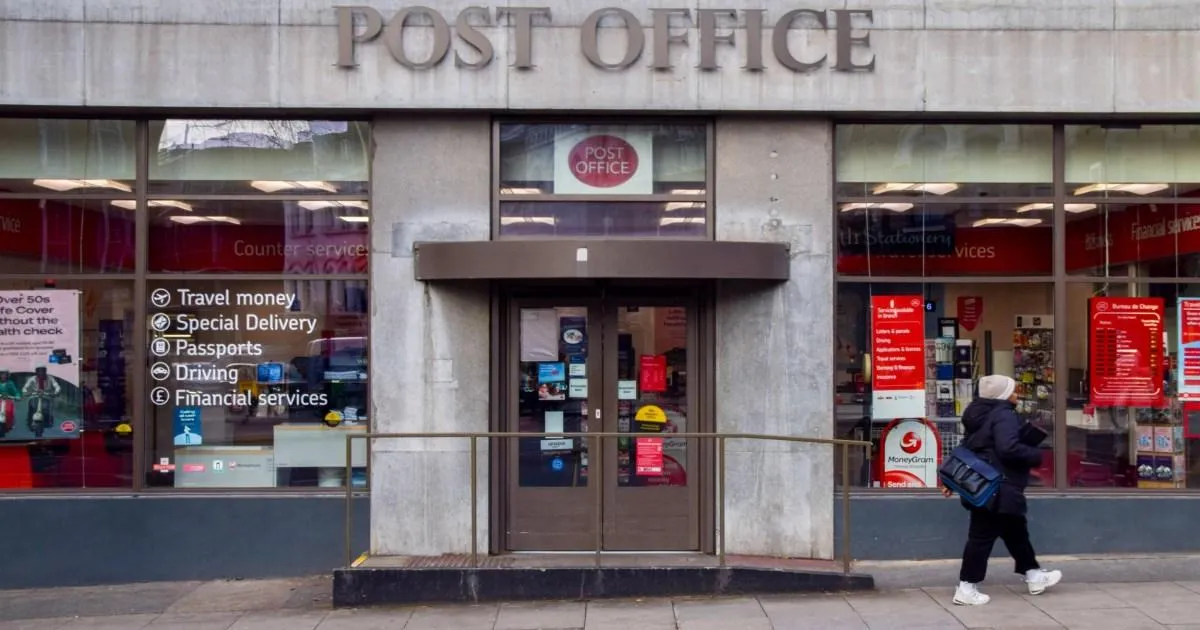
Imagine popping into your local Post Office to send a parcel, pay a bill, or deposit some cash. It’s a familiar, reassuring ritual on the British high street. But behind that everyday counter, according to a stark new warning delivered to senior government ministers, there is a hidden war being fought over dirty money. In a briefing attended exclusively by Metro, the National Crime Agency (NCA) made it clear that Post Offices have become a battleground in the fight against organised crime. Ministers were told that these much-loved local branches are now a “big problem” when it comes to money laundering, serving as a “key vector” for criminal cash flowing through Britain’s streets and often linking back to hostile state actors, including networks connected to Russia. The response is a massive, ambitious crackdown: five hundred new fraud-busters are being hired as part of a £500 million strategy designed to stop criminal profits from being laundered through Post Offices and dodgy high street shops, and to dismantle the corrupt systems that allow these funds to vanish across borders.
The problem, as outlined in the NCA briefing, is rooted in convenience and unintended consequences. Since 2017, Post Office branches have been able to accept cash deposits on behalf of high street banks. That change was welcomed as a lifeline for communities, especially as bank branches closed down across the country. But it also created a loophole that criminal gangs have been quick to exploit. The checks at Post Office counters are often less rigorous than those at a traditional bank, making it easier for drug dealers, fraudsters and other offenders to pay in profits without raising immediate red flags. Their trick is often as simple as it is effective: instead of depositing a huge, suspicious sum in one go, they split the cash into multiple smaller deposits, sometimes using different accounts and different branches, to slip under the radar. It’s a technique that lets dirty money mix with legitimate cash flow, and once it does, it becomes much harder to trace. The result, as the NCA told Security Minister Dan Jarvis and Treasury Minister Lucy Rigby, is that Post Offices now represent a “major vulnerability” in stopping criminal cash from circulating through the heart of local communities.
But it’s not just the Post Office that is in the spotlight. The high street itself has been described as a “key vector” for illicit profits. For a long time, investigators thought barber shops were the main hub of this kind of criminal activity, but officers have since discovered a far wider network of storefronts being used to wash money. Petrol stations, vape shops, convenience stores and other unassuming local businesses are all implicated in the trade. These shops can act as fronts where criminal cash is mixed into daily takings, giving it the appearance of legitimate revenue. The scale of the problem is staggering, with the NCA estimating that at least £12 billion of criminal cash is generated and laundered in the UK every year. The government’s new strategy focuses heavily on three hotspot regions where this kind of activity is especially concentrated: Greater Manchester, the West Midlands, and the counties of Kent and Essex. These areas are now the primary focus of the High Street Organised Crime Unit, a specialist taskforce launched in May to trace, disrupt and shut down the laundering operations running through everyday businesses.
The message from the top is deliberately tough. Dan Jarvis, the Security Minister, framed the crackdown as a direct warning to crime bosses who see the UK as a safe haven for their wealth. Speaking to Metro, he made it clear that times are changing. “It’s important that people understand that the UK is being made into a much harder target,” he said. “Kingpin figures thinking they can come and wash their money in the way they’ve done previously in the UK, they should understand there will be serious consequences for their criminality. Stay away from the United Kingdom because we will catch you, we will bring you to justice, and we will prevent you from carrying out your criminal activity.” His words were echoed by Treasury Minister Lucy Rigby, who stressed that money laundering is not some victimless financial crime. It funds some of the most serious threats facing the country, from hostile state activity and espionage to fraud, people smuggling and drug trafficking. Tackling it, she argued, is essential to protecting national security as well as local communities. The government’s strategy, therefore, is not just about chasing cash; it’s about going after the kingpins whose power is built on the ability to move and hide their wealth.
Beyond the high street, the new strategy takes aim at powerful transnational networks, particularly those linked to Russia. Ministers were briefed on ongoing efforts to destabilise these money laundering operations, which use the UK’s financial system to channel profits to hostile states. Officers have already arrested more than one hundred drug couriers connected to large-scale investigations into these groups, and the NCA is now setting up a dedicated Financial Intelligence Service to improve cooperation with banks. These public-private partnerships, involving a number of UK banks, are designed to combine intelligence, data and expertise so investigators can identify suspicious accounts and track money as it moves around the country in real time. The emphasis on partnership is crucial, because modern money laundering is sophisticated and fast-moving. It often crosses borders, and criminals are constantly adapting, using new technologies and tactics to stay one step ahead. The new funding for all of this comes partly from the criminals themselves. The government says that over the past year, £350 million was stripped from those involved in illegal finance, and this is being reinvested into the fight. The broader results are impressive on paper: £1 billion of dirty money stopped from being moved, 2,700 illicit finance operations disrupted, 4,000 laundering convictions secured, and £26 million returned to victims. Even £1 million was seized from people smugglers and immigration offenders, money that might otherwise have funded more dangerous crossings and more human misery.
What does all of this mean for the average person? On one level, it is a reassurance that the authorities are taking the problem seriously, investing real resources and building the kind of inter-agency cooperation needed to win a long and hidden war. Criminologist Prof Emmeline Taylor called the strategy “significant”, arguing that following the money is essential if the UK is genuinely serious about disrupting organised crime. She also pointed to the importance of protecting the high street itself, saying that if we want a high street renaissance, we must prevent criminal economies from taking root and driving law-abiding citizens out of business. That point matters, because the high street is more than just a place to shop; it is the social and economic heart of many communities. When a local shop is secretly a front for money laundering, it undercuts honest traders, distorts the local economy and normalises criminal activity. The Post Office, for its part, has defended its role, saying it works closely with banks and law enforcement agencies to identify suspicious activity and disrupt criminal behaviour. It says it continues to invest in controls, training and partnerships to respond to evolving threats. Still, the government’s message is clear: the era of easy money laundering in Britain is ending. The new strategy will not eliminate crime overnight, but it is a serious attempt to close the loopholes, harden the target and ensure that anyone trying to wash their ill-gotten gains through a local Post Office or a high street shop knows they are being watched. For ordinary people, the task is to stay aware and report suspicious activity. For the criminals, the calculation just got a lot more dangerous. The challenge now is to make sure the money can’t find another way through.